I sat outside for 10 minutes at lunch time. I did nothing. I closed my eyes.
This video inspired me. Taking a 10-minute break connected me to my senses. I felt the sun on the back of my neck. I heard hip hop music from a car stopped at a traffic light nearby. I opened my eyes and saw a sparrow, a few feet away, tilt its head.
I thought about the mastercard bill I have to pay. I strategized about meeting my daughter before one play practice today and after another. I wondered if it would be good enough if she had only a slice of pizza for dinner.
I felt some things. I thought some things. But I did not get bogged down in my thoughts or feelings. I hopped from thing to thing like the sparrow.
There may have been a few moments when I entered a state beyond thinking or feeling. I drifted into the sky. I saw a gold frame against the sky. What happens when you frame infinity? I thought, How funny – that there are stars in the sky during the daytime too. I don’t see the stars, but I know they’re there.
I thought, I have to work on my Magical Realism curriculum for the 10th grade World Lit class tomorrow. I added that to the part of my mind that contains the long To Do list.
I slowed my breathing. I glanced at my phone 9 minutes had gone by. One more minute to sit. One more minute to think about nothing. Closed my eyes. Heard a strange tapping. Then, I heard footsteps crunching. I opened my eyes. A mother and her teenage son walked in front of me, serious, going somewhere.
Meditation is watching a movie in my mind. Being a bystander. Not hopping on stage. I am not the star of the film; I am a witness.
Some people are splitters and some, lumpers. Some cut wood and some gather wood.
Learning is more fun when it’s experiential and relevant.
School rewards people who can compartmentalize. If you have a diversification of or a variety of interests, it’s harder.
Organizations must become small pieces, loosely joined, as opposed to big entities. Organizations grow (learn) best when agile.
Evolution teaches that a system can heals itself. (So if your organization is not agile, it can learn to be.)
Now that there is a lower cost to content, we’re abundant in resources, content, abilities to share.
Institutions no longer manage scarcity through central control. They manage abundance. We live in a world of abundance.
The cost of collaboration and the cost of communication has gone way down. The entrepreneurs who focus on sharing and agility succeed.
The key to success is on process and empowerment (in organizations) and less on control.
knowledge is power.
I am getting organized. Order is a thing of beauty. These notes are pieces of flotsam that drifted onto my evernote app. I am cleaning out the digital notes on my phone.
I like to say, “Organization is the key to success.” But I am also empowering others and sharing what I know. I have to redefine success.
Sometimes bad stuff happens so you close the door to your neighbors. But after Robert Green lost his mother and granddaughter in Hurricane Katrina (they slipped from him from a rooftop), the whole tragic experience made him open his front door wider. He spoke tonite at Riverdale, a few months after the 10-year anniversary of the national and personal tragedy of Katrina.
“The more I told the story, the less painful it was.”
In a short film shown about him, the message was: Tell your story, accept your pain, then enjoy the life you have.
He said that Brad Pitt’s Make It Right foundation helped. “Everyone knows Brad Pitt. Everyone loves Brad Pitt.” But it’s you all, he said – only he said it like ‘y’all’ – the young people who came to volunteer, who made the difference.
He really praised the young people. “The world’s not going to hell in a hand basket. This is going to be a great world because of y’all.”
He misses his mother. Yes, he misses his granddaughter, but he sees her in the spirit of children who come to volunteer. And the kids from Riverdale who, like so many, have done so much.
“I’m only as strong as the people who’ve helped me.”
He’s moved to permanent housing from a FEMA trailer. “And even when it’s cold and rainy, I still leave the door open.” Neighbors return to the Lower Ninth Ward. And he considers all of us his neighbors.
Mr. Robert Green, center, greets families to talk about New Orleans 10 years after Katrina.Mr. Green believes that young people make it right.
Hold Your Breath
When I used to take pictures with a real camera – not my camera phone – I would hold my breath for one moment to be sure that the image was not shaky. Or if the light was low, I’d hold for a little longer. I still try to stop time when I snap a pic.
Hang on to the Moment
My children think I take too many pictures. I can’t help it – I don’t want to forget the moment. But my son tells me that because I take a picture, I no longer remember the event. I, in effect, outsource my memory to my camera. I can’t help it; I want to hang on to the moment of transition, like my son’s high school graduation or college drop off. Life is so fleeting.
Hold the People Close
Sometimes I take a picture because I know I am not going to see the person for a while. And I want to hold them close to me by holding on to their image. Like the way people used to have portraits painted or wore lockets around their necks.
Yesterday my cousin Abby Nierman, who just started college in NYC, came over for Sunday dinner. She snapped a few pictures of me and Charlotte. (Chris was grocery shopping and Cate was in the throes of homework.) It took all of 20 minutes. She did such an awesome job. We felt relaxed and close. We love the pictures she took. We never had to hold our breath. We hung on to the moment and each other.
Visit Abby’s Facebook page. She’s majoring in entrepreneurship and is starting a small biz in portrait photography.
Make art because it feels good. Art is as therapeutic as a glass of wine or a good work out.
5 reasons to make art:
Your imperfections are beautiful
You are in the moment
You see things differently
You connect to your child-like self
You co-create with God
This is from a page in my art journal.
Just about every Sunday night, I sit at the dining room table and move around some gesso, paint, gel, old magazine pieces, ink, pastels, stamps.
I make crazy art collage books — a bunch of randomness. Searching for serendipity, synchronicity. I try to piece it all together. I really don’t care if people like or understand my stuff. I live so much of my life trying to get people to understand – as a writer, I want to be clear; as a teacher, I want my students to get the assignment.
So I appreciate the time with my art; time connected, not to my head, but to my body or spirit or flow. I know I am good with words, but sometimes words fail. Or words exhaust.
Then images remain, replenish.
I doubt I am much of a fine artist. One brother is a professional artist. Another is a graphic artist. And my father is pretty good with a paintbrush. My whole family is artsy. So I might have a knack.
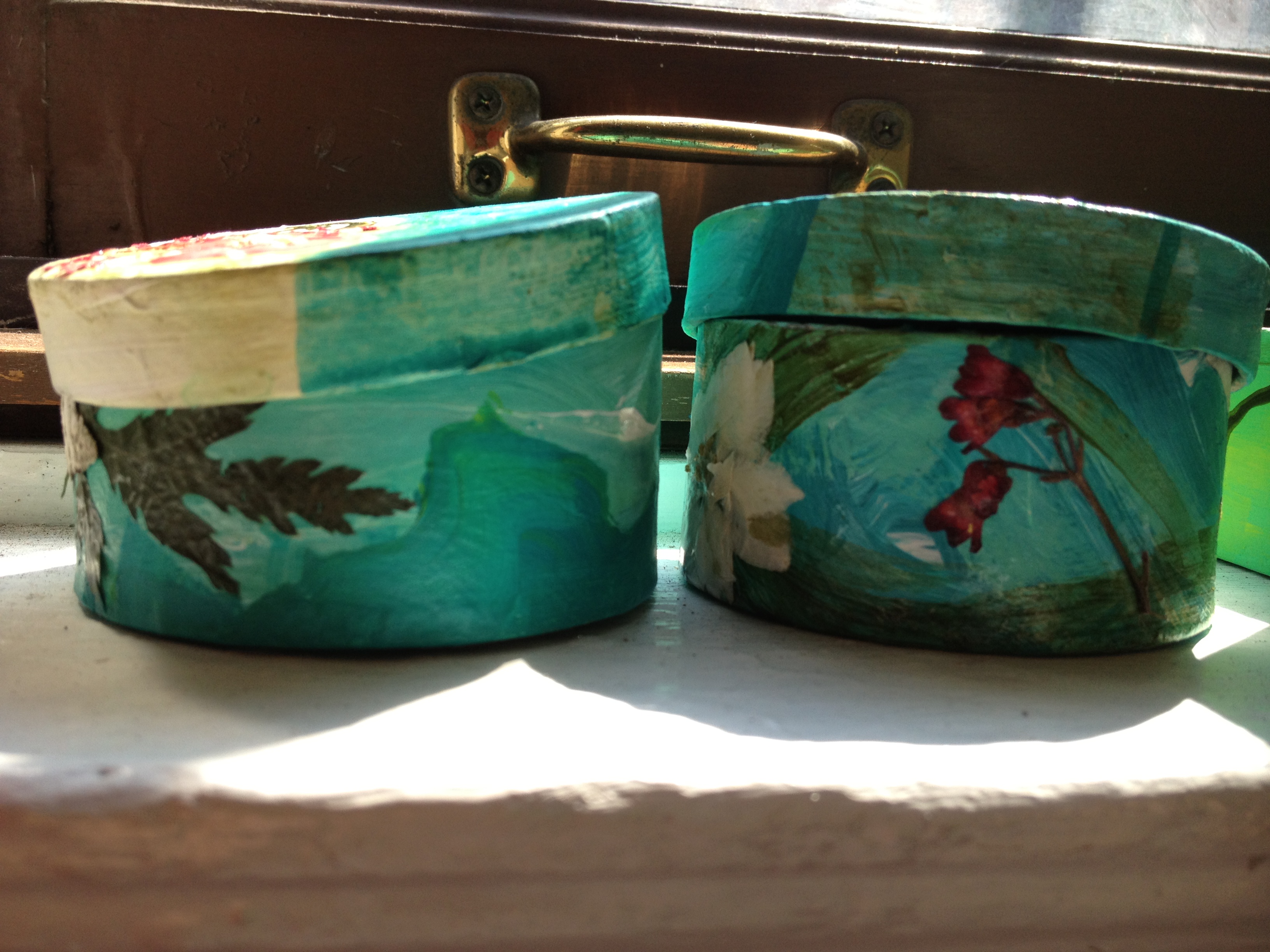
I am okay that my work is messy. Making art is about letting go of intentions. I start one project only to move on to another. Briefly, I was obsessed with painting small boxes. I have more than a dozen. I tried to give them away at Christmas a couple of years ago but one of my sister-in-laws refused the gift! LOL – An indication of how useful these little boxes are? Honestly, I think she was trying to honor her minimalism rather than denying my craftsmanship. And I can honor that and want to downsize too.
There is no reason to make art. But my dad once told me (don’t you love when politicians are always quoting their fathers?) “You should always do the thing for which there is no reason.”
I realize by making art that I have a unique way of seeing the world. I realize that making art is simply playing. Tinkering. I have to believe that the act of creation is something the creator wants us to do. And something that benefits us all. As actors, composers, singers, dancers, artists, we move the human race forward. And we receive therapy. It just feels good.
I don’t know why I love the Irish. Maybe it’s because I halfway belong to them on my mother’s side.
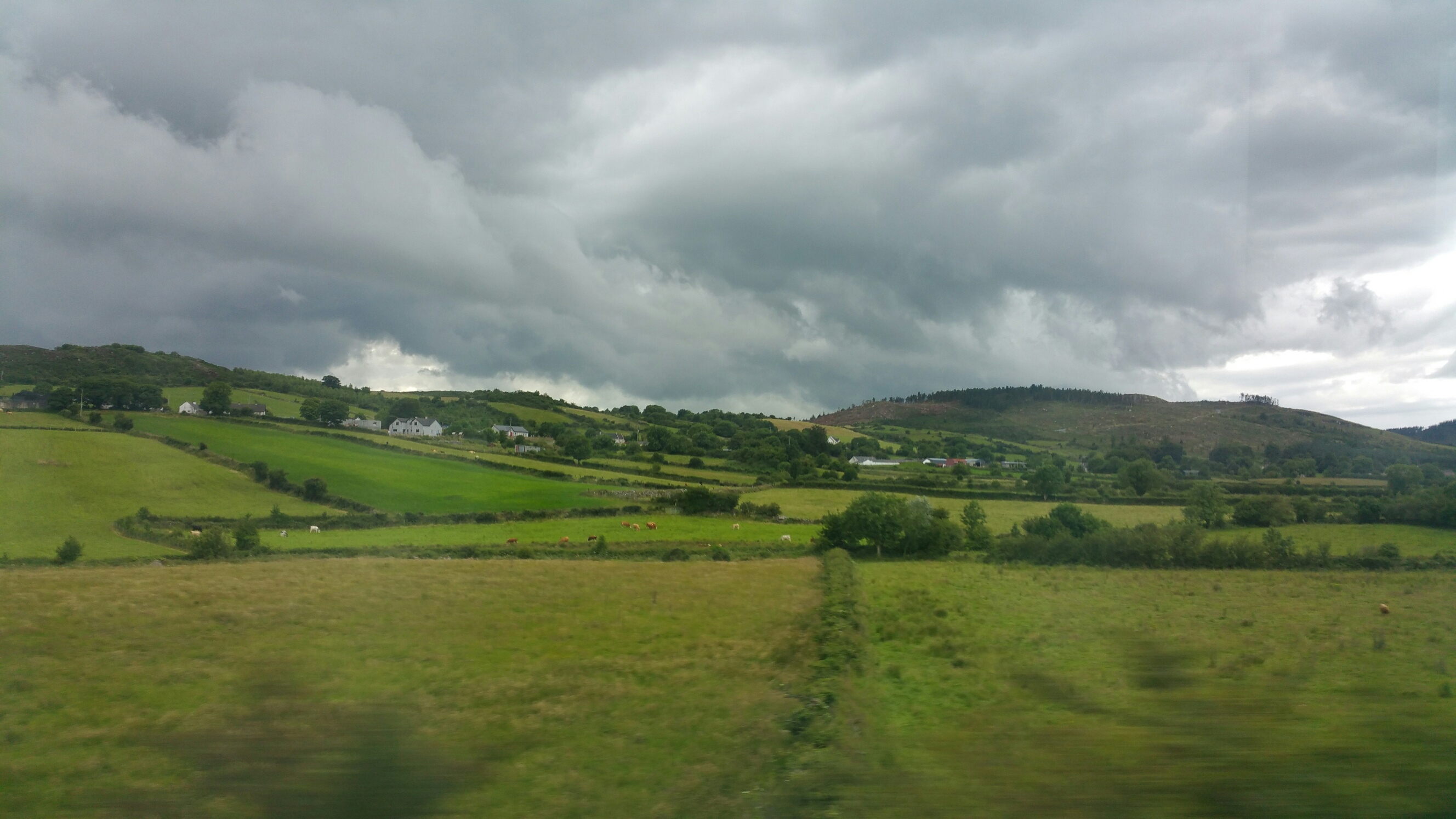
I snapped this pic from the train to Belfast from Dublin this summer. The Irish countryside is so delicious.
But I also belong, halfway, to my father’s Scandinavian side. And the two sides of me are occasionally in conflict. But there is one thing they agree upon. Traveling expands you. My people are a traveling people. My ancestors set sail and did not look back.
In the U.S. most of us are halfway something. And even if we came from this soil, this fertile soil of America, we too, are nomads. Travelers.
So, too, are our relations – the gazelles leaping across the Serengeti or the Monarch butterflies flitting towards Mexico. All of us belong to a branch of the biological family that is on the move.
And we do not necessarily travel fast. Consider the sloth. They are part of our family too. And I don’t want to stretch this metaphor until it snaps back on me, but my husband who has Parkinson’s is a bit on the sloth spectrum. Yet he hangs on to the family tree. And still, he travels. (Heading to Florida for a month and a half to direct a play.)
Still on the go.
The difference between us and our biological family is that when we return from our distant adventures – down the branch of the tree or across the vast plain or swamp or ocean – when we return from our journeys — we tell the tale. We huddle around the campfire, the Sunday dinner, the AA meeting, the bar, the water cooler, the back of the bus. And we regale our friends and family with stories of our successes and failures. We make something out of an ineffable nothing — that place that only resides in our memories — our distant homeland, our Ireland, our watering hole, our home.
And that is why I love to travel. And I believe it comes from both the Irish and the Scandinavian. It is not that I love the journey — the uncertainty of where I’m going. But it is that I love to return and tell the tale.
So today, look up from your computer, glance into the eyes of your officemate, your lover, your daughter, your spouse. Ask:
Where have you been? Where are you going? When you return, will you tell me all about it? And then that place — your place, your story — will live in my memory, as a story, too.
How do you feel about dying? I get tired of my person-ness at times too. I get sick of being me. I might like to be someone else. Or a bird. Or a deer. Or a rock. And I don’t think I’ll mind — in 40 years or so, I’m in no rush — when I have to get off the bus.
I heard Phyllis Tickle speak, like 22 years ago, at United Methodist Women. She was teaching at Union Seminary and she came over to the God Box (475 Riverside Drive) to speak to the Women’s Division Board of Directors. I was impressed.
I remember Phyllis saying that people asked her – because she was such an intellectual – why was she a Christian? And she said it was because when she was a child, there was something that rang true to her about Christianity. She could not argue with her child self’s cerititude. This seemed to me to be as good a reason as any to be a Christian. I may have misremembered her words. It was a long time ago.
Knowing you’re going to die someday — I’m going to, we’re all going to — does this knowledge make us a little more mindful? A little more aware of the beauty around us? Of the transient nature of our existence?
How do we stay present in every single precious day? Phyllis Tickle died on September 22nd. I wonder if the journey went as she remembered?
This October I’m going to blog every single fricken’ day.
I tried this last year and missed a few days. Because my darling Charlotte was in excrutiating pain and we landed in the emergency room with her fibroid cysts for a day. And well, you know, a trip to the ER can ruin a few days.
This year I’m back in the blog game. And my theme is mindfulness. Sure, it’s trendy. What’s wrong with that? I’m trendy. What are you saying? I’m fat? (That’s an inside joke — apropos of nothing, my sister and I like to say that. It’s funny. Trust me. The way we say it. It’s funny, okay?)
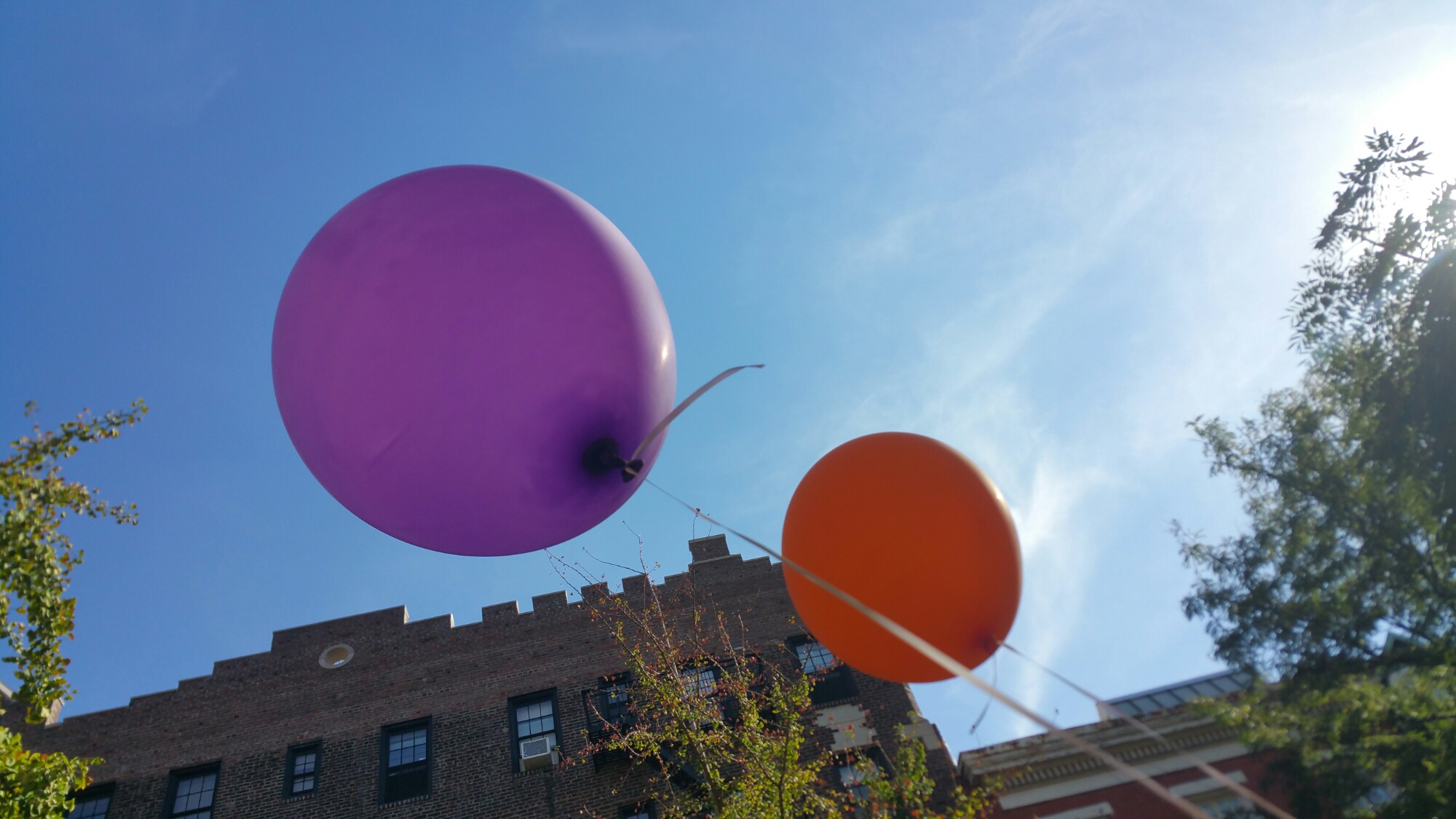
In the West Village. Balloons over the steps of Alma Mathews House, a short-term residence for faith-based professionals. The house is being sold. Change is inevitable. Mindfulness reminds us of impermanence.
Be mindful. Breathe. Notice. Be present. Not so funny? Maybe. But fun, and as previously mentioned, trendy.
Seriously. I came up with this theme when I realized I was just madly cycling through life. Ever feel like you’re just riding your bike in place? Not going anywhere? That’s called spin class. Also, trendy. I like to ride a bike, sure, but I like to go places. I realized at the end of September that I was restless. And I thought I would pursue a month of mindfulness to center myself. Figure out where I am and who I am. And what’s important.
I am lucky that I have two really wonderful part-time positions which together just about equal my former full-time salary
The world of work, for me, is a patched-together affair. Like a quilt, I provide comfort and care.
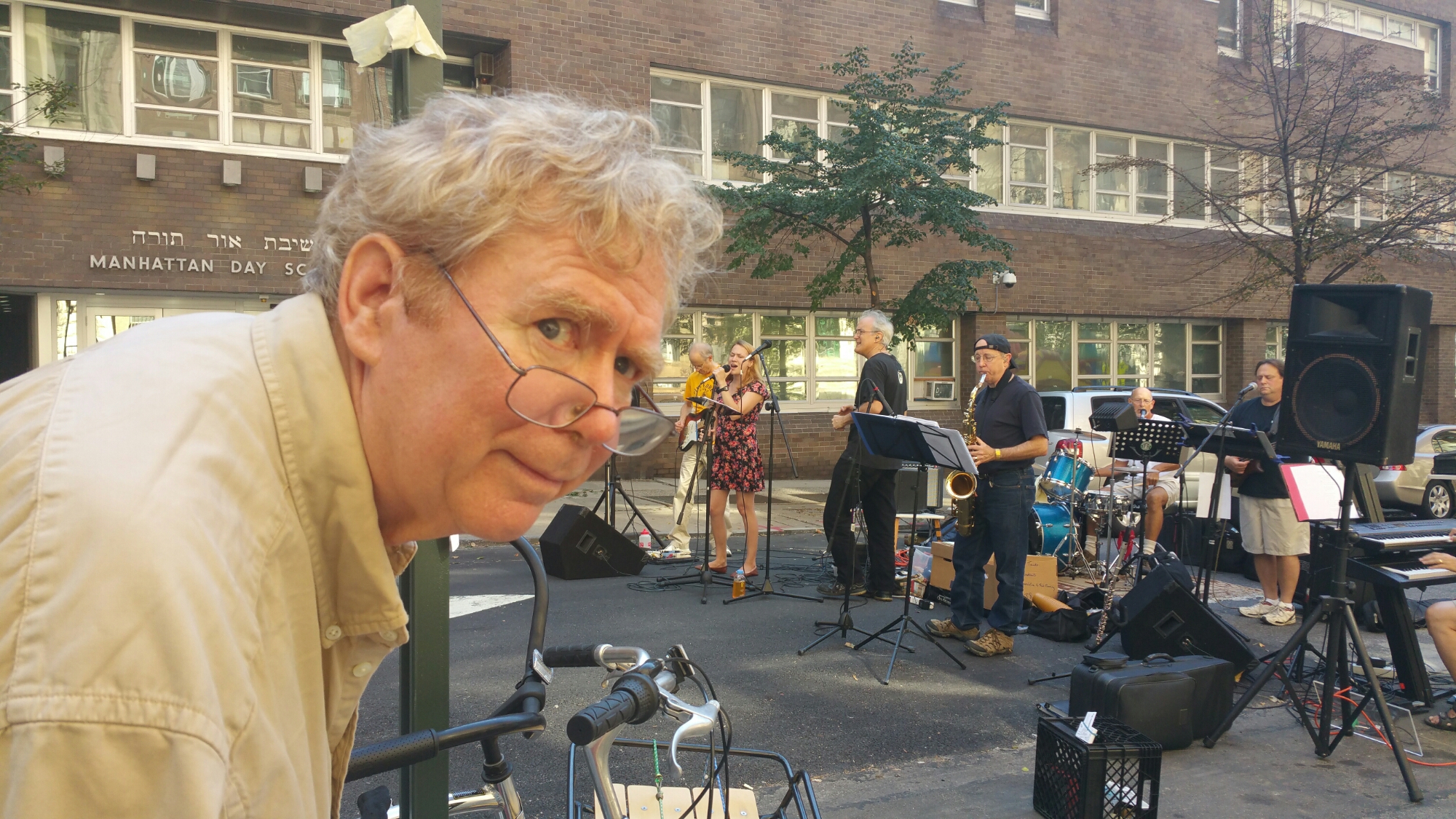
Chris yesterday at our block party.
Although I work a lot, I still need time to care for the family. Chris’s Parkinson’s impinges on his life and our family in small ways. While he is still capable of doing most of his own daily tasks, increasingly, over the years, there are ways the kids and I have had to pitch in — provide small services like helping him to stand after seated a long time or reminding him to take his pills.
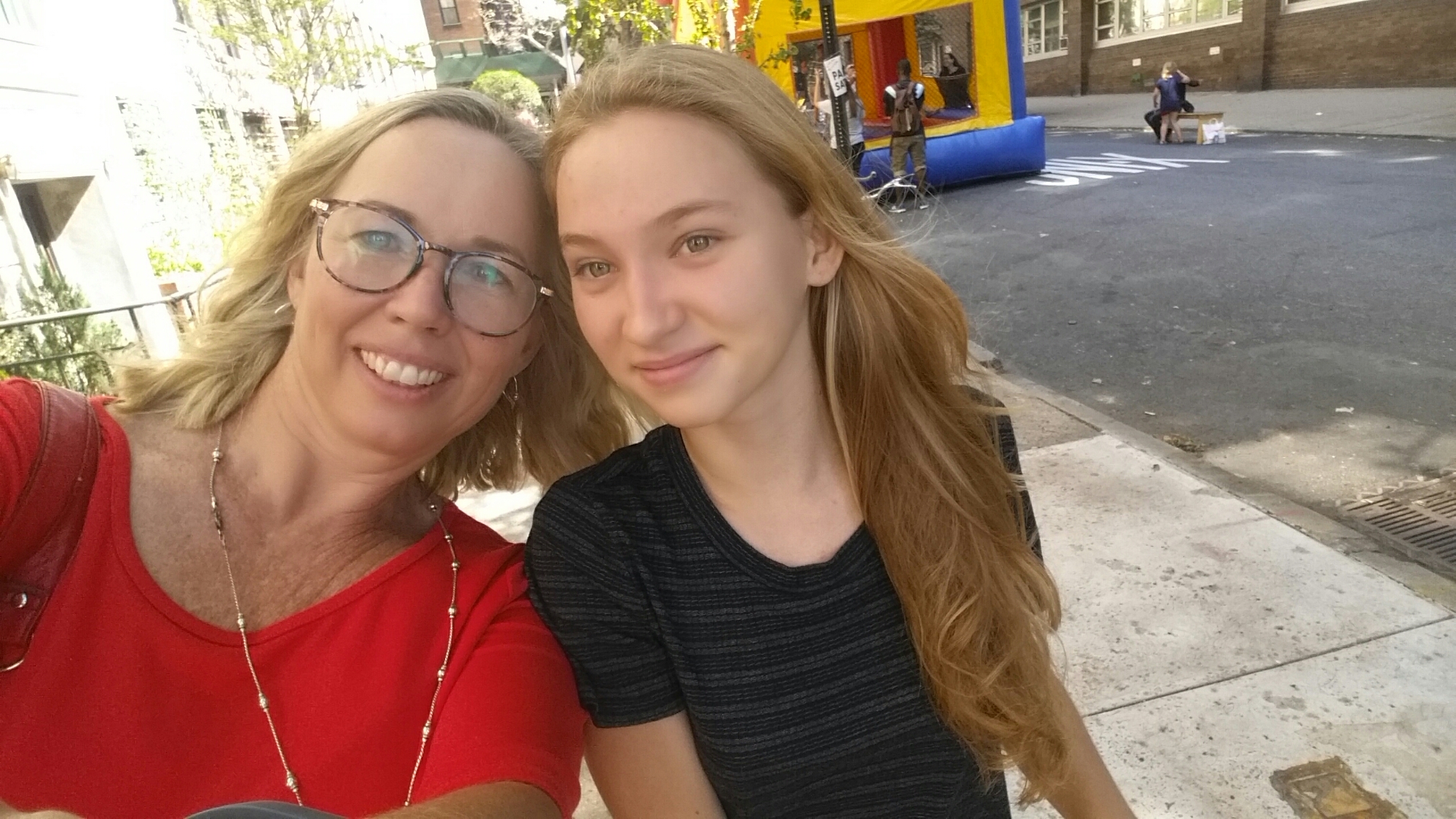
Me and Char at our block party. We chatted with our neighbors and local politicians.
Beyond paid work and caring for family work, I need time for self-care — work on my novel, my essays. Or simply read my book for book club. Or prepare a nice dinner party or plan some fabulous trip. (I have absolutely no upcoming trip and this always unnerves me — when am I going to go where?)
I rarely see a story of my patched-together work-life balance in popular culture. Although today’s cover article in the New York Times Sunday Review talks about “A Toxic Work World” where only the young, childless can survive. I agree. While society has changed, our expectations at work have not. Our work life is no longer Mad Men and our family life is no longer Fathers Know Best. I more identify with Frankie in ABC’s The Middle — overworked, struggling, but still, funny, hopeful.
Unlike Frankie, I am an intellectual too — a middle-aged writer, teacher, editor, just trying to keep it together — offering love and friendship and trying to make a very real positive impact on my world.
“We would think managing kids matters just as much as managing money,” Anne-Marie Slaughter, author of the Times article says. “We can, all of us, stand up for care. Until we do, men and women will never be seen as equal; not while both are responsible for providing cash but only women are responsible for providing care.”
I want to believe politicians are talking about this too. After all, Hilllary Rodham Clinton wrote the book, a million years ago, called, It Takes a Village. A cynical culture may refer to the title sarcastically or see the treatise only politically, but I see it as a reminder — none of us do it alone. Even geniuses, like the Beatles or Mother Theresa or Einstein, drew upon the wisdom and received help from their communities.
I snapped this pic from my bike ride to work the other day. Riverside Park.
I believe we are due for a cultural shift. And this may be the message of the pope when he flies through town this week. Caring for each other is way more important than competing against each other. I want to be a part of a culture of caring. Utopian? Let’s try it.
Like the song from South Pacific says, “If you don’t have a dream, how you gonna have a dream come true? Happy talk. Happy talk.”
We were having the last weekend of summer at Long Beach Island in New Jersey – me and my b.f.f. Joanne.
We’d become fast friends 17 years ago — when we’d both wheeled newborns through the lobby of our Upper West Side building. We admired each other’s carriages. She was impressed by my antique English pram. I liked hers — sleek and modern. We discovered our husbands had the same name, John, and both were character-type actors. And, of course, we both had newborn babies.
This last day of summer, we sizzled on the beach with our teenagers, gossiping about old neighbors and new careers. Jo has returned to the workforce full tilt as a fashion designer, while my career, freelance writing and teaching, limps along.
From the beach, we watched a parasail glide past us.
Jo adjusted her stylish straw hat and told me, “I’ve been promising Little E for years that she could try it. But, no pressure, we don’t have to do it…. If you think it’s too expensive.” Which I did. And which she did too.
But see, we are two ladies who don’t want life to beat us. And this last year, life has nearly beaten us.
Our tough year is due to our declining marriages. My husband’s Parkinson’s Disease is worsening and her marriage is devolving. But we are resilient. Jo’s daughters called her JSJ, Just Single Joanne.
I reached for my phone in my whicker beach bag and called the number advertised on the parasail.
By now, the girls had perked up on their towels. “Can we do it? Mom? Please!”
“It’s a definite maybe,” I said.
“Oh, like the carriage ride?” See, for my girls’ 8th birthday, I’d promised the twins a carriage ride in Central Park. They are now 14 and still waiting. I’m ambivalent. What about the whole carriage horse and anti-cruelty thing? Besides, it is expensive.
And so, I discovered when I called from the beach, is parasailing.
“$75 a person,” I reported.
“Girls, I don’t know. That’s $225.” Jo said.
“No. That’s practically a trip to Florida in February,” I said.
“The carriage ride!” they said.
I waffled. “Look,” I said “if the conditions are all right, then we can do it. Sunny day, light breeze, calm water. We’ll see.”
One of my daughters said to Jo’s daughter, “We’re never going to do it. She’s been promising us a carriage ride in Central Park for six years.”
“My mom’s the same. She’s been promising me a parasail for so many summers,” Little E. responded.
I ignored them. I turned to Jo, “Wait. You said, $225. But it’s only $150. Two girls at $75 each?”
“Oh, no,” she said. “I’m going to do it too. It looks fun. You and I can do it together.”
“I guess.” I shrugged. I am scared of heights. I don’t like ferris wheels. But it didn’t matter. I’d bought us time. The next day, I knew the forecast was for rain.
***
I woke before everyone else and looked out the window. Not a cloud in the sky. In fact, the conditions were perfect. Sunny day, light breeze, calm water.
Jo made us coffee. “I think we should do it.”
“Okay,” I exhaled. “Yolo. Carpe Diem. All that crap.”
The girls were thrilled.
At the shack on the Barnegat Light dock, I signed waivers on an ipad, not even reading the print. I had to rush to the bathroom.
We boarded the cushy white boat. The guide and the driver were 20-something year olds. Did they know about keeping me safe, synching cords?
We watched the shore get smaller.
When our boat was well out, Sean, the ex-Marine guide, asked, “Who wants to go first?”
“We do,” I said, answering for Jo and me. I wanted the whole thing over with.
“Okay.” He bent to slip one nylon strap over and under our thighs and another around our waists.
I whispered to him, “Basically, Sean, we two are single mothers so you cannot let anything happen to us. I’m not kidding. You have to make sure you bring us down alive.”
“That’s the idea,” he said. “We haven’t lost one yet.”
He sat us on the back of the boat. I looked around for the metal basket. Wouldn’t we be sitting in a metal frame like on a ferris wheel? No, the two straps of nylon were pretty much our whole seat and harness. I don’t know if it was uncomfortable. I had no time to think or feel because, with a whoosh, a gunning of the motor, we were jettisoned from the boat into the sky. We were suddenly miles away, it seemed.
Dreamlike, boats far below us left a trail of foam – V’s no bigger than a letter on a printed page.
“Oh, this is so fun.” Jo laughed, giddy, girlish, giggling. I recall a few moments in the sky where I was not utterly terrified.
I pushed my big sunglasses up my nose, looked at the beach houses, boats. Everything was tiny. Nothing mattered.
So quiet. I turned and looked up at the parasail behind us — full and reliable.
I noticed I was white knuckling it. My hands were clutching the straps. I told myself, Relax. Enjoy this. It will soon be over. I circled my wrists. The boat slowed, lowered us so we dipped our feet in the water. Then, we were raised up into the sky again. We laughed and shouted.
We waved at the girls.
“They’ve probably forgotten us,” Jo said.
But we could make out their tiny waves in the tiny boat.
After about 15 minutes, we were lowered back gently into the white boat. Behind my big sunglasses, I cried. I was so grateful to have survived. I had returned. Safety. I thanked Sean. I told the girls it was fun.
I watched my girls go up, kicking each other, swinging, waving, going no-handed. I felt a similar wide relief when my girls returned to the boat safely.
For a little while, that day, up high in the sky, life was light, someone else was driving. Everything – work, husband, money problems — was far away. I realized I didn’t need to clutch so tightly. I had been scared to let go. But it was okay when I did.
Maybe a carriage ride in Central Park will feel the same way.
Here we are sailing up.
I am part of a variety show this afternoon and I am going to read this essay. I’ve tried to sell it to a couple of magazines, but, sadly, no takers.







 100 Days of Poems and Pics