Saving Mr. Banks

I felt unhinged by Saving Mr. Banks.

Respect for Writers

First of all, it is always amazing to see respect lauded on a writer.

Respect is not why I write. But I have to admit that reverence for a writer – in this case, P.L Travers, the author of Mary Poppins, a children’s book, is a rare and beautiful thing.

Women as Creative Team Leaders

From a feminist perspective, I loved that the men, even the studio head, the great Walt Disney himself, deferred to Travers. Of course we all know men who defer to their female bosses or wives or business partners. It should not be an oddity. But somehow, the world has turned and I rarely see men respecting women in mainstream movies.

Maybe because I have teenagers I am overexposed to hyper-sexualized women in the media on awards shows – too many women rock stars wearing lingerie while the men wear black tee shirts and jeans.

But seeing Travers run the show? Well, that was just amazing. She is occasionally arbitrary – but what genius is not? Emma Thompson is brilliant at creating this very real, flawed, lovable, cold writer.

Explaining Mary Poppins

I loved, too, that Saving Mr. Banks explained why Mary Poppins does not change as a character. Like everyone, I love the Julie Andrews movie. But it’s always bothered me that Mary Poppins does not change – she does not become more loving or more interesting as the film progresses.

Her character does not go through the fires of some great conflict and come out the better for it. This movie explains why. She is the agent for other’s transformation, not her own. Change is reserved for Mr. Banks, the father, an idealized version of Travers’ father.

Becoming More Loving

Our Travers gently returns to being an imaginative and playful person. This transformation into a loving human being happens in small ways. Our hero here does not suddenly turn around and become a fabulous new person.

This is a subgenre of movie I happen to love — watching characters return to love — like the movie based on C.S. Lewis’ Shadowlands.

English: Screenshot of Julie Andrews from the ...
English: Screenshot of Julie Andrews from the trailer for the film Mary Poppins (Photo credit: Wikipedia)

What About Mrs. Banks?

Now, you know, I have to find something not to love. I did not love that Travers seemed to be seeking to come to terms with only her father. What about her mother? She certainly was equally complex. Is the mother not as curious and exciting and crazy a character to explore? Or are men more enigmatic? Why must it be the father we need to heal?

The Treasure Trove of Childhood

I, like Travers, have a treasure trove in my past – a childhood of great love, adventure, and benign neglect. But it is in from this personal history that so much creativity can spring from.

This book reminded me of Alice Miller’s Drama of the Gifted Child, a psychological text that explains why overly sensitive children do not have a full childhood as they are always in tune to their parents’ struggles. Then, as adults, they are adrift. They are less inclined or able to explore their own lives. I think about this from my own story and from my children’s reality.

There are times that I, perhaps due to Chris’s Parkinson’s, as a parent, turn to the children for more support than maybe they need or want to give. And then there are times, too, I just let them off the hook — but that’s another story. Or maybe it’s the same story. It’s the story of excessive attachment and then, benign neglect. I console myself with the certainty that great creativity can come from a troubled childhood.

You should see — or read — this story. Think about it, talk about it — about respect for writers, women as creative leaders, the importance of childhood, and what makes for creative genius.

Enhanced by Zemanta

Nice, SuperNice

Mother Theresa statue, Struga
Mother Theresa statue, Struga (Photo credit: Wikipedia)

Like 20 years ago, I was temping at a bank in New Rochelle. I was working for a banker — I forget his name — but he was younger than me by a few years. But he seemed older. He was getting over some kind of cancer. He used to buy me lunch almost every day. He seemed confused by me.

Then, he told me why. “You’re the nicest person I’ve ever met.”

“Really?” That seemed weird. I’m no Mother Theresa. I get impatient and insecure on a daily basis. I felt sorry for this banker — I mean, if I was the nicest person he’d ever met! Well, that just seemed sad.

Still. Nice gets a bad wrap. I remember in the book The Happiness Project when Gretchen Rubin is super-nice to everyone in her life for a week as a path to happiness. No one really notices her niceness and she’s glad when the week’s over ’cause it feels like kinda a waste of time. And niceness requires a lot of effort.

I have felt that my niceness is, at times, perceived as stupidity. (Especially at work — when the cynical males were perceived as smart and the young female optimists were seen as fools. Well ha! Fools have more laughs than cynics!)

I can’t help it. I am compulsively nice. And this kind of “nice girl” syndrome has cost me. Maybe in being nice I have swallowed some honest emotion.

Still. In the long run, I’d rather be overly nice than overly critical or mean.

My daughter and I had a screaming match yesterday and she accused me of being so mean. And ugh, that hurt. In a quieter moment, I asked my husband, “Was I mean?”

“When you two lock horns, no one wins,” he said. Which, I think, meant, ‘Yes, you were unfair or unkind.’ Hey, I thought, I’m sorry. And you only hurt the ones you love.

I don’t want to get into the deets of the argument, but my daughter and I talked it out later and we both promised to do better next time — to give each other a little more patience and more room to breath. Tough stuff. At least for me. Me? The nicest person you’ve ever met.

I have blogged about this before. And interestingly enough, I also wrote about my daughter four years ago in the blog post the power of niceness. I, then, too, referenced the Happiness Project and my resentment about workplace sarcasm winning over niceness. Weird. Four years later. I’m writing about the same stuff.

And still. Niceness wins. Every time.

Compassion, too.

This post was inspired by Daily Prompt: Nice Is as Nice Does

Enhanced by Zemanta

Halloween Begins the Holiday Madness

Happy Halloween! Wait! I’m not ready. Did I celebrate my daughters’ birthday, or even, 4th of July or Easter, well enough?

This is the first of the marching holidays and I’ve hardly finished my last holidays. But they march on, whether I am ready or not. I have to comfort myself that I do them well enough.

I am a do-er and I do the holidays well enough. But sometimes I want to celebrate Easter in November and Thanksgiving in March.

I am a do-er but also an iconoclast or an anarchist (or some big word that means rule-breaker.)

I can change some things, but I can’t change big things like the seasons. Christmas is good in the winter. Maybe it’d be better at the beginning of December? Maybe I should start a campaign to change the date of Christmas. I could start small.

Here’s my idea: Let’s pump up the less celebrated holidays, like Martin Luther King Jr. Day. Let’s make it a big peace and love day — bigger than Christmas. Same with International Women’s Day. Let’s really love on our international sisters that day.

And I can use the money I save buying shit nobody needs at Christmas to throw some really big Pace and Love parties.

I’m not a Scrooge. While I like, and even love, Christmas and other holidays, I reject the disgusting materialism and commercialism that pervades our culture. I don’t want new things. (I want new experiences.) I don’t want my kids — or anyone for that matter — to think the acquisition of goods leads to the acquisition of happiness.

I have been happiest traveling light. The less stuff I have, the happier I am.

I have been happy with friends, having — and going to — parties, being with my kids, my family. Happy Halloween! March on holiday madness!

So,  “If bloggers had their own Halloween and could go from blog to blog collecting “treats,” what would your blog hand out?” asked the Daily Prompt today. And I answer: more fun, more love, more peace, and more parties. 

20131031-125550.jpg
At the church retreat at Shelter Island last weekend, some of the teens carved awesome pumpkins. This is one.
beach scene in October
Leaves blew on to the beach on Shelter Island.

Caption Correction

“That is so awkward!” Charlotte said in the cab.

See, I had just posted a picture from her soccer game on my Instagram and it flipped over, as usual, to Facebook, Tumblr and Twitter too.

I tagged Charlotte and captioned the pic, “That’s my girl, on the ball.” I noticed some friends and family liked and cheered.

Only my picture wasn’t of my Charlotte. It was another kid named Charlotte. My Charlotte was right behind her.

“What can I say?” I defended myself. (I can be defensive.) “It was bright – you were far across the field.”

“But I don’t even have those shoes!”

I could not claim that I was confused by the usual screams from the sidelines.

No one was yelling, “Go, Charlotte!” or anything, because it was Silent Sunday. Parents were not allowed to yell, neither were the coaches.

For this one day, soccer was like golf. We watched intently. We concentrated. It was peaceful. Until the cab ride when one of my favorite subjects pointed out that I had misidentified her. Then, it was so awkward!

Below you can obviously see that the first pic is not my Charlotte, but the next one is. I think.

20131027-182045.jpg

20131027-182125.jpg

Boys Are People Too

English: , American author
Rosalind Wiseman, courtesy of Wikipedia

I have blogged about my son driving me insane with his Xbox habit.

At Trinity School last night I got some insights into my son and his boy culture. Rosalind Wiseman spoke about the social pressures and dynamics of being a young man in today’s hyper connected world, based on research from her new book, Masterminds & Wingmen.

Here were some of my take aways:

We say to girls, “‘You can do it. You can do anything.’ And girls have a vibrant support system.” Wiseman is not knocking this important empowerment base for girls — after all, she’s also the author of Queen Bees & Wannabes so she knows girls. But Wiseman says, ‘If you are a 13-year old boy, you don’t see that you have power.” Because, at 13, a boy is still a boy and a girl is a young woman.

Wiseman likened the emotional life of 11th grade boys to 8th grade girls. This cracked me up. This is who I’ve got at home!

For her book, Wiseman interviewed 200 boys and 40 girls. She came away with some surprises.

One gem? “Straight theater boys get more hookups than football players.” (All right! Let’s hear it for the theater boys.)

More gems:

Happiness is …

  •  Meaning beyond one’s self
  • Hope of success
  • Social connection
  • Satisfying work

I love archetypes. And Wiseman, with the boys she interviewed, came up with some types:
The Mastermind
The Associate
The Bouncer
The Fly
The Entertainer
The Punching Bag
A Conscience

But these boys don’t mind being stereotyped. Remember that rule for happiness? They are happy to have social connections.

I loved Wiseman’s advice to a boy when he criticizes another boy’s sensitivity, “You cannot deny someone’s emotional truth.” So true!

She also says, “There is a difference between snitching and reporting.”

And this! “It is a social skill to get help.” One mom I chatted with after Wiseman’s presentation said she she was going to put this quote on sticky notes all over the house.

When a boy comes to a parent with bad news, here’s what to say, “1. I’m sorry this happened. 2. It’s hard to come forward. I respect that you did. 3, Now let’s think about what we can do about this.”

And when there’s conflict, expect push back.

When you get a “Bad news bomb,” Wiseman says a parent can realize:

  • This is one moment, not a lifetime.
  • Don’t make excuses.
  • Ask for what you need.
  • If it gets heated, you might say, “Let’s talk in 10 minutes. I can’t hear you over the sound of my heart beating so loud in my ears.”

I am going to try and talk about the tough stuff with my son. Wiseman advises, ‘Talk to your son about falling in love and breaking up. Don’t expect the generic advice to ‘respect a girl’ to be useful, especially at a party. What does respect mean?’

Boys, like girls, feel used and confused over relationships. Some boys asked Wiseman how to deal with aggressive drunk girls.

Wiseman began her lecture with a scenario of how one boy felt shamed by other boys’ comments around his body. Yes, body image is important to boys.

This lecture helped me realize my son’s “emotional life is deep and rich.”

Even though my boy always seems to have some tech thing in his hand, he still needs his hand held!

And I’m going to hold his hand — and yes, embarrass the hell out of him while doing so.

20130911-160541.jpg
Rosalind Wiseman talks about boy culture.

Reflections on Race after the Verdict

Here are a few random thoughts on race.

**

I believe more people should learn conflict mediation skills and fewer people should carry guns.

I was thinking about the Girls Leadership Institute (GLI) workshop that my daughters and I attended last year. A key factor in resolving conflict is TALKING, not fighting, not fearing each other.

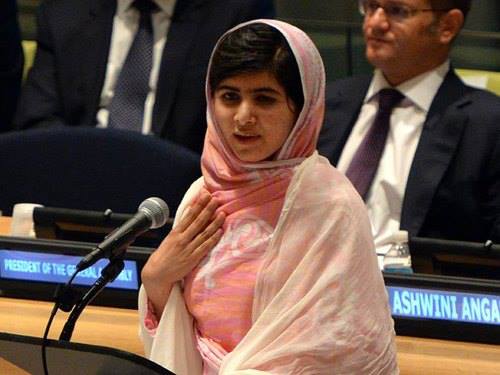
After being shot by the Taliban, on 16th birthday, Malala Yousafzai spoke at the United Nations. (photo courtesy of Charter for Compassion)

The talking solution may sound girlie, sissy, touchy-feely. But in fact, if more people talked about their feelings and fears, there would be less trigger-happy people and disputes.

Look at what a girl can do when you look at Malala Yousafzai who had been shot by the Taliban for speaking up. She celebrated her 16th birthday by speaking to the United Nations in favor of educating girls.

Personal gripe: Last year, when I worked for the faith-based women’s group, I wrote a curriculum on using conflict resolution skills in small group settings for a young women’s training. Despite being riddled with conflict, even the women’s group saw conflict mediation as a low priority.

**

If my 16-year old son were walking the streets of Florida, no one would feel alarmed. This case was definitely about race. The Paula Deen incident shows people talk about race in private, but not in public.

We say nothing. We are afraid. We don’t want to offend. We avoid conflict. But talking (writing) is the best solution. And we may need to employ conflict mediation skills to let one another talk without judging. Use “I” statements and all.  We need to learn to talk about tough stuff. I do, any way.

**

What the hell, Florida?

My father belonged to a neighborhood watch group in Florida.

Last year, I asked him if he saw anything worrisome. He said once he saw a group of Hispanic men hanging out near a park at night. He called it in. The cop said leave them be. My father said the group claimed to be a soccer league, but my dad did not see any soccer ball.

He never saw the group again.

**

Once I was at a cocktail party in the Adirondacks and I met the writer Nell Irvin Painter. She wrote the book, “History of White People.” She was about to go on the Daily Show to talk about her book. She was studying art. We sat on a comfy couch and talked about Princeton, art, writing, and race. Her book sounded brilliant.

Nell Irvin Painter
Nell Irvin Painter (Photo credit: Wikipedia)

We shared some laughs. I wanted to read her book about white-ness and the construct of race. I have not read it yet.

**

I was at another cocktail party in the Adirondacks. (Apparently that’s the only place where I go to cocktail parties. (Though once I went to cocktail party at Gay and Nan Talese’s house. That’s another story. (Charlie Rose was there.))

Back to this friend in the Adirondacks — she said that the U.S. should’ve never fought the Civil War. This idea was anathema to me. She said, ‘We should have annexed the south because southerners were and are such a drain on the country. The north would accept all people as free people. The south, because of its bigotry, would implode. All would be welcome in the north. We would thrive.”

Again, it was provocative cocktail party talk.

**

I want to take my kids to see Gettysburg.

Once I went to Gettysburg with college chum Jeff Carey (T. Jefferson Carey). I was splitting up from my first marriage. He was going through some shit.

We took this crazy road trip in his really crappy car. We totally made all these connections about how the Civil War was a metaphor — for my marriage and for our families, for our divisiveness within ourselves, and for our country, even today.

I kind of remember him burying something on our road trip  — some kind of talisman — under a tree. Or maybe he dug something up. I can’t remember. It was a long time ago.

I do remember that Jeff and I bought this tape. We played the dramatic tape in his tapedeck as we drove around listening to the story of the bloody war at Gettysburg. I remember crying over that tape’s dramatic narration of Gettysburg — where brother fought brother.

I want my kids to hear and learn about Gettysburg. I want, as a country, for us not to forget the Civil War. I want us not to forget Trayvon Martin. I want us to listen to people like Malala Yousafzai and Nell Irvin Painter.

I want fewer people to have guns. I want to read books and talk about race. I want people to learn how to mediate conflict and talk about race and gender, like we learned to through the GLI.

After all, this is the least we can do to mark the 150th anniversary of the Battle of Gettysburg.

P.S. I want to go to more cocktail parties.

Iron Man Ignored the Kid

The iron man and us
The iron man and us (Photo credit: Bev Goodwin)

I love summer blockbusters. I also love French films and independent films and basically any kind of films (though, true fact: I have never seen an X-rated movie, unless flipping around and catching Robin Byrd on cable counts!)

I just love losing myself to the dark of any movie theater.

But something kept rattling in my brain after seeing Iron Man 3. I was disturbed by the way Iron Man treated the kid who had rescued him. He totally ignored the kid.

Iron Man seemed to think a dark roomful of toys/tech equipment could replace the presence of a loving adult.

See, the kid in the movie had been abandoned by his dad, and no surprise, when Iron Man showed up, the kid assumed he was a dad figure. And when the superhero needed help, the kid was helpful. (This is not a spoiler. I think it’s fairly obvious that the kid will be useful to Iron Man.)

iron man 3But then the kid was not rewarded for being there for this father figure. In the end, the only thing the boy received was all kinds of digital devices for him to tinker with. This is his reward?!? The kid needed a frozen yogurt with the dad figure, or a picnic in the park, or, yes, the proverbial, game of catch.

In this room of tech equipment, the product placement of FiOS plastered all over the huge flatscreen TV was jarring and obscene. I was totally taken out of the movie and felt I’d landed in a stupid commercial.

So the message on this Father’s Day weekend seems to be: you want to be a good father? Buy your kid off, get them tons of tech stuff so they can play alone in a dark room. And then you can retire, alone yourself, in your own dank and dark digital kingdom. That’s Hollywood.

This is relevant to my life right now because my son is being punished (I won’t go into the details). And his tech equipment is taken away. He is clueless as to how to survive. I’ve suggested fro yo, a picnic, or a game of catch. But like Iron Man, our superhero, he’d rather be alone with his devices than outdoors with his friends or dad or sports or, even, ice cream.

I find this choice sad — not nearly as thrilling or active as an action film or life could be.

I blog about happiness and honesty

When I started blogging, I had four blogs:

  • My Beautiful New York, my NYC people and places
  • Running Aground, my goal to run a 5K
  • the Connected Life, getting my kids off technology
  • A Church A Day, on trying to find meaning by visiting a church a day.

Now they’re all rolled into one (thanks to web developer extraordinaire Felicity Fields). This one, To Pursue Happiness, is about those four goals and the primary goal: to stay happy.

I pursue happiness though I may have absolutely no reason or right.

I feel a loss that my kids are growing up at lightning speed. I feel a sadness that my husband is increasingly challenged by his Parkinson’s Disease.

While these are challenges, they don’t define me. I don’t have to enter or stay in a place of permanent sadness or loss. Life is about what you do with the hand of cards you’re dealt. And I’m dealing.

I’m thriving. I’m staying honest. I’m finding joy. Two great joys in the last couple of weeks were:

Curtain call at the Listen To Your Mother show
  • As a cast member of Listen To Your Mother at Symphony Space
  • As the leader of Artists’ and Writers’ weekend in the Adirondacks.

I was anxious about how these would turn out. Would I deliver the goods? Could I? I did!

In these forums, I could be honest, funny, and surprising.

I could write about and share a lot of feelings, including but not limited to sadness or happiness. A range of emotions, even ambivalence and anger, is acceptable and encouraged in my writing.

So while I still do feel, at times, lost, I can find myself through writing and in the company of other women writers. That’s how I pursue happiness.

***

from LTYM
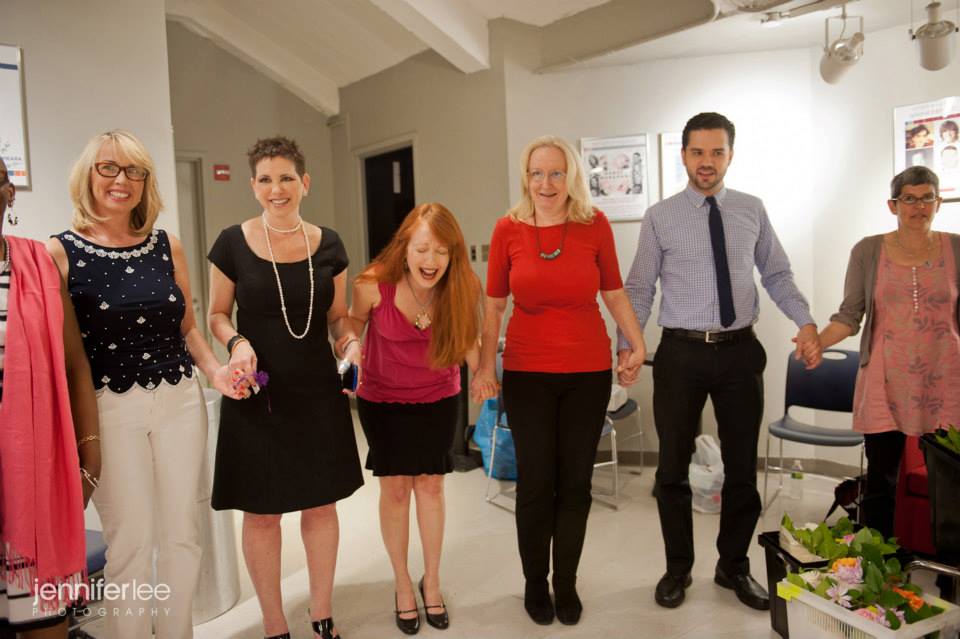
Before the Listen To Your Mother show, the cast warmed up. And that’s Shari Simpson-Cabelin, assistant director, doubled-over, laughing. (I’m in the white pants.) (Photos by Jennifer Lee)

At last week’s Listen To Your Mother show, I was reminded that I am not alone. There are a lot of women telling their truths, deep stories about hardship and love.

Here are some of the Listen To Your Mother (LTYM) New York City posts from my fellow cast members.

Thanks to Shari’s blog for compiling these so I could repurpose! And thanks to producer Holly Rosen Fink, a steady presence, who made this show such a hit.

I got to work with the fab director Amy Wilson, who blogged on motherhood conspiring against her, even as she put on a show.

Here are more stories from the Mother’s Day show.

  • Co-producer Varda Steinhardt‘s piece was about tracking the orbit of her sons’ stars. 
  • Marinka received the dreaded call from the nurse’s office, It’s Always Bad News.
  • Kim Forde, 8 and 1/2 month pregnant, read Welcome To The Circus, a guide to the family circus.
  • Elizabeth (Kizz) Robinson wrote About Me, on how to be child-free and loving.

I haven’t posted my story yet. I want it to be a surprise.

Over the summer, you can see the show at the Listen To Your Mother YouTube channel. There will be videos from all 24 shows across the country, some still going on. Also, upcoming are professional photos of our NYC show by the awesome Jennifer Lee.

***

At my Adirondack retreat and at my LTYM show, I heard a lot of stories that make me go, “aww” – and I feel in the company of AWW — Awesome Women Writers.

Through relentless honesty, these women writers (and one guy) make it okay to be honest and to tell my story too.

***

Tomorrow’s the Big Day

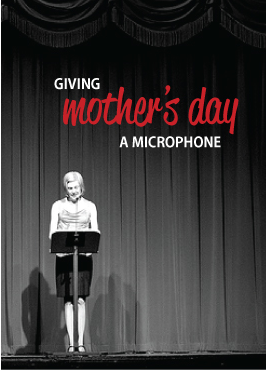
I’m going to be performing in front of hundreds of people at the Listen To Your Mother show in NYC, 5 pm, Sunday, 5/12, at Symphony Space on Broadway at 95th.

listenI gotta tell you, I’m very nervous.

One part of me knows I’ll be great.

Another part of me feels like apologizing for my story in the show — it’s a small story about a small moment. It’s nothing big, nothing earth-shattering, nothing out of the ordinary. Sure, I could’ve plumbed the depths of my soul (could I?); instead, I chose a story about taking out the trash with my surly teen.

So I’m inclined to say, “Awww, P’shaw! My story? Me? We’re not that important.”

But wait! I must remember my advice to myself. When I used to do stand up, right before I went on, while nursing a diet coke at the bar, I’d psyche myself up by telling myself these three things:

  1. Be yourself
  2. Have fun
  3. It is important

These three rules seemed to make a positive difference in my performance. Also, I received precious advice from Eddie Brill who told me, way back when: “Never apologize in your stand up act!” That was great advice! It turns out that audiences don’t trust or appreciate apologists!

The truth is that I love the truth. I love hearing truths about motherhood — good, bad, and indifferent truths. Extraordinary and ordinary truths.

I love that I am someone who loves the truth. Because too much of my mothering and my life is spent putting up a good appearance and trying to keep up with the Joneses 🙂

So the fact that I am invited to tell my truth along with a bunch of other truth-tellers, well, it’s just icing on the cake of my life.

Lintault quilt
When I saw this quilt, I thought it was as beautiful as any Michelangelo oil painting. I saw the quilt by Joan Lintault at the Shelburne Museum in Vermont.

Do I think the other writers have bigger truths? Maybe. But it’s not a competition. It’s a collaboration. And each square of the quilt makes for a beautiful pattern. Some of fabric is flowery, some plaid, some embroidered, some plain. Each story, each piece, makes up this crazy quilt.

When we tell our stories, we make room for even more truth. And, as the saying goes, the truth will set you free.

This Listen To Your Mother show is not a  show for or about perfect mothers. It is not about pretty mothers like Stepford wives. If you’re looking for that, look in the Mother’s Day aisle for a Hallmark card. (Although I’m pretty sure Hallmarks’s marketing strategy has turned towards a more honest appraisal of motherhood as well.)

In this show we laugh and cry over our real truths. And in these truths, the writers have made art, found freedom, and even, perhaps, woven together a new kind of patchwork quilt, more beautiful together than we could ever have been on our own.

I am honored to bring my piece to the show.

I am just going to show up; have fun; be myself; and remember, it IS important.

This post was inspired by the the daily post prompt: “We each have many types of love …Is there a single idea or definition that runs through all the varieties of ‘love’?”

Thanks to director Amy Wilson, producers Varda Steinhardt and Holly Rosen Fink, and assistant director Shari Simpson for weaving me into the show.

And thanks to the rest of the cast, truth-tellers and artists all: Barbara Patrick, DeBorah “Momma D” Gray, Jaime Fernandez, Kim FordeKizz Robinson, Laura Pruden, Marinka, Nicole Goodwin, Nivea CastroRebecca Land Soodak,Sandy Rustin, Sasha Schreiner, Shari SimpsonSofia QuinteroStacy Morrison, Susan Buttenwieser,Tracy Beckerman, and Virginia Watkins.

Listen To Your Mother — Again!

I used to audition a lot. That was back when I was in my early 30’s. I had a little cable TV show and a commercial agent who sent me on a ton of casting calls. I landed a few callbacks and a few international spots, but my acting career never really took off.

Maybe I lacked confidence or maybe I was slightly more quirky than super model-y. It didn’t matter, I told myself. I’m a writer first and I’ve got meaningful work. Besides that, in my mid-30s, I hit my stride when I discovered my life’s purpose: to be a mother to Hayden, Charlotte and Catherine.

badge-2013So last year, when my Aunt Ellen, (the poet Ellen Wade Beals) recommended that I audition for the Listen To Your Mother show, I figured maybe now I’ve got a shot. I’m wiser and more confident. I’ve got a lot of funny essays about parenting. I can do this.

At the audition last year, I read a really good piece of writing — a story about dropping Hayden off at Camp Dudley. My essay was so funny and touching. (See what I mean: I have more confidence.)

When I read the Camp Dudley essay to the several women who were holding the auditions, I detected one (Holly, maybe?) had a tear in her eye.

“I nailed it,” I thought. “I’ve got it! I might still be a successful performer as well as mother, blogger, wife, sister, teacher, worker, etc. Wow! It’s great to be alive!”

But I didn’t get it last year — despite the excrutiating beauty of that little gem of writing. So this year, when I got an email alert about the 2013 auditions for Listen To Your Mother, I brought in a piece of writing, slightly above average, about a tricky little bit of mothering and taking out the garbage with my son.

I was the last to audition. There were dozens of people who’d gone through the audition door ahead of me that Sunday afternoon.

Through the door, I could tell that the guy in the room just before me was really really good. I sat outside, getting nervous. The room was full of laughter as he left.

I recognized the women behind the table from last year, including Holly. But I felt no ill will towards them, just my inevitable lack of success.

I felt insecure. I think I made small talk, something like, “Wow! That guy who was just in here sounded really funny! I don’t know if you remember me. I auditioned last year and I heard the show was really good!”

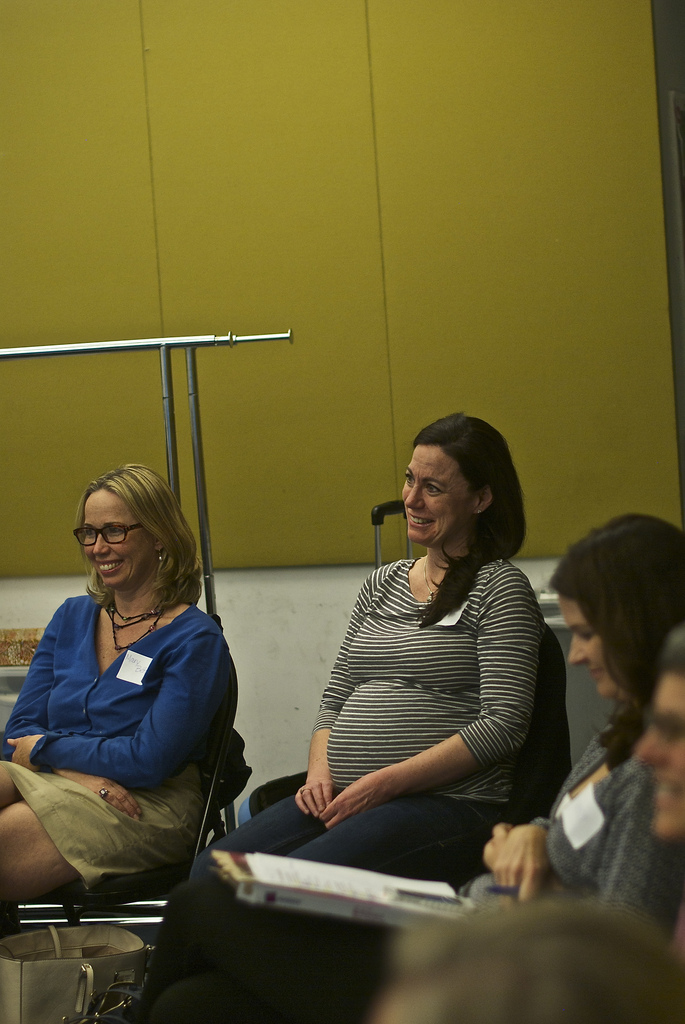
Me and Kim Forde listening to rehearsal the other night (photo by fellow cast member Elizabeth Robinson).

I read my piece, stumbling in a few places. I did not feel confident as I walked out the door. After all, the year before, when I had felt confident? Nada.

So I was surprised, no, I was ecstatic, when, like a week later, I got a call from Amy that I was invited to be in the cast.

I don’t know if my piece is any good, but the show is really really good. And that guy who went in ahead of me, Jamie Fernandez, he’s in the show too and he is really really funny. The brief stories about mothering and mothers are funny, sad, scary, true, and lovely.

But don’t listen to me. I am not a good judge of my own writing. This Sunday, Mother’s Day, come to Symphony Space. Tell me what you think. We’ll have a drink at the Thalia.

NYC tickets support this cause: Family to Family

And thanks Elizabeth for getting this list of links together!