Ode to Hugs

Oh hugs! I love you!

Eight hugs a day!

The baby reaches out her arms and wails awaiting her morning hug and mother’s milk.

And in the evening hours, awaiting sleep and a cup of tea, the grandmother reaches for her glasses and receives a lapful of cat, purring, snuggling, burrowing in for the night.

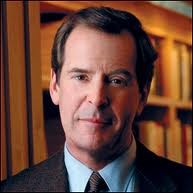
Bishop Minerva Carcaño hugs Community Developer Elva Michal.

Baby, grandmother, and all in between: hugs for all, eight hugs a day!

I wrote this last night in my Number One Son’s literature class. The middle school offers Riverdale Reads, an English class experience for parents and families. Like the middle schoolers, we studied odes by Sophocles, John Keats, and Pablo Neruda.

Yes, we read an Ode to French Fries and an Ode to the Artichoke! So brilliant! So fun!

So in line with my life rule #2 Escape through literature.  https://mbcoudal.wordpress.com/2009/08/11/rule-2/

NaNoWriMo Takes Off Without Me!

Okay, my beloved NaNoWriMo (National Novel Writing Month) started on November 1st. What?!! Already! I wasn’t ready. I was tired that first night. And last night was Election Night and I had book club. Does it sound like I’m making excuses? Well excuse me. What? Do I sound defensive?

Here’s the truth: I really don’t want to start another novel this November until I finish the one I wrote one last year for NaNoWriMo. (And I did win NaNoWriMo last year!) But it might not win a Booker Prize (and I might have to be English any way to win that prize).

When I looked at the novel again, I thought, it’s not bad. It’s kinda good. When one of my twins woke up early yesterday morning, she found me with my novel, tentatively called “The Missing Twin,” spilled out in front of me on the kitchen table. Charlie asked if she could read it.

So I read Charlie a few pages from the middle of the book.

“It’s good,” she said. “Although you should add more details.”  My kid is brilliant. She’s so right. I have to add more details!

Here’s a little bit of the novel from around page 51: (Don’t judge yet, it’s only a second draft. And I need to add more details.)

We were approaching the stop light at the corner of West End and 72nd. A white van slowed and pulled up beside to our cab. The driver wore dark sunglasses. He lifted a piece of paper.

The sign read, “I’ve got her.”

“Jordy!” I meant to yell. But it came out like a whisper. I slunk down.

“What?”  He was still looking at the picket line. “I think I see Angela, our cleaning lady, there.”

I slunk even lower and pointed at the white van.

Jordan looked. He laughed. “That’s weird.”

“Weird? That’s scary. What if he means Elise?” I asked.

I glanced back at the van. The man’s sign read, “I’m wearing panty hose.” The traffic started and the van rode ahead of us.

“Oh my God, a minute ago, he had another sign. It said, ‘I’ve got her.’ I’m worried about Elise,” I could hardly speak.

“Why didn’t you tell me?” Jordan said.

“I did,” I said. Jordan pulled a pad from his pocket and wrote the license number AGS 254. The van turned on 74th Street. We turned on 77th Street. I sat up in the cab. I told myself to breathe. Inhale. Exhale.

ABC Producer

At any given luncheon, there are three factors I consider:

1. What’s to eat?

2. Who do you sit with?

3. Is the speaker interesting?

The answer to these questions are:

1. Wraps, chips, cookies.

2. Pat Pattillo from National Council of Churches. Good conversationalist.

3. Yes, substantive. Jeanmarie Condon, senior producer for ABC News Nightline.

Before I head to another luncheon, let me post a few takeaways from last week’s RCC* luncheon.

1. Take Religion Seriously

When making a documentary about Waco TX, Condon learned the big mistake in law enforcement was that they didn’t take the religious beliefs of the Branch Davidians seriously. This ignorance is lethal. “Mainstream media ignored the religious content.”

“When Chilean miners got down on their knees to thank God for their rescue, did the media tell this story?” Condon asked.

Yet the tides are turning. At this moment, people are paying attention to religion. Religion is relevant. After all, “God and money motivate people,” Condon said.

Condon produced a documentary, Jerusalem Stories, with Peter Jennings. It was unpopular with conservative Christians. Condon also made a documentary about St. Paul. (Presumably that one was more popular.)

She was asked for The Century Project, What was the most meaningful event of the 20th century? “The Iran Hostage Crisis,” Condon concluded. That event ushered in the Islamic Revolution but started as a secular movement. Due to a vacuum of power, Khomeni moved in. And so, too, the West Bank and free media for Palestinians. “What started as a conflict over land was taken over by religious leaders.”

2.  Cover Religious Content with Respect

The wrong way to approach religion in the media is “from a quaint anthropolgical perspective. ‘Look what they believe and what they do,'” Condon said. Rather, “Have respect for all perspectives. Do not look at religion from the outside in. Look at it from the inside out.” Peter Jennings established the religion beat (Terry Moran, educated at Notre Dame, among others at ABC News, like Condon, are continuing to cover religion.)
When Condon traveled with Peter Jennings to the Church of Holy Sepluchre. “We were watching religious pilgrims touching the stone (where people claim Jesus’s body was anointed before his burial). He (Jennings) was crying.”

3. Make A Good Story

Condon said three things are essential:

1. Character
2. Narrative
3. Access

A character is a person or group of people interesting enough to write a short story about.”

The narrative is the story — with a beginning, middle and end — wherein the characters are compelled to take a journey.

By access, Condon means Nightline has to have uncensored time with the character, even if the subject of the profile is Hilary Clinton.

Condon produced a documentary on the search for the Real Jesus (using chants and Bob Dylan music). She also created a special setting out to uncover any facts upon which the novel, The DaVinci Code, was based.

“No truth to it…Mary Magdalene was probably a wealthy businesswomen,” Condon said.

A recent example of a good story? Nightline learned that Christian pastors from the Congo were performing excorisms. “We went and investigated.” The story uncovered abuses by the parents, the pastors, and the overarching need for medical care for kids there. It’s this kind of investigative story Nightline does so well. And perhaps the reason Nightline is the Number One late night show with four and a half million viewers.

Another recent religion story from ABC was their town hall meeting about Islam where the variety of Islamic pundits and practioners showed that Islam is as diverse as Christianity.

Good luncheon = Good food. Good table. Good speaker.

***

*RCC = Religion Communicators Council.

The locations of the monthly meetings of the New York Chapter of the RCC rotate. The October meeting was held in a windowless meeting room of the Church of Jesus Christ of the Latter-day Saints.

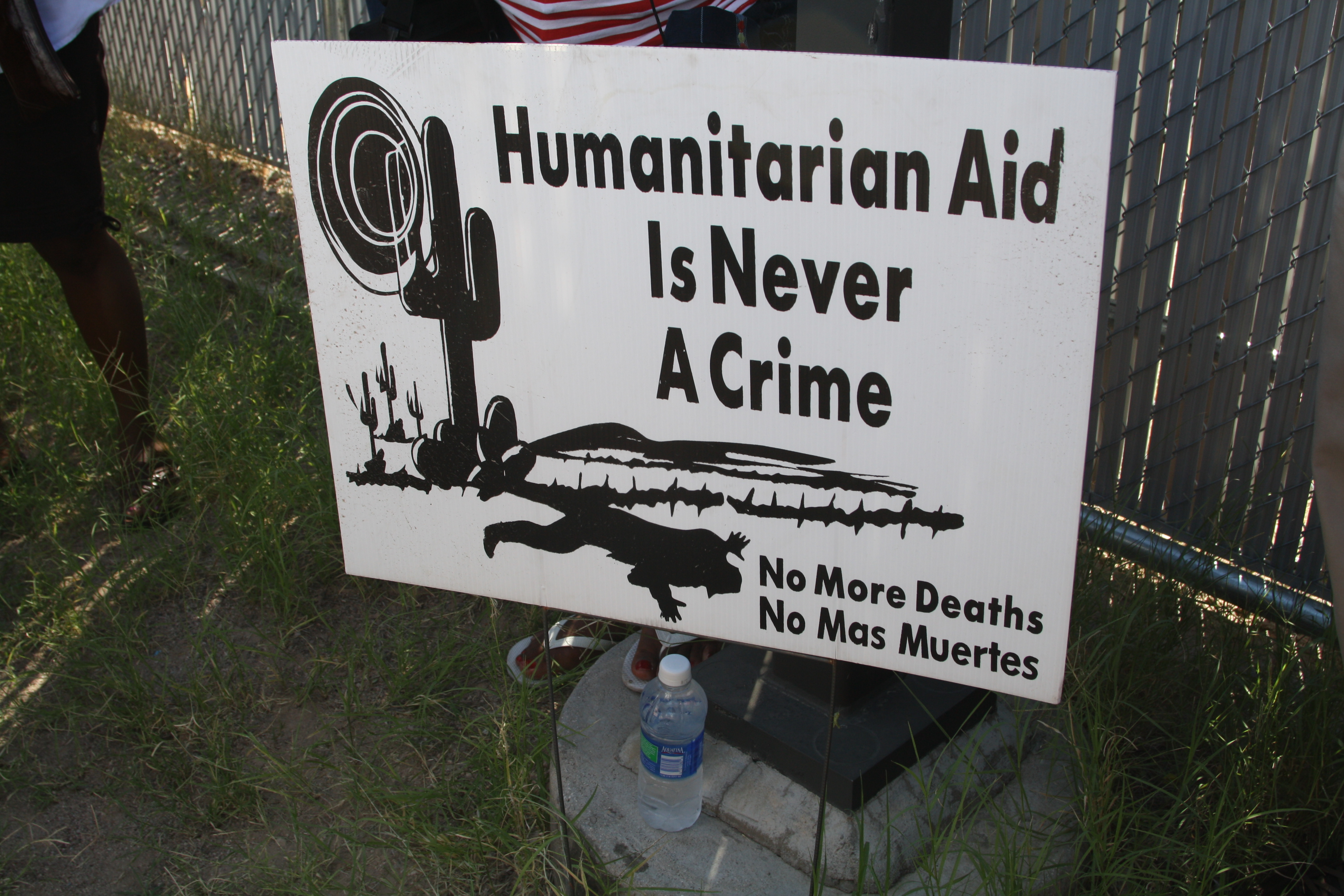
Humane Borders

image

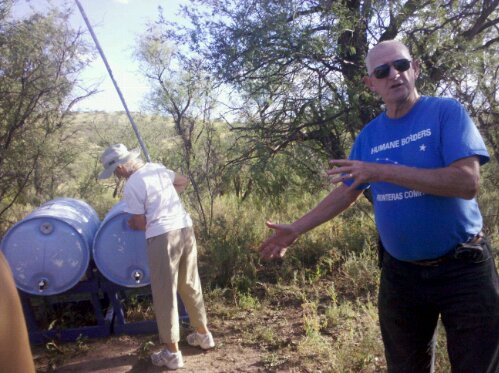
Meet Lois Martin and Gary Wolf. They’re volunteers with Humane Borders, a group in Arizona that puts water stations in the desert so that migrants who are traveling into the US will not die of thirst. Their work is legal — they emphasize this repeatedly because, apparently, some people think it is illegal to give out water to prevent death.

Dehydration is the leading cause of death in the desert and hundreds of people die every year for lack of water in the vast Arizona desert.

There were about 15 of us in the community developers group who visited the water stations. Two among us told how they had crossed these very same borders from Mexico, in the cool of the night, running, one as a girl and the other as a young woman. They are now both documented US citizens.

The Humane Borders volunteers reminded us that people cannot be “illegal.” People are people. Rather, they are people lacking documentation.

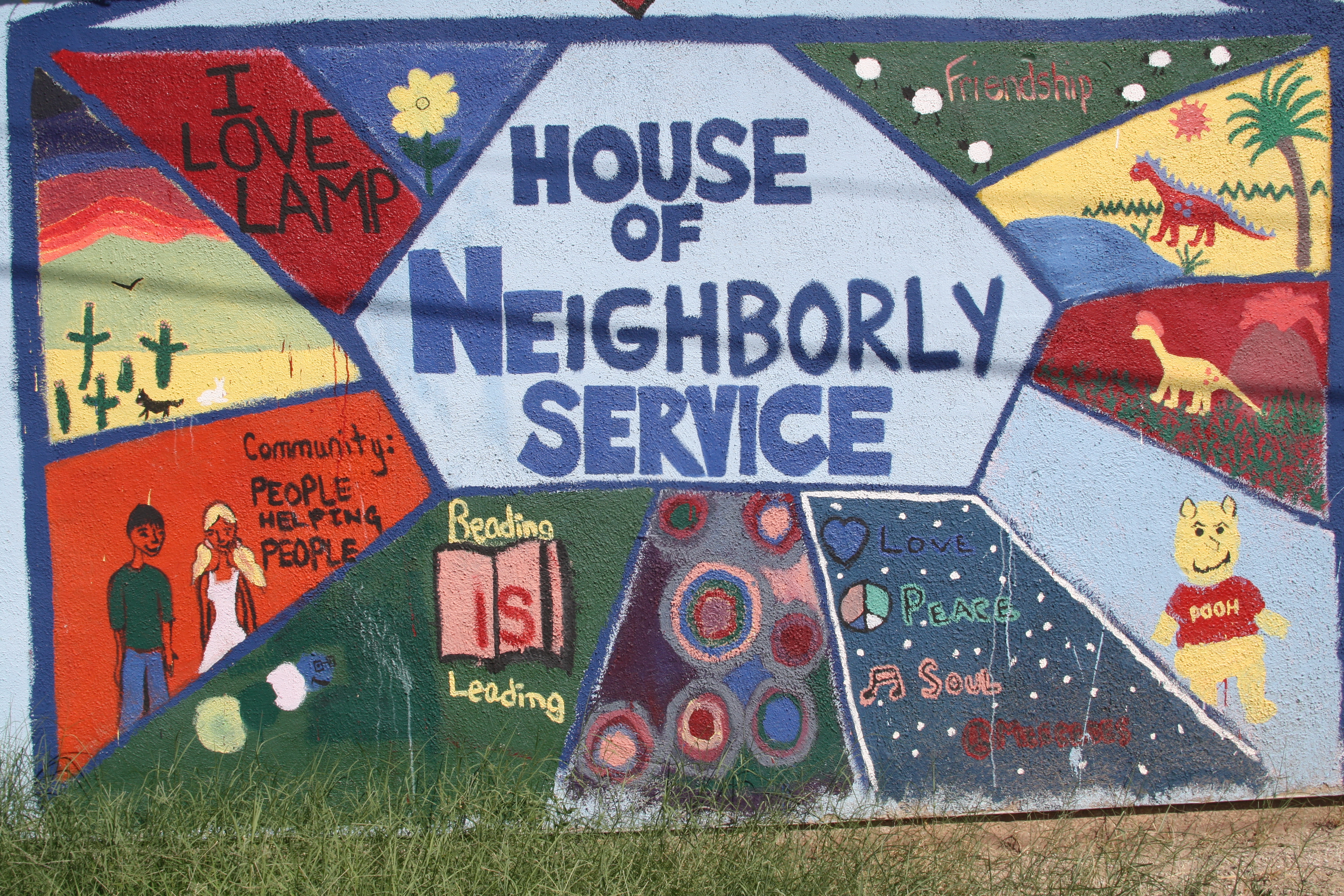
Mural on the wall at Humane Borders

Most migrants come from countries beyond Mexico. Imagine the journey.

This was the first day of the “Let’s Get Radical” event for community developers in Scottsdale, Arizona, when more than 70 community developers traveled to Tucson to visit this group, Humane Borders.

Rev. Robin Hoover, Humane Borders President, First Christian Church Pastor, taking a group to the Mexico/US border, discussing immigration, compassion, providing water.

A handful of our group went into Mexico with the Humane Borders president, across Nogales, AZ to visit the tents of compassion, weigh stations run by Catholic nuns, who minister to those who are ejected from the United States, dumped back on the Mexico/US border, with blisters on the feet and no money in their pockets.  The nuns and volunteers do what they can.

Bishop Minerva Carcano of The United Methodist Church spoke about working in the tents of compassion. She told how she met a family in the tents — a father and two young children, Melvin and Joslyn. The bishop played with the family and laughed with them.

“It is an amazing journey that these brothers take. They take the journey depending on God. We do stand on the word of God. Leviticus 19:  ‘You shall not oppress the immigrant. You shall welcome that immigrant as a citizen. … and you will remember you were an immigrant in the land of Egypt.’

As she left, she gave money for the small family to the father. As she walked away, she heard others say, “Gracias, mi hermano.” The father had given the money to other migrants in the tents.

“I felt I had seen the face of God,” the bishop said. Having so little, that father shared so much. (This, like many stories at the community developers’ event, made us cry.)

Community Developers group -- Mary Beth, Monte Payne, Tonia Rios, Humane Borders volunteer Karl Tucker, Malik Saafir, Rhonda Robinson

I was with the group that visited the water stations. The blue flags that mark their locations may be torn or full of bullets but the Humane Borders workers continue to check the water supply underneath the 100 or so flags in the desert. At times, they move the water stations to optimize giving (and perhaps avoid entrapment of migrants by the minute men or border patrol?)

“Minute men are right-wing whackos….Its an evil, evil, evil mess,” Karl Tucker, our volunteer, said.

We ended the day-long trip with a visit to Sasabe, Arizona. There were no people anywhere, except for about six border patrol officers, one of whom wielded a huge gun.

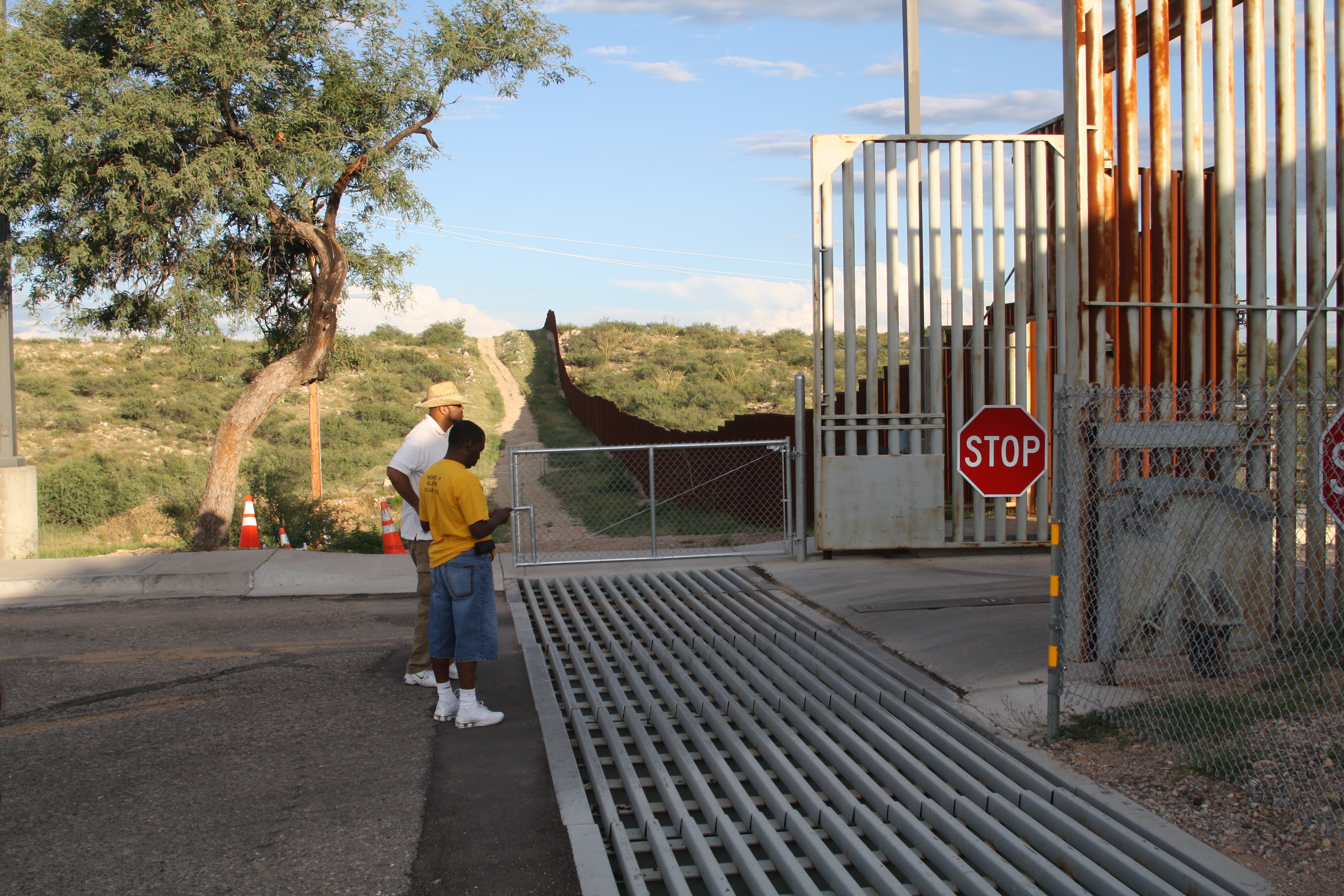
Community developers approach the wall.

The diminutive, yet powerful Lois Martin requested and the officers agreed, to let us approach the wall.

It was shameful that this is how we, the US, ‘welcomes the immigrant’. We give them a wall and tell them to keep out. Whatever happened to:

“Give me your tired, your poor, Your huddled masses yearning to breathe free, The wretched refuse of your teeming shore. Send these, the homeless, tempest-tost to me, I lift my lamp beside the golden door!”

No, there is no lamp beside a golden door. There is a wall. At least there is water. And people like the Humane Borders volunteers who give small comfort. And in so doing, they save lives.

http://gbgm-umc.org/global_news/full_article.cfm?articleid=5846 is another article about the day to Humane Borders posted on the General Board of Global Ministries website.

Went Missing

My young adult novel, “The Missing Twin,” went missing. I had been using my Swiss Cheese method of writing — punching a hole in the ‘durn thing for 10-minutes a day for several weeks. I’d written it in the flurry of NaNoWriMo last November and been editing in dribs and drabs since then.

I want to write another novel this November so I desperately want to put last year’s novel, “The Missing Twin” to bed. But the editing is hard. And my baby won’t go to bed, she’s not even sleepy.

NaNoWriMo was simply one of the best writing experiences I’ve ever had. It was communal. Tens of thousands of people are writing a 50,000-word novel for 30 days. You can chat with people on Twitter who are going for the same word count. But, alas, writing is more than word count. Sadly for me, because I can pile up words pretty quickly. I type superfast. Even faster than I can think. But editing takes time and thought.

I have to get back to telling you about missing my “Missing” novel. But it’s hard to write right now because the flight attendant is pleading on the loud speaker, “Is there a doctor? Nurse? Medical professional on board? We have a medical emergency.” Sheez, this is stressful, wondering what’s going on. Hoping it’s not serious. But the urgency in the flight attendant’s voice says it is.

Okay, stay focused. So, I thought I packed my novel in my bags when returning to NYC on Labor Day. I’d been traveling with the white binder back and forth up to the Adirondacks every weekend of August. I would do my 10 minutes a day, then put it away. I’d read and marked up about two-thirds of the blasted thing. But I couldn’t find it anywhere in the apartment.

Update on the medical emergency: the flight attendants are getting the big black CPR Kit box out from the luggage rack. I’m kicking myself for not ever training to become an EMT. There seemed to be no doctors or nurses on board just two young-ish, reluctant people, a 20-something Asian woman and a 20-something clean-cut White guy, came forward shyly. Medical students, I’m guessing.

So, the other day on the phone, I asked my husband, Chris, to look around the Big House for my novel. (He was directing the play, “Good Night Desdemona/Good Morning Juliet” at the Depot Theatre and stayed in the North Country.) I thought I left it on the floor near the couch in the bedroom (all important things lands on the floor near a couch!).

“No. Can’t find it,” he said.

Update: The flight attendant and the medical-type people appear to be giving oxygen to the young man in medical distress.

Just before the flight took off, I checked my messages. Chris left me a voicemail, “I found it. The white binder was on the floor in the closet.”

Chris found my “Missing” novel. (He’s good at finding lost things!) It’s got to come out of the closet! I kind of wished I’d lost it for good. Then I’d have a good reason to abandon it.

I do want to find out how it all ends. So I guess, I’ll return to reading, rewriting, editing the novel. Right when I get back from this business trip.

Final update: “He’s doing better,” says the young woman to the flight attendant who’s now carrying pillows back to the galley where the medical and flight team are huddled. Thank God. Turns out this teenager hasn’t eaten or drank anything for several days.

Advice for the traveler: Everyone, please hydrate before you fly.

And keep your novels close at hand.

This is where I am as I upload this, early morning Scottsdale, AZ.

10 minutes a day

I work on my unwieldy novel most days for so little time. It’s the Swiss cheese method of writing. You just poke a tiny hole in the task. You punch a moment into that insurmountable infinity.

I read this method in Alan Lakein’s book, “How to Get Control of Your Time and Your Life” a long time ago when I was Barbara Weaver’s assistant in the Women’s Division. Sometimes I wish I was somebody’s assistant again. More often, I wish that I had an assistant!

“The underlying assumption of the Swiss cheese approach is that it is indeed possible to get something started in five minutes or less. And once you’ve started, you’ve given yourself the opportunity to keep going…Swiss cheese is supposed to lead to involvement,” Lakein says. I’m not so sure.

I start my Stopwatch app. And I glance at the numbers. Occasionally, I will go past 10 minutes, but usually, I watch the time flip over to 10:00 and then I go, “Phew.” I put the novel away. The Swiss cheese method has not led me into the zone. I do love to enter the flow of writing — when time passes without being noticed. When writing is bliss. I like that. But it’s okay when it’s Swiss cheese too. It’s something. It’s edible.

NaNoWriMo Again

I love writing.

Revising? Editing? Not so much.

I love the act of creating. When I was on my sabbatical, writing a blog post a day, I was in heaven. Always new. Always thinking. Always up for another cup of coffee. Hit the Post button. I’m done. I wrote it. I’m brilliant in the very short form. The long form. Ugh.

Last November, I wrote a novel in a month. NaNoWriMo. Na=National, No=Novel, Wri=Writing, Mo=You get the idea.

I wish that I had as much gusto for editing the book these last 10 months as I had for writing the book in that one month.

So it is with any big achievement.

Everyone’s up for a wedding, but who is up for the day-to-day of marriage? Helping the newlyweds redecorate or navigate their finances? Nah! Everyone loves to celebrate the baby’s birth, but the grueling day in and day out of diaper changing? Not for the faint of heart. No big balloon bouquets for the daily slog. How about graduation? Heck, I’d love to send the graduate a card with a few bucks tucked inside! But help her in the days, weeks, months ahead as she’s looking for a job? Not really feeling it.

I honestly never felt so purposeful as I felt writing my novel last November. Never felt so accomplished as when I finished it. I made myself cry (but if you know me, well, crying’s my forte.)

Loved the challenge of reaching 75K (or was it 50K? How soon I forget) of NaNoWriMo. I loved the support, encouragement of my cyberfriends and my real family.

Charlotte quieted the other two, “Shhhhh, Quit fighting. Mom’s writing.”

Hayden bragged about me at an all school assembly.

Catherine brought me a cup of tea, then backed away like a geisha girl.

But the month was over. Weeks turned into months. It’s almost November — time to start a new novel. How can I start another baby when I haven’t completely finished the last?

I opened the humongous file of the 2009 NaNoWriMo winner, stared at the screen. My fingers lay dormant.

After a while, “What are you doing, Mom?” My head was on the keyboard.

“Thinking about my novel,” I said.

“I thought you wrote that book already, Mom,” Char said.

“I did. But now I have to rewrite it,” I said. Honestly, I have to — not only rewrite and edit it, but I have to start to read it. I can’t even remember my main character’s name. I wrote those 175 pages in November as if in a trance.

Hayden walks by carrying a plate of Bagel Bites. “Your book? Mom, when is your book coming out? I should make an announcement at school again,” Hayden nodded.

“Oh, it’s not done.”

“Really?”

I don’t know. Maybe there’s someone somewhere who actually spews out words and doesn’t have to rewrite them. I wish that was me. But that ain’t me — Gotta rewrite this part! Got to, rather — That isn’t me.

I need to brew and stew and revisit. Ah, maybe that’s how I can get back to the novel. See it as a little visit to a world I once knew and loved and forgot. Like remembering the high of a wedding, a birth or a graduation. Rest on achievement represented by that one big day, but don’t let the one big day stop me from really living the one big life. ‘Cause life is an accumulation of days, some big, some small, mostly average. That’s what writing and editing is – the daily grind, no big who-ha! And I’d rather party, but I’ve got to slog.

I am challenging myself to read my 2009 NaNoWriMo novel and edit and revise for 10 minutes every day until November when I begin a new novel. I will try to periodically check in here and post progress. That seems to have been a successful way to get myself to start running; the semi-public act of blogging about running has made me a more consistent runner. http://runningaground.wordpress.com/

Maybe the semi-public act of writing about novel writing will make me actually work on my novel. If you think this is true, see an earlier blog post where I have considered doing this in April. http://gettingmyessayspublished.wordpress.com/2010/02/27/nanoedmo/ It’s just easier (more fun!) to write than edit.

Writing Childhood Memories

Loved teaching “Food and Faith” at St. Paul and St. Andrew’s last Sunday.

I love that childhood memories are treasure troves, little magical boxes full of light. Memories point our way. Remembering where I come from reminds me of where I am going and who I am.

One exercise in my workshop was to write about a childhood memory of food that brought you closer to your family. I wrote about my Norwegian grandmother’s Christmas lunches. The open-faced sandwiches. The mutton, head cheese, slim-sliced hard-boiled eggs. The meatballs. The herring. It was the one day a year we all sat down to eat on Grandma’s enclosed porch together.

In the workshop, Barbara wrote about her father teaching her to count by planting seeds in the garden. Memories are like shoots of green. The memories are the parts of the plant that are still showing. The memories lead to an ancestry that lies buried deep in the soil, connecting us to relatives who are long gone.

Writing down the memories of family meals or family gardens takes you back and takes you deep — into the heat of a summer garden in Pennsylvania or the  bright light of Christmas in Chicago.

Writing down your memories reminds you of where you come from, who you are. Writing takes you home.

The End of Men?

A report by Hanna Rosin in The Atlantic‘s July/August cover article, “The End of Men,” subtitled “How Women Are Taking Control — Of Everything” is so good. http://www.theatlantic.com/magazine/archive/2010/07/the-end-of-men/8135/

The previous month’s cover story, “Fat Nation” with an obese Statue of Liberty on the cover was also really provocative. The magazine is just so good at noting and analyzing trends in the nation. I love following trends. And this one’s pretty interesting.

One trend noted — and I so hope this is true — is that companies are looking towards an effective and new kind of leader, a transformational one.

My one worry about women taking over is that I like partnership. It’s cliche but it’s true. “Don’t walk ahead of me, I may not want to follow. Don’t walk behind me, I may not want to lead. Just walk beside me and be my friend.” I thought that equality — not superiority — was what the women’s movement was all about. That, and equal pay.

I still think that’s what it’s about. Because while I am excited that women are taking over, I know that women are not being paid fairly for their new leadership and on-going labor. Women are still paid about 80 cents to every dollar that a man earns. Until there is no wage gap, men are probably not too worried that their end is near. Although, perhaps, it is.

Wired to Care

I had an absolutely awful day at work last week. And I felt, “Shoot. My problem is that I care too much. I like getting a gold star. I like being appreciated. My caring for others, wanting them to care about me — This is my failing, my Achilles Heel. I should care less. I should be crabby. Then people will respect me. I will definitely get ahead if I am critical and negative in my job, instead of being caring and collaborative.”  

My sister has said that she and I are alike, “We are just wired to care.” Then I saw that same expression – Wired to Care — in someone’s Twitter feed. So I followed the link to this lovely website, promoting a book by the same name. (And as I’ve mentioned on this blog, I like reading book reviews and visiting book blogs and yes, occasionally, I like reading books too!)

http://www.wiredtocare.com/

On this site, the author of the book , Dev Patnaik, talked about how corporations like Target and Ford have discovered that if their employees care about their customers, care about their products, care about one another, the workers are more productive. I’m sure the workplace is more pleasant. Why does the power of empathy surprise me?  

My mouth hung open as I listened to Dev talk. I had to Google a management expert to be reminded that kindness and caring, these are not failings, these are assets. And companies like assets.

At St. John the Divine Church, about a year ago, I heard another lovely, smart person, Sharon Salzberg, talk about the Buddhist practice of Loving Kindness. In fact, she wrote a book called, “LovingKindness.” This is an excerpt:

http://www.beliefnet.com/Faiths/Buddhism/2000/07/Learning-About-Lovingkindness.aspx

I am glad there are authors and smart people promoting the practices of kindness and empathy in homes, schools, workplaces. It takes courage. And it affirms my way of being in the world, my way of caring too much. I have to admit that at times, I am afraid to be empathetic because my colleagues may see me as foolish or intellectually light-weight, neither of which I am. Should I turn cynical and critical to earn respect? I don’t know. I am trying to figure this all out.

Until I do, I will practice empathy and I will practice lovingkindness. It may not get me very far, but then, maybe it is about how you get there and not getting there. The journey and not the destination — And all that crap.