the day darkens. i get too tired. i find the housework oppressive.
i ask for help, then don’t want it. like in the decluttering. i don’t know why it bothered me. what to do with the tapes from my old show? leave me alone.
Snow day in Riverside Park via mbcoudal
the snow — more of the same color of the same grey sky.
i like when the sky is a crisp blue, like today. then i can forgive the weather gods. i can go on. but when dark and grey, i want to stay in bed. i have only a few weeks left of winter. i would like them to be azure blue.
i would like blue sky days. but after all the grey — why is grey so like death?
i go to Florida — old people, malls, alligators.
for a few days, i sleep in a twin bed, and laugh with Nicole and my brother, (and dad and Marty). we talk about creativity.
Lower school sunset in Riverdale via mbcoudal
that is the start of my spring. and that is followed by the buds on the trees in Riverside Park.
my kids get older, get away from me, find fault in me, our apartment, why don’t we have nicer floors?
the sun does not ask for thanks. so i try to just give light too. just do my job — mother, wife. but the endless giving becomes a chore.
sure, the sun must want a thank you. the grey day gets no thanks. for it takes my energy. it does not give. it is the negative ion. i need the positive.
the wind whips and the shadows blend into dark night. i know spring comes after winter, always taking me by surprise. then the summer. lighter, longer days of laughter, hugs.
we are destined for spring.
Laughter is the language of the soul (Photo credit: symphony of love)
First of all, it is always amazing to see respect lauded on a writer.
Respect is not why I write. But I have to admit that reverence for a writer – in this case, P.L Travers, the author of Mary Poppins, a children’s book, is a rare and beautiful thing.
Women as Creative Team Leaders
From a feminist perspective, I loved that the men, even the studio head, the great Walt Disney himself, deferred to Travers. Of course we all know men who defer to their female bosses or wives or business partners. It should not be an oddity. But somehow, the world has turned and I rarely see men respecting women in mainstream movies.
Maybe because I have teenagers I am overexposed to hyper-sexualized women in the media on awards shows – too many women rock stars wearing lingerie while the men wear black tee shirts and jeans.
But seeing Travers run the show? Well, that was just amazing. She is occasionally arbitrary – but what genius is not? Emma Thompson is brilliant at creating this very real, flawed, lovable, cold writer.
Explaining Mary Poppins
I loved, too, that Saving Mr. Banks explained why Mary Poppins does not change as a character. Like everyone, I love the Julie Andrews movie. But it’s always bothered me that Mary Poppins does not change – she does not become more loving or more interesting as the film progresses.
Her character does not go through the fires of some great conflict and come out the better for it. This movie explains why. She is the agent for other’s transformation, not her own. Change is reserved for Mr. Banks, the father, an idealized version of Travers’ father.
Becoming More Loving
Our Travers gently returns to being an imaginative and playful person. This transformation into a loving human being happens in small ways. Our hero here does not suddenly turn around and become a fabulous new person.
This is a subgenre of movie I happen to love — watching characters return to love — like the movie based on C.S. Lewis’ Shadowlands.
English: Screenshot of Julie Andrews from the trailer for the film Mary Poppins (Photo credit: Wikipedia)
What About Mrs. Banks?
Now, you know, I have to find something not to love. I did not love that Travers seemed to be seeking to come to terms with only her father. What about her mother? She certainly was equally complex. Is the mother not as curious and exciting and crazy a character to explore? Or are men more enigmatic? Why must it be the father we need to heal?
The Treasure Trove of Childhood
I, like Travers, have a treasure trove in my past – a childhood of great love, adventure, and benign neglect. But it is in from this personal history that so much creativity can spring from.
This book reminded me of Alice Miller’s Drama of the Gifted Child, a psychological text that explains why overly sensitive children do not have a full childhood as they are always in tune to their parents’ struggles. Then, as adults, they are adrift. They are less inclined or able to explore their own lives. I think about this from my own story and from my children’s reality.
There are times that I, perhaps due to Chris’s Parkinson’s, as a parent, turn to the children for more support than maybe they need or want to give. And then there are times, too, I just let them off the hook — but that’s another story. Or maybe it’s the same story. It’s the story of excessive attachment and then, benign neglect. I console myself with the certainty that great creativity can come from a troubled childhood.
You should see — or read — this story. Think about it, talk about it — about respect for writers, women as creative leaders, the importance of childhood, and what makes for creative genius.
Like 20 years ago, I was temping at a bank in New Rochelle. I was working for a banker — I forget his name — but he was younger than me by a few years. But he seemed older. He was getting over some kind of cancer. He used to buy me lunch almost every day. He seemed confused by me.
Then, he told me why. “You’re the nicest person I’ve ever met.”
“Really?” That seemed weird. I’m no Mother Theresa. I get impatient and insecure on a daily basis. I felt sorry for this banker — I mean, if I was the nicest person he’d ever met! Well, that just seemed sad.
Still. Nice gets a bad wrap. I remember in the book The Happiness Project when Gretchen Rubin is super-nice to everyone in her life for a week as a path to happiness. No one really notices her niceness and she’s glad when the week’s over ’cause it feels like kinda a waste of time. And niceness requires a lot of effort.
I have felt that my niceness is, at times, perceived as stupidity. (Especially at work — when the cynical males were perceived as smart and the young female optimists were seen as fools. Well ha! Fools have more laughs than cynics!)
I can’t help it. I am compulsively nice. And this kind of “nice girl” syndrome has cost me. Maybe in being nice I have swallowed some honest emotion.
Still. In the long run, I’d rather be overly nice than overly critical or mean.
My daughter and I had a screaming match yesterday and she accused me of being so mean. And ugh, that hurt. In a quieter moment, I asked my husband, “Was I mean?”
“When you two lock horns, no one wins,” he said. Which, I think, meant, ‘Yes, you were unfair or unkind.’ Hey, I thought, I’m sorry. And you only hurt the ones you love.
I don’t want to get into the deets of the argument, but my daughter and I talked it out later and we both promised to do better next time — to give each other a little more patience and more room to breath. Tough stuff. At least for me. Me? The nicest person you’ve ever met.
I have blogged about this before. And interestingly enough, I also wrote about my daughter four years ago in the blog post the power of niceness. I, then, too, referenced the Happiness Project and my resentment about workplace sarcasm winning over niceness. Weird. Four years later. I’m writing about the same stuff.
Off and on, since September 2012, I have been on unemployment. I have also worked as a substitute teacher, after school teacher, tutor, videographer, journalist, copywriter, workshop leader, graphic designer, photographer, and more. I like doing a variety of work.
I have wanted to get my small biz off the ground, providing coaching for writers and creative content for companies. Yet unemployment stipulates that you mustn’t start a new business, only look for an existing job. Otherwise, it’s fraud, my friends.
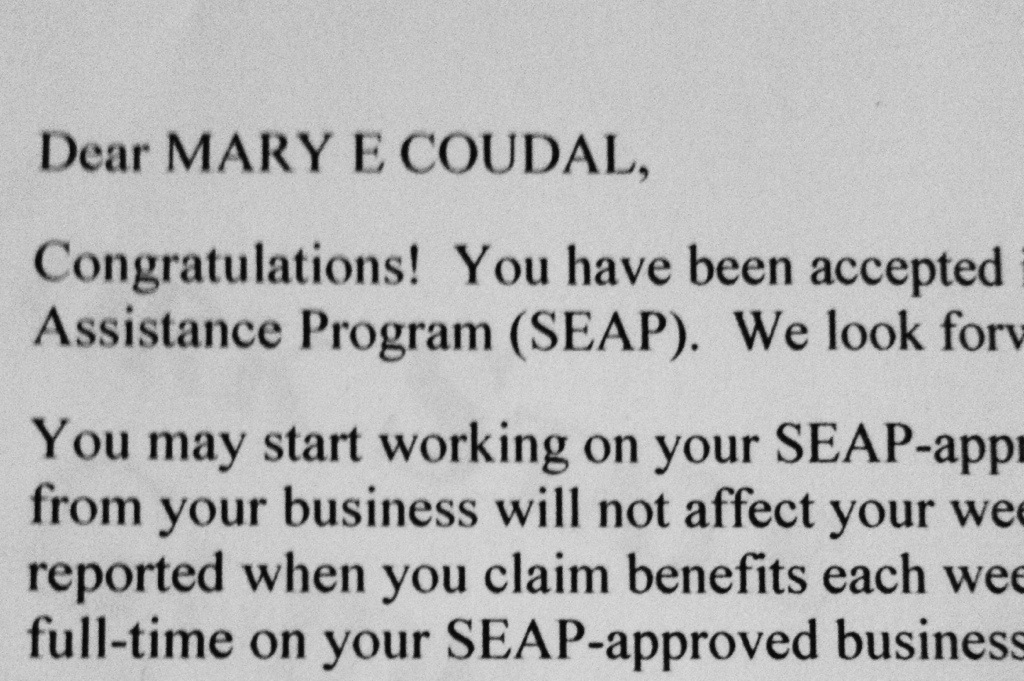
So, what to do? I just found out this week that I am accepted into the Self Employment Assistance Program, SEAP, which means I have to take 20 hours of entrepreneurship classes and meet with a mentor a few times. I have to fill in a bunch of progress reports. In return, I can receive full unemployment benefits for another four or five months, and keep my earnings from my biz.
I have had an entrepreneurial streak since I started babysitting at 12. Even before that, at 10, I started a nursery school with April Fisher. We set up a blackboard in my basement. But one morning, before our neighborhood kids arrived, April and I messed around, wrestling, and I broke my hand, and any way, our summer school was cancelled.
My next biz? In high school my dad had a newfangled personal computer as big as a pony, whom we fondly referred to as Norty (for NorthStar). I intended to start a label-making company. I did not get past the company-naming part of a small business. I came up with the name, get this, Ready, Willing, and Label. Clever, no? See, I was always good at snappy prose.
In college my best friend and I started a biz, selling earrings on a corner near Tower Records in the Village. We made and sold earrings from pieces of film we swiped off the editing room floor. We never really got that biz off the ground, but again, you can see, great idea.
So, I’ve always loved freelancing and starting companies.
Now, back to unemployment, the last time I reported to the office on Varick Street, I was among about 40 people — the majority of whom were middle-aged white men. I thought why don’t they just group us by our skills or areas of expertise and we could start our own companies? Or at least schmooze?
I became eligible for unemployment over a year ago, when I took the company buyout, offered to all of the 300 or so employees of the global agency of the United Methodist church. I basically knew that jobs in communications would be shuffled and that my position as staff writer for the mission agency was precarious. (After all, why pay tens of thousands for a salary when you could pay a couple hundred per article?)
My particular buyout offer at GBGM came to about eight months pay and the possibility of unemployment. I took it. And it turns out, I’m glad I did.
Because just this week, my dream came true. I’m a legit small business start up. And this time, I won’t mess things up by wrestling with April Fisher before the day starts and breaking my hand and having to cancel the whole damn biz.
My old workplace at the Interchurch Center in New York City (Photo credit: Wikipedia)
I chatted with Vonnegut once in the early 90s when I was performing stand up at the New York Comedy Club. It was like a Thursday night at 6 pm. He poked his head in the club and asked, “What’s going on in here?”
“Comedy. Women’s night. Starts in an hour.” I told him. “Come to it.”
“Sounds great,” he said or something like that. I was totally impressed and told the couple of jaded comedians at the bar, “That was Kurt Vonnegut.” They nodded casually. Stand up comics do not swoon. But he didn’t come back.
Then a couple of years later I was having a party with Dan Wakefield at my house and Wakefield had invited Vonnegut. Vonnegut called to say he was sorry but he couldn’t make the party. I think he had a cold. “That’s okay,” I told him. “Feel better.” So basically, I had a few near misses with the great man.
But I feel I got to spend time with him when I read this new collection of commencement addresses, edited by Wakefield, If This Isn’t Nice, What Is? Advice for the Young.
In the forward, Wakefield points out that Vonnegut took part in his communities. Like, he was in the Volunteer Fire Department and taught a Great Books course with his wife. Vonnegut extolled compassion and neighborliness.
Each talk is unique. There are several themes, one of which is how Jesus slammed down the Code of Hammurabi (an eye for an eye).
“When Jesus Christ was nailed to a cross, he said, ‘Forgive them, Father, they know not what they do.’ What kind of man was that? … Bye-bye, Code of Hammurabi. And for those words alone, he deserves to be called ‘the Prince of Peace.'”
And Vonnegut, a humanist, hands us funny twists on Christianity. “‘Blessed are the meek, for they shall inherit the earth. Blessed…’ Not exactly planks in a Republican platform.”
And here’s Vonnegut’s son’s advice: “‘Father, we are here to help each other get through this thing, whatever it is.’ So I pass that on to you. Write it down, and put it in your computer, so you can forget it.”
I know there’s a winter wonderland outside my New York City apartment today. I took this pic of Riverside Park last night with my iphone. I have no idea why I’m writing about Vonnegut now. Except I started this post a while ago and I’m cleaning out my blog’s dashboard. It just seemed like today was a perfect day to read Vonnegut and Wakefield.
I am a lighthouse. I stand tall, watch for shipwrecks, give light.
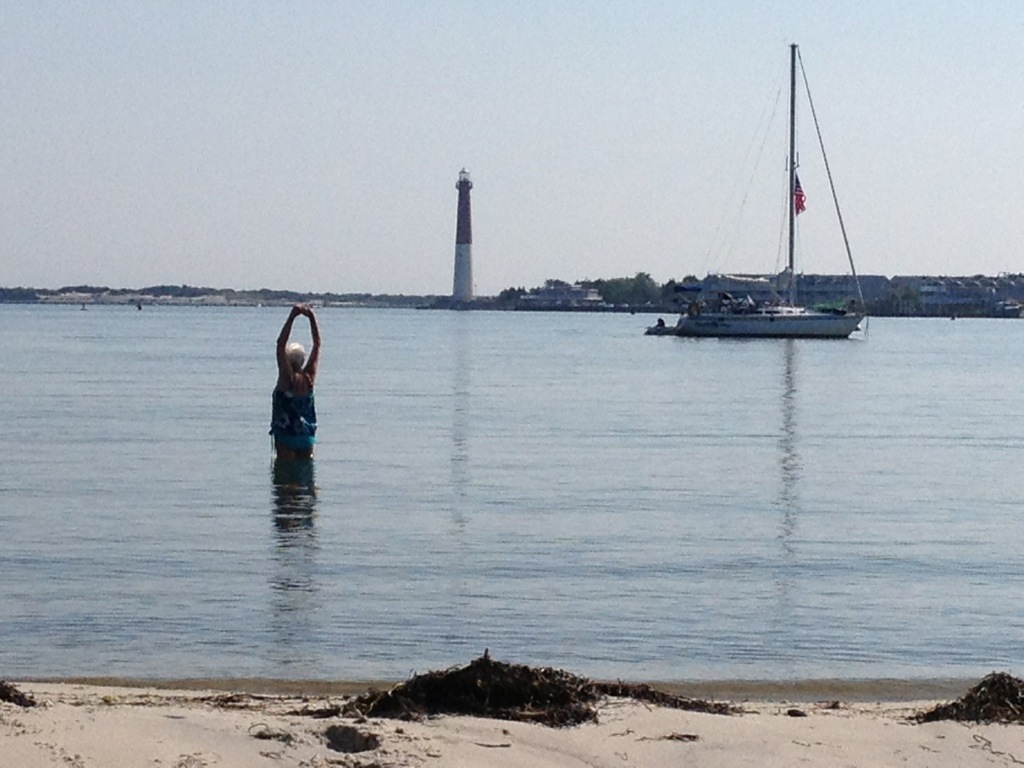
Barnegat Lighthouse. On the night of the full moon, we climbed the 217 steps.
Earlier in the day, we’d walked to the lighthouse and I said, “Let’s walk out on the jetty.” But we didn’t.
In the morning, my mother stretched in the bay. I think she missed her daily Chicago yoga when she was visiting me on the East Coast. At the bay beach, mom was bitten by little bugs and wanted to go to the ocean side and so we did. She left for the airport at lunchtime.
That night of the full moon, we climbed the lighthouse steps. I told the girls, “Go ahead! Scamper up! I am going to take my time.” I got dizzy in the spiral staircase. But I love spirals.
All the metal, echo-y steps were the same. Looking up and looking down were the same. It was hard to orient myself.
I think I would like to live in a round building. When my son lived briefly in a yurt at camp, he said there is nowhere to hide when there are no corners in your cabin, so campers were more engaged in conversations. And he said, that campers were closer to nature, and could hear people talking outside the yurt.
Maybe round structures like yurts and lighthouses are more a part of the elements. Round buildings fit in better with nature, like tree trunks and whirlpools. And spirals.
The girls stopped in a windowsill and asked me to take their pic. The flash blinded us.
We waited about an hour to climb the stairs of the Barnegat Lighthouse. It was worth the wait.
While standing in line, I thought about the last time I was at Barnegat Light with my son. We kept singing the jingle, “Stronger than the Storm.” And I thought, maybe I don’t always have to be strong. Maybe it’s okay to be weak or vulnerable. What’s so great about being strong? That’s a very male quality. How about I value a more female quality — being soft and round, like a mother?
Every night the sun sets on Barnegat Light.
Yes, I know the sun sets and the moon rises everywhere. I just don’t notice it. Maybe I am not a lighthouse after all.
The full moon rose as we waited to climb the lighthouse steps. And then it followed us home and hung around all night.
I thought when I left my job more than six months ago, I wouldn’t know what to do with myself. Um, not so much. As my friend, Linda B. said, “Looks like you’re having fun!”
Work is overrated. A regular paycheck definitely has its benefits, but there are way more valuable assets than money. One of which is time. I have had time, especially recently to visit with old friends.
On one of these scorching hot days, we walked the High Line, the public park converted from railroad tracks. After walking this path from 30th street for a mile and a quarter down into NYC’s trendiest neighborhood, MeaPa, (the meat packing district), we stopped for brunch.The flowers on the High Line are lovely.
Besides time with friends, there’s something I’ve come to treasure lately: time alone — to read and paint.
Book club seems to be on a summer hiatus. I’m a huge Kindle fan, but I’ve rediscovered the joy of books: all kinds of books (don’t judge me): feminist, erotic, non-fiction, self help.
These three books are on my bedside. And I started the Pulitzer Prize winner, Middlesex by Eugenides too. (Lest you think I’ve lost my literary bent.)
I love to make collage art and book journals.
I started taking class again at Art Students League. You receive very little instruction, but you get a ton of inspiration. Here’s a little project I worked on.
I collaged two small boxes to send to my darling girls at camp.
And then of course, I work on my biz, Boot Camp for Writers, teaching memoir writing workshops. I love teaching and writing. It’s really all I want to do. Well, that and walk the High Line, visit friends, make art, go to the theater, perform improv, make short films, and read books. That’s all.
Last night we saw A Little More Than You Wanted To Spend, a funny, sad one-man show with and by Chris Clavelli about the death of his 6-year old son Jess.
This sucks. I mean the play is awesome, but the show reminds you that life sucks.
Life is a total crap shoot. You get shit. You get joy. You live. You die. Other people live and die too.
You have to talk about it. You have to write about it. You have to tell about it. You have to live it. You have to make something, maybe theater, out of it.
The sucky part, sometimes, is living on and getting up when you feel like curling up in bed and not getting up.
***
Taking the garbage out last night with my daughter Charlotte, one of our neighbors, a former Hollywood starlet from the 1950s (and this is not even giving her away because we have several senior actresses in our building), asked me, “How’s your boyfriend?” or something like that.
Charlotte looked at me quizzically.
“He’s doing good,” I said, about my husband. “He’s got a great creative spirit. Is directing a show upstate this summer.
The former starlet said, “He’s wonderful. He’s got a twinkle in his eye and great artistry despite the tragedy of his life.”
We said good bye at the recycling bin.
“What did she say?” Charlotte asked. “The what of his life?”
“The tragedy. I suppose, she meant the tragedy of his Parkinson’s diagnosis,” I told my daughter.
I don’t think of my husband Chris’s life as a tragedy.
This is not the first time a neighbor has used stark terms to refer to my husband’s disease in front of my kids. I guess, in the dailiness of life, the reality of Chris’s illness is not a tragedy, it’s normal.
It is not always a comedy, but tragedy? I don’t know. Chris feels he is lucky. He feels there are worse diagnoses.
***
This is the second time I’ve seen Clavelli’s play. It’s blown me away. Made me laugh and cry.
I am friends with Clavelli, and his girlfriend Leonisa, who funnily enough, was my work out buddy at my former workplace, before she and Clavelli got together.
The play reminded me to hug my darlings, to love the people in my life, to laugh and cry with them, to talk about truths, to listen to other people’s truths, to make art.
When someone tells their truth, I can’t argue or judge. Hearing someone’s truth makes me want to tell my truth. Because, I know, making art is a way of healing.
Life is a tragic-comedy.
***
Any way, go see Clavelli’s show. It’s really good. It’s only running in June in NYC.
the Connected Life, getting my kids off technology
A Church A Day, on trying to find meaning by visiting a church a day.
Now they’re all rolled into one (thanks to web developer extraordinaire Felicity Fields). This one, To Pursue Happiness, is about those four goals and the primary goal: to stay happy.
I pursue happiness though I may have absolutely no reason or right.
I feel a loss that my kids are growing up at lightning speed. I feel a sadness that my husband is increasingly challenged by his Parkinson’s Disease.
While these are challenges, they don’t define me. I don’t have to enter or stay in a place of permanent sadness or loss. Life is about what you do with the hand of cards you’re dealt. And I’m dealing.
I’m thriving. I’m staying honest. I’m finding joy. Two great joys in the last couple of weeks were:
Curtain call at the Listen To Your Mother show
As a cast member of Listen To Your Mother at Symphony Space
As the leader of Artists’ and Writers’ weekend in the Adirondacks.
I was anxious about how these would turn out. Would I deliver the goods? Could I? I did!
In these forums, I could be honest, funny, and surprising.
I could write about and share a lot of feelings, including but not limited to sadness or happiness. A range of emotions, even ambivalence and anger, is acceptable and encouraged in my writing.
So while I still do feel, at times, lost, I can find myself through writing and in the company of other women writers. That’s how I pursue happiness.
***
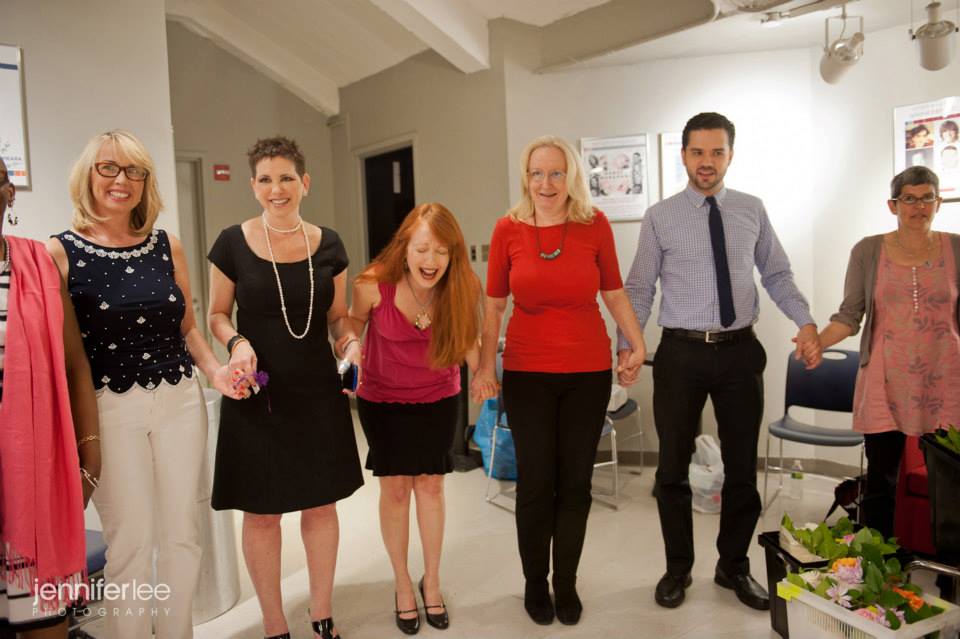
Before the Listen To Your Mother show, the cast warmed up. And that’s Shari Simpson-Cabelin, assistant director, doubled-over, laughing. (I’m in the white pants.) (Photos by Jennifer Lee)
At last week’s Listen To Your Mother show, I was reminded that I am not alone. There are a lot of women telling their truths, deep stories about hardship and love.
Here are some of the Listen To Your Mother (LTYM) New York City posts from my fellow cast members.
Thanks to Shari’s blog for compiling these so I could repurpose! And thanks to producer Holly Rosen Fink, a steady presence, who made this show such a hit.
I got to work with the fab director Amy Wilson, who blogged on motherhood conspiring against her, even as she put on a show.
Here are more stories from the Mother’s Day show.
Co-producer Varda Steinhardt‘s piece was about tracking the orbit of her sons’ stars.
Marinka received the dreaded call from the nurse’s office, It’s Always Bad News.
Kim Forde, 8 and 1/2 month pregnant, read Welcome To The Circus, a guide to the family circus.
Elizabeth (Kizz) Robinson wrote About Me, on how to be child-free and loving.
I haven’t posted my story yet. I want it to be a surprise.
Over the summer, you can see the show at the Listen To Your Mother YouTube channel. There will be videos from all 24 shows across the country, some still going on. Also, upcoming are professional photos of our NYC show by the awesome Jennifer Lee.
***
At my Adirondack retreat and at my LTYM show, I heard a lot of stories that make me go, “aww” – and I feel in the company of AWW — Awesome Women Writers.
Through relentless honesty, these women writers (and one guy) make it okay to be honest and to tell my story too.
I had an awesome weekend. I am writing this from the southbound Amtrak from Westport, NY to New York City. I am so high and grateful for the time to simply write and make art. I’m so happy about my (and Kelly Wallace’s) business, Boot Camp for Writers or Writers Boot Camp East and West, or whatever the hell we call it.
I’ve been offering writing workshops — sporadic, weekly, or weekend-long – since August ‘12. This weekend, May 16-19, the workshop was held at Skenewood, the Georgian manor house owned by my husband’s family on Lake Champlain, five hours north of New York City.
As in any adventure tale, this weekend had suspense, characters, details, and setting.
Suspense
Whether this weekend was going to go was a mystery. A week ago, after I came down from the high of being in the cast of Listen To Your Mother, a collective of New York city writers at Symphony Space, I wondered whether to offer the weekend retreat. The turn out was so small that I couldn’t foresee breaking even. But my passion for helping writers is bigger than my desire to make a buck (I know, I know. I have to work on this!).
My goal as a writing teacher is to make writers, skill writers up, and build their confidence.
So what if we were a smallish group? Fewer people meant fewer people to please and less dishes to do.
Characters
Every story needs some sympathetic characters. And my workshop crew — Rashida, Kathryn, Lena, Joanna — was totally fantastic. They offered so much, so much artistry, integrity, skill.
We began on Thursday night with a candlit dinner in the dining room. On Friday we wrote in the morning, walked and made art in the afternoon. Late afternoon we hung out at Ted Cornell’s amazing art farm, populated by massive sculptures, oil paintings, Adirondack charm, intellect.
On Friday night, I invited a handful of local authors and folks to our evening salon. Several — Dan McCormick, Scott Gibbs, and Lindsay Pontius – joined us. The last two read some of their work. Brilliant. And we retreatants read some of our stuff or shared our book journals. Joanna Parson rocked us out with some guitar.
Details
On Friday and Saturday afternoons on the table in the children’s dining room, we spread images and words cut out from books, newspapers, or magazines. With Rashida Craddock’s and Kathryn Cramer’s guidance, we made collages and covers for our journals.
I got in the zone, getting lost in the details of visual art and print. Totally inspiring. I made a half dozen pages of my crazy art journal that I’ve been working on for a year.
Without diving too deeply into the waters of our writing, I can tell you we wrote about parents, grandparents, children, relationships, theater, and more. Some of our work was fiction and some non-fiction and some blurred the boundaries.
Setting
I slept so heavily over the weekend. Maybe it’s the fresh air or just the big house wrapping its arms around me.
I think the house likes it when a nice group settles in. Words fail me when I try to write about the feelings of being at Skenewood – because there are so many feelings, and so many smells and sounds.
Like the smell of the lilac bush.
Or the smell and feel of the earthy damp basement when I go barefooted for raspberry jam.
Or the crack of dry wood in the fireplace.
Thanks
The talent of my friends is not limited to words and music and art. Some of my friends are artisans with food. Thanks especially to Carolyn Ware of Ernie’s and David and Cynthia Johnston at DaCy Meadows Farm.
And Edward Cornell for the visit to the Art Farm. And Michelle Maron for the soothing, restorative morning yoga.
The thing about a literary journey is that the hero ends up in a different place than the one she set out for. But the journey makes her stronger or wiser. And that is the case with this weekend.
Four of the five of us: Rashida, Lena, Joanna, MeA visit to Ted Cornell’s art farmWe contemplated the beach.At the apple orchard near Kathryn’s houseMaking art journals in the children’s dining roomwith Ted on his art farm














 100 Days of Poems and Pics