For Mother’s Day, let’s remember Cleopatra who became even more powerful when she had children. It’s a little different today when parenthood enhances a man’s career but detracts from a woman’s.

When my book club read Cleopatra: A Life by Stacy Schiff, we were blown away by how Egypt and nearby nations bowed to Cleopatra’s empire-building. She followed in the footsteps of Alexander the Great.
I wished I lived at a time when motherhood was empowering and sexy. It was a part of their religious life. The universe of Ancient Egypt was ruled by sexy goddesses like Isis – earth mother, sensual creature, healing presence, happy lover.
“Motherhood not only enhanced Cleopatra’s authority…but solidified her links with the native priests,” Schiff says.
One problem in the Christian tradition is that our model for motherhood is a passive, ever-suffering, homebound Mary, not an active, sexy, pleasure-seeking adventurer. In the Christian tradition, motherhood does not solidify our spiritual place among the priests.
We need more Isis.
I don’t know about you, but I’d like to believe motherhood has made me more powerful and sexy, not submissive and virginal.
Reading Cleopatra reminded me that this time is not the only time. We can find new archetypes from other traditions and times when mothers had power.
And style. Like sometimes I wonder — am I destined to wear stretch waistband pants from Coldwater Creek? No, I can wear sexy togas and jewel-encrusted snake armbands like Cleopatra did.
What am I saying? Tying up a toga is exhausting. Motherhood is exhausting. Most modern mothers are too tired to be sensual and too preoccupied with children to care about empowerment or sexuality.
On that happy note, Happy Mother’s Day! To celebrate, I think I’ll go clean a bathroom. Or maybe I’ll just read a book and fantasize about a time when being a mother imbued an already powerful woman with even more power.
When I posted on this fitness blog that I wanted to lose 5 to 10 pounds, I got a huge number of readers — more than 60. The number of readers inspired me. I’d hit a nerve. I planned to update regularly on the good news of my easy weight loss. Ummm… Hmmm… Not so much.
Since posting that goal, I’ve said nothing on this blog. I have nothing to report.
As someone who’s never tried to lose weight, I’ve discovered that the story of weight loss is boring. And not too fun. I am not a fan of depriving myself, even in small amounts.
I have tried to cut my portions. Like last Sunday, instead of eating a whole burrito from Chipotle, I split it with my son. I am trying to eat a little less, eat a little healthier and ride my new bike a little more. This does not make for a good story. Good stories have drama — big news, big changes, big ideas, big laughs.
Yet — small is beautiful. Take, for example, small boxes from Tiffany’s, small children in strollers, small status udpates, small acts of kindness.
I’m all for little things making a difference over the long haul. I’d like to post some huge, big news. But all I’ve got today is this one small idea. Small is beautiful.
Producers John P. Blessington and Liz Kineke from CBS Religion and Culture Series spoke to New York’s Religion Communicators Council at lunch today in a conference room in the Mormon temple near Lincoln Center.
The two talked about their love for producing television documentaries on topic’s like this year’s line up — unemployment, the environment, immigration, and pluralism — all from a faith perspective.

The two won a 2011 Wilbur award from the RCC for their documentary, “Haiti: Religion’s Response to Disaster,” which featured my colleague, Melissa Crutchfield, disaster relief exec at UMCOR, (you can hear her on Youtube at: http://www.youtube.com/watch?v=H-TEg7om4y4). I didn’t see the Haiti documentary but I think it included the story of our beloved UMCOR colleague Sam Dixon who died after being trapped in the collapsed Hotel Montana in Port-Au-Prince.
Blessington spoke about making the decision to focus on Haiti, even though, “We knew there would be fatigue on the issue of Haiti.” The producers didn’t shoot new footage in Haiti, but relied on B-roll from Church World Service and other faith-based relief agencies.
The discussion was mostly in the form of a Q and A. I asked if the producers would consider another topic that is often seen as heated and confrontational in culture and religion — sexuality as a gift from God. I mentioned the cover story in today’s New York Times http://www.nytimes.com/2011/04/19/us/19gays.html about the struggle of evangelical college students to affirm their sexuality identity.
But Blessington said they couldn’t cover that. Any television show on sexuality and religion would irritate too many viewers he said. Hmmmmm..
That’s too bad since their documentaries seems in-depth and compassionate. And on compassion, Blessington mentioned that he loves the Charter for Compassion. And who doesn’t? How can you not love a charter that overleaps religious differences to unite the world through the golden rule? http://charterforcompassion.org
The CBS Religion and Culture series website is pretty lame, but they’re working on it. You can check out when their documentaries will be released and in which local markets at: http://www.interfaithbroadcasting.com/rc.aspx
As always, the couple of dozen religious communicators in attendance were pretty interesting people — Christian Scientist, Mormon, Jewish, Catholic. I chatted with a guy who is producing events called Laugh Out Loud to end bullying through laughter.
So the luncheon started with a discussion on Haiti and religion, and ended with laughter and bullying. And that’s my report from this month’s RCC luncheon.
Last night I volunteered at the women’s shelter at St. Paul and St. Andrew’s. I sat around with six volunteers and my family of five (whom I’d made come to drop off the homemade cookies). My husband and son cut out as soon as we finished our job of setting the table with plasticware and my son was assured he’d get community service credit for the help.
The girls wanted to leave too, but I told them, “Stay until the women arrive.”
I was sitting by the door when the six or so women arrived. I jumped to my feet and greeted them. “Hi! Welcome! Good to see you!”
One women looked confused and indignant, “Do I know you?”
“No,” I said. “I’m just being friendly.” I was embarrassed. Behind the woman’s back, one of my daughters, C., lifted her eyebrows at me protectively. I rolled my eyes, shrugged. Maybe, at times, I can be too friendly. Maybe she didn’t want friendliness, she just came for dinner and shelter. I didn’t mind.
I chatted with a woman who sat beside us. I complimented her on her camouflage-patterned rubber rain boots. We chatted about

the ease of slipping on rain boots and all the pretty patterns they come in nowadays. One of my daughters has a pretty pair.
The food was ready and one of the volunteers suggested, “Please help yourself.”
I suggested, “How about a quick grace first?” Then I asked my boot-wearing friend to lead us in prayer. She stood up in the center of the room and blessed the food. I think that’s what she did, I couldn’t hear her too well and she mumbled. It was a short prayer and heartfelt — my favorite kinds.
The girls and I left before dinner. As we said good bye, the Do-I-know-you-woman gave me and the girls a big smile — a huge silly giggly smile — like a kid who’s made a new best friend. We smiled equally wide back at her.
I said good bye to another woman one who was smoking on the front steps. “I’ll come right in after I finish this cigarette,” she said. “Thanks for volunteering.”
“No problem,” I said. And for some reason, she reminded me of my mother. We hopped in a cab and came home.
I don’t know which of my rules this experience relates to. Maybe to the rule about Expect the Best, Love What you Bet. Even from your overly friendly self.
Friday was a long day. Biked to work, worked non-stop, then stopped at my women’s spirituality group, went back uptown for a late work dinner with colleagues.
I was so happy to walk through the front door around 10. Kissed the darlings. Took off my coat. Headed to the kitchen to fix myself some herbal tea.
Disaster. Total freakin’ disaster. The plate that 15 hours earlier I’d served warm cinnamon rolls on was crusted over and piled high with the detritus from dinner — empty pasta box, dirty plates, cups, milk carton. You get the idea.
I was totally exhausted. While Parkinson’s Disease has made my husband less competent at cleaning up after himself and the family, my kids have no good excuse. I told my darlings to turn off the TV and help me. They did (unhappily) but we chatted (happily) as we unloaded and reloaded the dishwasher.
I told them just because women do the majority of the world’s housekeeping, it doesn’t mean we like it. I don’t. I like herbal tea. I like reading the paper. I like writing in my journal.
Today I continued the chat. “Look, Dad’s less able and I’m less willing. We’re working very hard for the family. You’ve got to work hard too. You’ve got to step up to the plate.” (I love using sports metaphors to talk about creating a smooth-running family team!)
They agreed and made promises. And you know the rest — after dinner they got up from the table to watch a TV show. I called them back and pointed out all the kitchen clean-up still to be done — the pots to scrub, the food to put away, the crumbs on the floor.
It is a thankless job but I am going to ride the kids until they do more housework for the good of the family. If I do everything for them, I am doing them no good. I am simply increasing their dependency and my stress level. I cannot hire more housekeeping help. (I already have A. coming to clean once a week.) The kids have to pitch in.
Wish me luck.
Do you ever borrow a cup of sugar from a neighbor?
Asking for help — even a half-cup of help — is difficult for most of us. We like to be the helpers, not the helped.
I have borrowed an egg or sugar from a neighbor. I’ve got several go-to neighbors in our apartment building. I’ve done it more than once.
Honestly, I’ve usually sent the kids to do my borrowing. (The same way I’ve sent them to the subway musician with a dollar to put in an open guitar case.) Kids are good at doing the begging, borrowing and paying out for the parents.
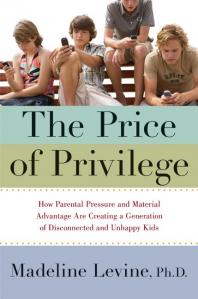
I’ve been thinking about all of this while reading The Price of Privilege: How Parental Pressure and Material Advantage Are Creating a Generation of Disconnected and Unhappy Kids by Madeline Levine. She says:
Women often slide into unhealthy dependency when we turn to our children for the loving connections missing in our adult relationships…The idea of trekking over to a neighbor’s house when the pantry is short an item or two seems almost laughable now. The easy camaraderie that existed among working-class women, a function of both desire and necessity has been lost to take-out food, housekeepers and a fear that revealing our problems, no mater how incidental, will result not in support but in embarrassment.
Hmmmm, yes. To counter the self-reliance I feel imposed on me (by who? my church? my education? my status?) I’ve made my Rule Number One: Pile on the People. While I don’t like asking for help from anyone, I do need it. A husband with Parkinson’s Disease, three kids, a full-time job and a time-consuming writing habit, I, in fact, need all the help I can get. (Another mantra — draw the circle wide.)
There is a benefit not just for us, the borrowers, but for the friend across the hall, the one whom we borrowed from. In exchange for the egg that she lent (gave) us, she received a handful of warm kid-made peanut butter cookies. I wanted to take a picture of the cookies to post on the blog, but there are only a few crumbs left.
(I wrote about this book on my other blog, my blog about writing and being connected: http://gettingmyessayspublished.wordpress.com/2011/02/23/a-generation-of-disconnected-kids/)
Having to attend to one another emotionally is draining. And we need to energize one another. Those who drain us won’t be part of the team again. That’s why I’m trying to stay confident at work.
Two-way streets are tough for those of us who travel only one way — alone. We have to excel collectively and let go of our perfectionist and insecure tendencies for the good of the team. There’s beauty in teamwork, especially when we have confident players.

I want to lose 5 to 10 pounds. It’s not a lot and it’s not a big deal. But I want to be faster and lighter. Being fast is important to me, as an overachieving Type A mother and writer living in New York City.
My weight has crept up. When I first met my husband about 18 years ago I was just under 110 pounds. I’m about 5’6” so yes, that was too thin. Since those happy salad days when I was single and 30, I’ve eked up a pound or two every year.
After my son was born 14 years ago, I was around 135, and then along came my twin daughters and another pound or so every year. You get the idea. A pound a year isn’t much, but if I live to my late 90s, that’s another 50 years and another 50 pounds! And I’ve heard from older women, as we age it’s harder to lose weight.
So I’m posting this goal on this blog, Running Aground. There’s been a kind of magic for me to blogging — it’s turned some things around. This is my goal — by the end of 2011, I’m aiming to lose 5 to 10 pounds and be back under 140 pounds.
Blogging works. I achieved my goal of running a 5K after blogging about it. I”m proud of myself for running a 5K on a rainy, hilly Upper Manhattan race a month ago.
Like my 5K goal, this 5 to 10 pounds weight loss goal is a SMART goal — Specific, Measurable, Achievable, Realistic and Time Sensitive.
I see two trends I can immediately implement to work towards my goal: more cardio, less carbs.
Since my plantar fasciitis, I’ve slacked on my cardio, but with the nice weather, I’m going to dust off my bike (or buy a new one) and bike a bit in Central Park and Riverside Park to kick in the endorphins.
I’m doing this to feel good, and, yes, to look good too. And to stay fast.