The other night I saw Beautiful: the Carole King Story. It was an awesome rumination on the creative process. Want to be creative? You have to be dogged.
Sure, King (born Klein) was brilliant — the characters mention several times how she graduated high school at the age of 16 — but she was hard working. I love that. “Good things come to those who hustle.” And our girl Carole hustled.
I loved that the musical shows how creativity is a collaborative and a competitive process.
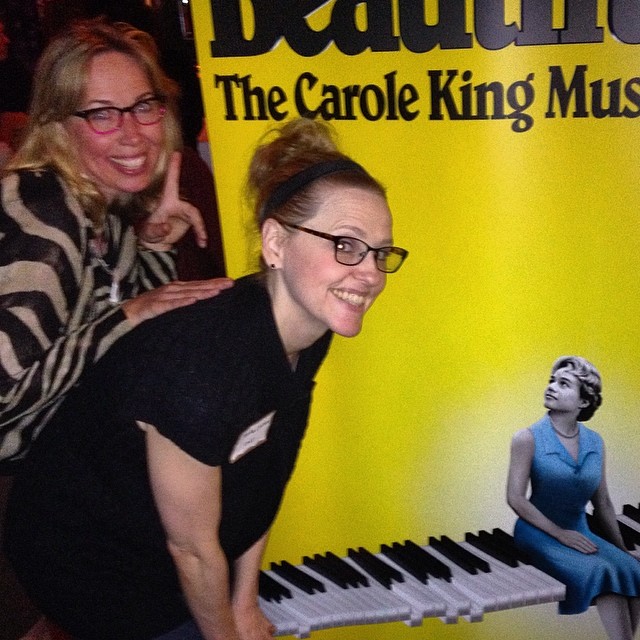
Mary Beth Coudal, blogger, and Anika Larsen, who plays Cynthia Wiel in Beautiful.
The cast was awesome. Everyone’s raving about how amazing Jessie Mueller is. But so is Anika Larsen as songwriter Cynthia Wiel, Carole’s gal pal, foil, and competition.
Now, from my lonely feminist perspective, I must point out that King’s songs really defined a generation of women finding joys in being a woman, “You make me feel like a natural woman!” (co-written by her partner, Gerry Goffin.) So fantastic — a real anthem and celebration of natural womanhood. I, for one, in this age of Botox and plastic surgery, would like to return to the beauty of natural womanhood.
I also wanted a little more about how Carole came to love herself and not just the ups and downs of her romantic and troubled love for her fellow songwriter and husband, Goffin. But this musical shows one slice of her life. To find out more I think I will have to read her memoir, A Natural Woman.
This musical is amazing. Carole King’s talent and output inspire me. Go. See it Sing along.
“Get up every morning with a smile on your face and show the world all the love in your heart.”
Disclaimer: Thanks to Beautiful and the Serino/Coyne group for the tickets. The opinions on this blog are always my own.
One of my recent ad hoc jobs has been assisting in the Columbia University graduate business school, coaching on presentation skills and strategic messaging.
I don’t want to give away all of my tips and tricks. But here’s some of what I’ve learned and taught.
Plant your feet to make a point
Make eye contact
Breathe
Be prepared, but not memorized
Put it in a story form
Show the benefits to your listener
Use emotion
Let me explain what I mean by all of these. I’ll use myself as an example.
Plant your feet and make your point. Don’t wander around. Don’t fidget with a pen either. I need to remember this. I’m a passionate person, and so I like to really emote! That’s fine (see #7). Sure, move out from behind the podium, but move on the pause, and stop when you speak. Plant your feet. You can move as you think. But stop when you talk.
Look ’em in the eyes for several sentences. Six (?) years ago, when Hilary Clinton was
Barack Obama (Photo credit: jamesomalley)
debating Barack Obama, I noticed Hil scanned the crowd as she talked. Her eyes hopped from person to person. Not Barack. No, he spoke several sentences to one person, then moved his gaze to another person. Like #1, don’t wander – not even with your eyes. Fix your gaze on one person. Make sure they get your point and then focus on another person’s eyes.
I sometimes look up when I’m thinking. I do that on the pause. Then, I have to remember to look down and make eye contact when I talk.
Breathe. A breath brings inspiration. Take time to think things through. I tend to talk fast. And so I get breathy and soft-spoken. When I take time to breathe, I’ve got fuller authority. I’m more centered. When you’re making a presentation, take time to inhale. Then, speak on the exhale.
4. Know your stuff. When I’m watching Shark Tank, I can tell that people who have memorized their whole pitch. If they lose their place, they’re lost. They only really need to know the salient points – their numbers, their benefit to the user, their unique factors. They don’t need the verbatim script, they need to speak just the basics.
5. Make a story. Everyone loves a beginning, middle, and end. Put your presentation in a story form — perhaps, a context of overcoming great odds. Or making the story about a heroic journey. You were lost and now you’re found. These story types are so primal and so inspiring. Everyone loves a narrative arc.
6. Show the benefit. I realized people were a bit self involved the first time I had skin cancer. I blogged about it. In conversations, people would ask me, “Does this mole look like yours looked?” People weren’t asking, “How are you feeling? What’s the latest?” No, they were telling me how they were feeling. All people are basically self-interested.
If your presentation is relevant to people, they will be interested. If you can help people learn about themselves or help them make money, then they’ll be into your presentation. I love inspiring people to learn about themselves. It’s why I love coaching writing.
7. Emote. Don’t be afraid to laugh, cry, admit that you don’t know something in your presentation. It’s all part of the human experience. People will remember what you say when you are passionate, but they may not remember your dry facts and figures.
Give yourself away. Go deep and don’t be afraid to be human. Get real.
Bobby Steggert, Frederick Weller, Grayson Taylor and Tyne Daly (photo courtesy of entertainment weekly, Joan Marcus)
I saw Terrence McNally’s Mothers and Sons in previews on Broadway the other night. I liked it. It threw me back to a really sad time. This play is the story of a deceased actor’s mother showing up like 25 years later, after all this time, to reminisce about her son with his beloved.
I think the two main characters, the mother and the lover, want forgiveness from each other. And basically I want that too. I want the characters to love each other, to get over their awkwardness.
The mother, played by the amazing Tyne Daly, cannot give love and can hardly give acceptance. The two circle one another without coming to a resolution. Fortunately the new husband, played by Bobby Steggert, and the couple’s son arrive. Just in time, to cut through the BS and awkwardness.
These two are the heroes because of their forthrightness – the new husband calls out the mother’s past injustices and the little boy articulates the family’s need for a grandmother.
The play reminded me of how the AIDS crisis in NYC swamped us. I felt overwhelmed by this again, when my son was reading Angels in America for his Constructing America class and he asked me and Chris, “Did you lose friends to AIDS?” And we told him “Yes.” Among them, Chris’s actor friend Robert Farber, a great artist, a great friend, whom we visited in his West Village apartment when he was getting close to death. And I think that we are still bothered that we didn’t visit him more.
So the play brought that up for me – how much of yourself do you give when you know someone is dying?
It was particularly heart-wrenching in the play when the survivor told his lover’s mother, “You and I are the only ones who still remember him.”
I don’t think that’s true. There are people, like me and Chris, friends on the margins, who remember. We know what happened and we still talk about it.
In the ’90s, I used to host my TV show, Mary Beth and Friends, at Manhattan Neighborhood Network right after Act Up taped their show. And I would schmooze with the on-camera people and the crew. I told them their stuff was cool, their interviews, their lying down protests, their silence=death. And I told them I supported them. But honestly, they weren’t all that interested in my opinion. They appreciated my support, I guess. But let’s face it, they had bigger issues.
It was a crazy time. I worked at the Vista Hotel in the World Trade Center in the mid-late ’80s and lost a friend, fellow front desk clerk, He was a few years older than me and I was still in college. And he seemed to be one of the first deaths by AIDS. And it was so very hushed, very uncertain, a gay man’s disease, that we didn’t know how to talk about it. We didn’t have the words.
The play reminded me about all that. About how we talk or don’t talk about death and dying. A year or so, I bumped into an actor friend whose partner/friend had died of AIDS. I told him I still often remembered his friend fondly. In the coffee shop, we didn’t get all maudlin. We just reminisced. We just talked about his friend, like it was 9/11. Like, such a tragedy. Still, it had not stopped our lives. Remembering a death can cause us to stop in our tracks, unprepared for grief, but the remembering doesn’t make us stop living.
That’s the thing about Mothers and Sons and the death of someone you love — you see that serious illness, death even, doesn’t stop loved ones from living. You can’t stop living, even when someone you love is sick or dying. (And, of course, for me, this brings up Chris’s Parkinson’s. How can I stop myself from living? How can I not stop and treasure each day? Each day, a gift.)
Now, about my home girl, Tyne Daly – she just throws lines out there, so naturalistically. I love her arch intelligence. She owns the stage. The other actors were wonderful too, but it was hard to know if their awkwardness was due to the great lady on stage with them or just the scenario of the play itself – the mother of a deceased ex descending for a night on your boisterous, wonderful, ongoing family life.
What can you do? Keep living. Keep remembering. Keep talking. Silence=death.
Disclaimer: Thanks to Mothers and Sons and Pivoting Media for the tickets. The opinions on this blog are always my own.
Everyone loves a winner. So talk up your winning biz. You can take several routes.
The humble way – Shucks, we’re just ordinary plain folk who got lucky.
The hardworking drudge – Well, sure we’re a success, but all we do is work, work, work. And we never see our kids, spouses, or mothers.
The boaster – I’m pretty fricken’ amazing. That’s it. I kickass.
The passionate soul – I love this work. Man, I’d do it for free. It’s all I’ve ever wanted to do. And it’s a labor of love.
I suggest when you talk about your biz, mix it up and use all four routes. Go the humble, hardworking, boastful and passionate way. “We got lucky, we work it, we’re awesome, and by the way, we love what we do.”
Mary Beth Coudal and Cheryl Sandberg exchanged a few laughs at BlogHer in Chicago.
Note: I say “we” because, sometimes people appreciate the ‘we’ better than the ‘me.’ Or at least, we think so. Who’s we? Me and Cheryl Sandberg of Lean In. I think she said something like this at BlogHer last summer in Chicago — how women are more powerful when we’re collaborative rather than competitive.
Even though I’m pretty much a shop of one, I feel like I bring a team with me on my assignments. Ya know, I get by with a little help from my friends.
This post was inspired from a post by Seth Godin, marketing guru.
I’m not giving up red or white. I’m not giving up sweets, trashy TV, gossip or coffee. Been there, done that.
In fact, I might even drink more, watch more Shark Tank, eat more sweets, dish on the neighbors, and hit the latte bar.
Seriously, you know, I’m a righteous soul. I’ve got to do something for Lent.
I’m going to take up some things that make me happy:
Decluttering
wine in the Adirondacks. waiting for summer.
Blogging
Traveling
Eating a plant-based diet*
Having people over for dinner*
*These last two were inspired by Pastor Andrew’s sermon a couple of weeks ago at Rutgers Church.
On second thought, having dinner parties may be challenging, given that I’m going to be traveling too. (My friend Barbara Wheeler-Bride just wrote an awesome blog post about one of my parties, Thank you, Mary Beth, at Busted Halo. Thank you, Barbara.)
If you want to join the decluttering challenge and do some synchronous cleaning, I can add you to a super-secret Facebook decluttering group. Just message me.
I want to blog more because I have been learning so much through starting my own business. I want what I’m learning to be useful to other people.
And why travel? Just because. I’ve been a little down this week. And travel always makes me happy. In fact, I’m writing this from beautiful Nokomis, Florida. (Thanks, Nicole and Brendan for hosting me!) Next week, the family and I will be on spring break at Circle Z dude ranch in Arizona. Then, just my son and I head to Charlotte, North Carolina to look at colleges for him.
While in Charlotte, I’m offering a really fun and creative workshop, Spiritual Journeying, with Cindy Sloan. We’ll be making collages and writing about moments from our lives. We’re offering the workshop on Sunday afternoon, March 23 at Dilworth United Methodist Church ($29). Please come and tell me what you’re giving up for Lent. Or if, like me, you are just giving up.
Yesterday I was at the awesome NYU Entrepreneurial Festival. A highlight for me was Luke Williams’ class on disruptive thinking. Here’s what I got out of it.
In your biz and in your life, chose the scary route. In this picture, look at the dude on the left, “Who is he? I don’t know — just the happiest guy I could find on the internet,” Williams said. “Why is he so happy? He’s complacent. He’s the face of all the companies we know. Doing what he’s always done, making small incremental changes.”
Luke Williams at the NYU Entrepreneurial Festival.
Like Kodak, everyone saw that Kodak’s biz was going down when digital cameras came along, but the CEO of Kodak basically said, “Why stick your hand in an engine that’s running?” If you’re the mechanic, you don’t reinvent the car while you’re supposed to fix it. Right? Williams is smart.
Now look at Janet Leigh. This is how your client or company should look — scared. And ready for change.
Hitchcock killed off his leading lady in the first 30 minutes of Psycho. No one had ever done that. Be like Hitchcock. Be counter-intuitive.
How do you do that? If sodas are supposed to be inexpensive, sweet, and aspirational; make them expensive, sour, and real.
Look for cliches — “widespread beliefs that govern the way people think and do business.” And then disrupt the cliches. Be like Little Mismatched, the company, that sells socks, not in pairs, but in singles or in threes.
Feed your own rebellious instinct — the one that wants change for the sake of change.
I plan to disrupt this endless winter with spring.
Spring starts in five days for me. I’m going to Sarasota, Florida for a few days, back to NYC for a few days, then to a dude ranch in Patagonia, Arizona with the family for almost a week, then just me and Hayden, my 11th grader, go to look to North Carolina (where I’ll offer a writing and art workshop with the fabulous Cindy Sloan.) And Hayden and I will visit a couple of colleges in Charlotte and Raleigh-Durham for a few days.
I have been so slammed with work. Tomorrow and maybe a couple of more days this week, I’ll be subbing middle school English at a nearby prep school. I’m also continuing posts and articles with my fabulous blogging client. I have lovely tutoring jobs. I have an annual report due for a new client. I have to meet with my mentor to get my paperwork signed for my self employment assistance program.
I don’t want to disrupt my busy work life. But I don’t mind disrupting winter to get to spring. And summer.
Ellen Wade Beals at Solace in a Book invited me to join this blog tour. The idea is that I answer a few questions about my writing process and then introduce you to some new bloggers who might, next week, answer these same questions. And so it goes.
1) What am I working on?
a sexy novel, length of a kindle single (tentatively called Unwieldy Soul. No one likes the title.)
2) How does my work differ from others of its genre?
use of bullets
humor
emoticons ;0
lack of proper punctuation and capitalization
I think I am known for my honesty. I have a tendency to be a little dramatic and a little funny.
I am pretty loose with my style. I believe that we should all push ourselves into dangerous terrain when we write. I’ve several times led a workshop called Dangerous Writing. I find the best essays show some break through, humiliation, self doubt, and ultimately, resilience. Yes, grit.
I write because I need a lot of attention. My husband is an actor who has Parkinson’s and well, he’s a fabulous person, and he needs attention too. And honestly, I know this is not true, but there are times I do not feel my life (or work) is as important as his.
And since I feel sidelined by my marriage or my husband’s illness, writing puts me back on the field as a star player, if only to myself. I love sports metaphors and am slightly athletic. But I love metaphors because they are visual. I am a visual thinker and a team player.
Inevitably, when I’ve felt like stopping this blog, someone tells me — at the checkout line in the grocery store or at a party for a school event — that she reads my blog and is inspired by it.
And people tell me they like my pictures (all taken with my iPhone 4S). And that keeps me going. That real life connection feeds me.
4) How does your writing process work?
I journal every morning, a la Artist’s Way, before the kids get up
I write right after the kids leave for school
I use the pomodoro technique. I set the timer on my phone for 25 minutes, let nothing interrupt me, do my work, stretch for 5 minutes. Then I do that again. And again.
I learned the pomodoro technique at my fabulous coworking space, New Work City. I get a lot of support there for my business. I like being accountable to my coworkers about my goals.
my writing business
I started this coaching-of-writers biz last year. I’ve offered dozens of workshops and weekend retreats. I’m giving it a good go. But as my spring meeting with my accountant creeps up on me, I am forced to face the reality: the business has brought in very little money to our household.
Last night one of my daughters asked me, “Isn’t it time you go back to work?” The kids think that they liked when I worked, but they forget how much they complained when I traveled for work.
I told her, “I’m doing so much and making some money too — substitute teaching, tutoring, videography, corporate blogging.”
“But that’s not from your writing workshop business?”
“That’s true.”
“And you’re not making as much as you used to make?”
“That’s true,” I agreed. “But look, I went to almost every one of your swim meets. I couldn’t have done that when I worked. And it’s been priceless.”
And so there it is. I write because I need the attention. I’m trying to promote my biz. And I’m trying to entertain, inspire, learn about myself, and show my own and my family’s resilience.
– m ;b
P.S. Let me introduce you to three bloggers, who might keep this blog tour rolling next week. They are writers I know and love IRL (in real life). I love their honesty and their integrity. I love their grit.
Next stops on the blog tour might be:
Xavier Trevino – We are friends from Charles’s class. He says:
I started this blog about a year ago. I wrote one or two posts and got one or two visitors for the first four months, then I sort of lost my job and had more time (and things) to write about. In April of last year I started writing more posts and getting more readers, and I settled on writing two posts a week, Tuesdays and Saturdays. Since then I’ve written 106 posts and gotten almost 5,000 views.
Some posts do very well, some are hardly looked at. Some are shared on facebook, or reposted on other people’s blogs.
I’ve always written, and I guess I have to describe myself as a former drug abuser who works as a doorman and writes.
Wendy Karasin – We are friends from a women’s once-a-month writing group. Wendy worked in educational publishing, taught, and raised four children as a single parent. She says, “Losing my parents in relatively close proximity profoundly changed my life. And that’s the subject of my memoir, Passing Through.”
She says:
I have a distinct and hearty laugh that once heard is not soon forgotten. My mother used to say among a million people in China, she could locate me by my laugh. Curious, happy and responsible; conscientious, educated and playful – all wrapped up in a blogging, baby boomer. Love reading, writing, cats, yoga, kindness and connection.
And then, my brilliant biz partner Kelly Wallace. She has a lot of projects; here’s one:
working on a memoir tentatively titled “The Yellow Blanket” a manuscript about her experience as a child sexual abuse survivor and rejection by her entire paternal family system. The story opens with eight year old Kelly on the witness stand testifying in court against her grandfather. The focal point of the story focuses on the rejection Kelly experienced by her entire paternal family and her father’s legally aiding her grandfather’s defense team.
the day darkens. i get too tired. i find the housework oppressive.
i ask for help, then don’t want it. like in the decluttering. i don’t know why it bothered me. what to do with the tapes from my old show? leave me alone.
Snow day in Riverside Park via mbcoudal
the snow — more of the same color of the same grey sky.
i like when the sky is a crisp blue, like today. then i can forgive the weather gods. i can go on. but when dark and grey, i want to stay in bed. i have only a few weeks left of winter. i would like them to be azure blue.
i would like blue sky days. but after all the grey — why is grey so like death?
i go to Florida — old people, malls, alligators.
for a few days, i sleep in a twin bed, and laugh with Nicole and my brother, (and dad and Marty). we talk about creativity.
Lower school sunset in Riverdale via mbcoudal
that is the start of my spring. and that is followed by the buds on the trees in Riverside Park.
my kids get older, get away from me, find fault in me, our apartment, why don’t we have nicer floors?
the sun does not ask for thanks. so i try to just give light too. just do my job — mother, wife. but the endless giving becomes a chore.
sure, the sun must want a thank you. the grey day gets no thanks. for it takes my energy. it does not give. it is the negative ion. i need the positive.
the wind whips and the shadows blend into dark night. i know spring comes after winter, always taking me by surprise. then the summer. lighter, longer days of laughter, hugs.
we are destined for spring.
Laughter is the language of the soul (Photo credit: symphony of love)
My coworking guru Tony Bacigalupo suggested a MeetUp for coworkers at the Metropolitan Museum of Art. So a handful of us meet there on Wednesday, Lincoln’s birthday, to fire up our laptops and work. We also took a few quick breaks to see a few cool things with Museum Hack’s brilliant Jen Oleniczak.
Jen gave us some insider info on Madame X by Sargeant. And then in honor of Lincoln, we checked out his death mask (created while he was alive). She was an awesome guide and leader — really passionate, smart, informative, funny.
We even got to groove on the vibe of the Visible Collection, a vast storage space I’d never visited before. Jen showed us a scary story here (you can tell, we’re scared).
We hacked into the Museum so hard that we even got into the Media Lab. That’s me with a 3-D printer.
Here is our group. And below, that’s the Met’s media lab manager Don Undeen, showing us some cool stuff the Met’s working on to marry tech with fine art. They’re making projects around smiles in art and around getting pathways mapped out for people with special needs.
I am crazy in love with the flowers in the grand lobby of the Met. They never fail to blow me away.
The highlight of the coworkers’ hacking into the Met to celebrate Lincoln’s b’day?
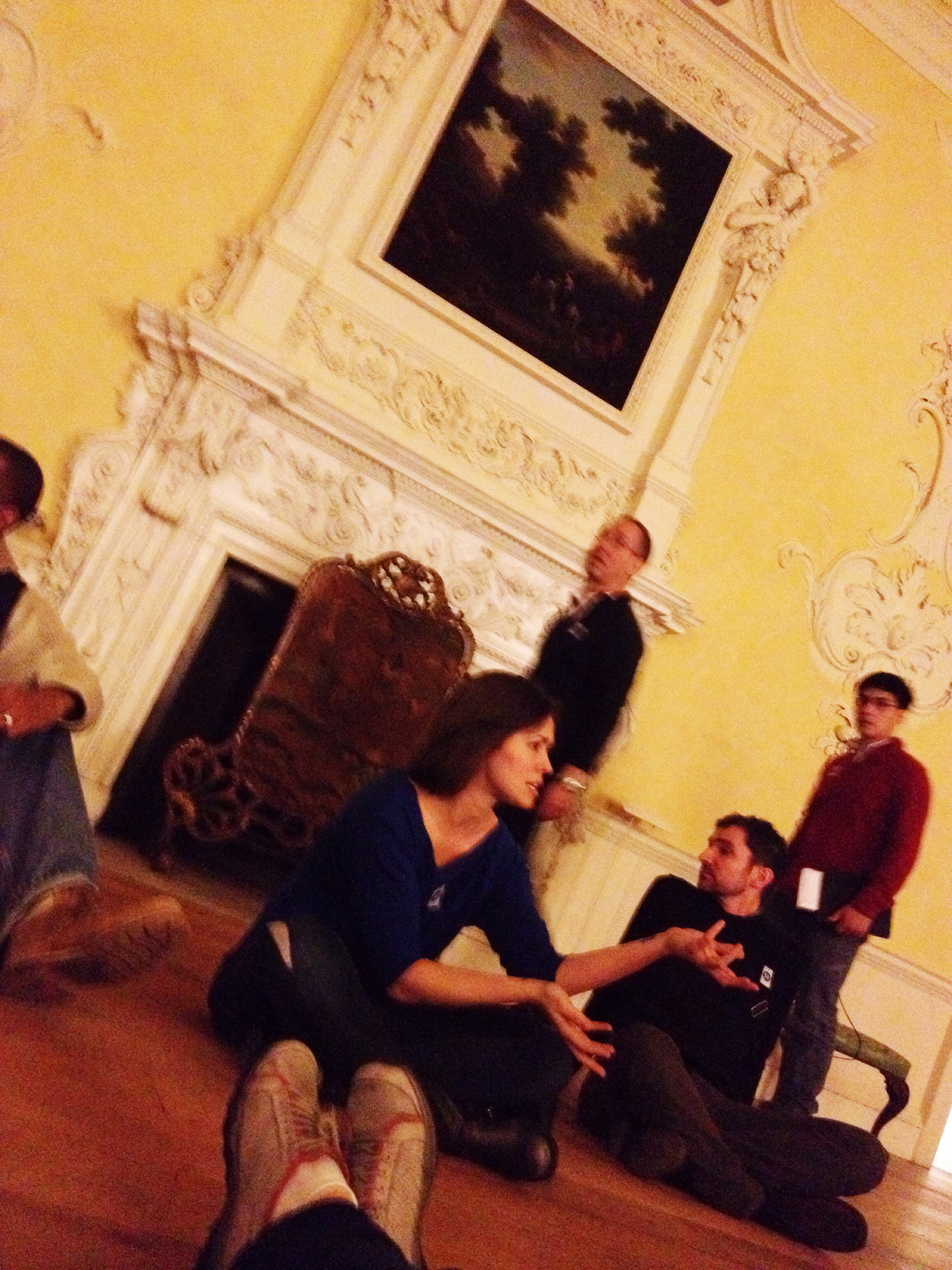
Yup, we sat on the floor — and also sprawled out on the floor — of the Fragonard room. We looked up at the Rococo ceiling and took in the whole frilly mess. So cool. From the three hundred year-old floorboards, you can take in all the possibilities at the Met from a new angle — literally and figuratively.
Thanks so much to Jen and Tony for making this day happen. I’m going to do this every year to celebrate Lincoln. And take all the stuffy out of the Met museum. (And use their awesome free wifi!)
First of all, it is always amazing to see respect lauded on a writer.
Respect is not why I write. But I have to admit that reverence for a writer – in this case, P.L Travers, the author of Mary Poppins, a children’s book, is a rare and beautiful thing.
Women as Creative Team Leaders
From a feminist perspective, I loved that the men, even the studio head, the great Walt Disney himself, deferred to Travers. Of course we all know men who defer to their female bosses or wives or business partners. It should not be an oddity. But somehow, the world has turned and I rarely see men respecting women in mainstream movies.
Maybe because I have teenagers I am overexposed to hyper-sexualized women in the media on awards shows – too many women rock stars wearing lingerie while the men wear black tee shirts and jeans.
But seeing Travers run the show? Well, that was just amazing. She is occasionally arbitrary – but what genius is not? Emma Thompson is brilliant at creating this very real, flawed, lovable, cold writer.
Explaining Mary Poppins
I loved, too, that Saving Mr. Banks explained why Mary Poppins does not change as a character. Like everyone, I love the Julie Andrews movie. But it’s always bothered me that Mary Poppins does not change – she does not become more loving or more interesting as the film progresses.
Her character does not go through the fires of some great conflict and come out the better for it. This movie explains why. She is the agent for other’s transformation, not her own. Change is reserved for Mr. Banks, the father, an idealized version of Travers’ father.
Becoming More Loving
Our Travers gently returns to being an imaginative and playful person. This transformation into a loving human being happens in small ways. Our hero here does not suddenly turn around and become a fabulous new person.
This is a subgenre of movie I happen to love — watching characters return to love — like the movie based on C.S. Lewis’ Shadowlands.
English: Screenshot of Julie Andrews from the trailer for the film Mary Poppins (Photo credit: Wikipedia)
What About Mrs. Banks?
Now, you know, I have to find something not to love. I did not love that Travers seemed to be seeking to come to terms with only her father. What about her mother? She certainly was equally complex. Is the mother not as curious and exciting and crazy a character to explore? Or are men more enigmatic? Why must it be the father we need to heal?
The Treasure Trove of Childhood
I, like Travers, have a treasure trove in my past – a childhood of great love, adventure, and benign neglect. But it is in from this personal history that so much creativity can spring from.
This book reminded me of Alice Miller’s Drama of the Gifted Child, a psychological text that explains why overly sensitive children do not have a full childhood as they are always in tune to their parents’ struggles. Then, as adults, they are adrift. They are less inclined or able to explore their own lives. I think about this from my own story and from my children’s reality.
There are times that I, perhaps due to Chris’s Parkinson’s, as a parent, turn to the children for more support than maybe they need or want to give. And then there are times, too, I just let them off the hook — but that’s another story. Or maybe it’s the same story. It’s the story of excessive attachment and then, benign neglect. I console myself with the certainty that great creativity can come from a troubled childhood.
You should see — or read — this story. Think about it, talk about it — about respect for writers, women as creative leaders, the importance of childhood, and what makes for creative genius.
 I also wanted a little more about how Carole came to love herself and not just the ups and downs of her romantic and troubled love for her fellow songwriter and husband, Goffin. But this musical shows one slice of her life. To find out more I think I will have to read her memoir, A Natural Woman.







 100 Days of Poems and Pics