Twitter versus Facebook

Lately, I’ve received Twitter messages that say, “Follow me on Facebook too!” I thought Twitter and Facebook were two different worlds.

I thought Facebook was for people you had met in high school or real life; and Twitter was for people you wished you’d met in high school or real life. My Twitter friends are writer-types with names like SmartBitches, AmyLow, GottaLaff and HippieChick (I wish I’d thought up a clever name. I’m simply MaryBethC). My Facebook friends are also sassy-types, only they use their real names.

After being on the Twitter-verse when I log on to Facebook, the Facebook world feels slow and earnest. It feels like cross country skiing after downhill racing. 

Sometimes I like the random roll of the dice of Twitter. And sometimes I like the mashed-up friendliness of Facebook.

After I’ve been on Facebook a while, when I get on Twitter, I wonder Who ARE these people? Do I know them? But I can’t stop reading their updates.

I’d like to write more about this right now, but I’ve gotta check my Facebook and Twitter accounts. I’ve got to see what my friends — real and cyber — are up to.

Off the Grid

On Christmas Eve day and Christmas Day, I unplugged.

Time off the grid was not boring. I had good food, good times with family — card games and board games. We played Crazy Eights, Headbanz, Funglish, Backgammon, and Taboo. We went outside and cut down a tree. We decorated the tree. We went caroling. We ate, we drank, we laughed.

I did not check email, Facebook, Twitter at all. Oh, noble me. But I made one mistake — I checked my voicemail. I wondered if one of my brothers or parents had called. No, instead there was a phone message from Elizabeth, the funny nurse at the dermatologist’s office. She said the last biopsy was fine, but that I had Grover’s Disease. She said, “It’s just a minor skin irritation that seems to strike old Italian men and you and me.” (I told you she was funny.)

How would I know how “minor” this skin irritation was if I couldn’t Google it? I wondered what Wikipedia had to say.

It was one thing not to update my Facebook status (‘I am making bacon for breakfast’), but quite another not to be able to peruse medical journals and find a cure for this disease that — who knows, could potentially ravish me in an instant? Why call it a disease if it wasn’t serious? I had a very good reason to search the world wide web. But noble me, I did not. I shrugged. What could I do about it any way?

I made a joke at the dinner table, “I just learned that I have Grover’s Disease. It sounds like something you get at Sesame Street.” My sister in law said, “You’ll soon be turning blue and furry.” Funny. (I know a lot of funny women!)

Well, my two days off the grid passed. I got on line. The first thing I did was check Grover’s Disease at Wikipedia. Indeed, it’s an uninteresting and very minor skin irritation. Thank God I did not ruin my social media and internet sabbath to learn that. Sometimes it’s just better not to know.

The Hunted and the Hunter Mind

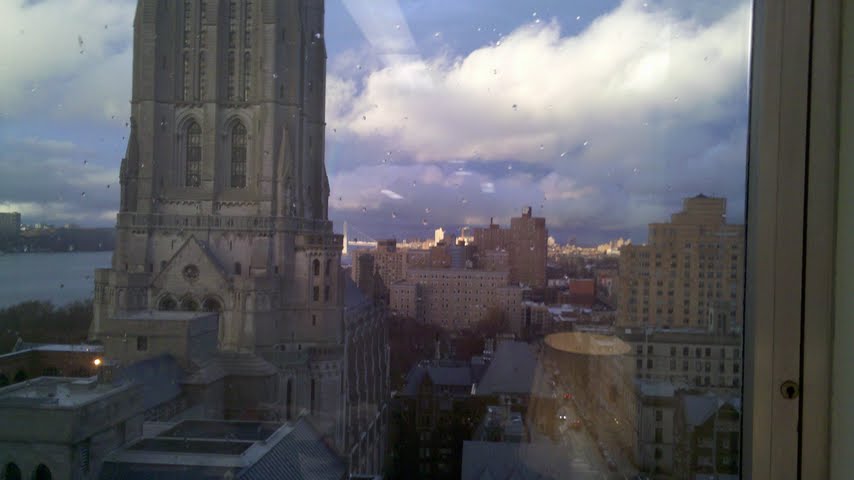
From my desk at work, I watch the hawk of Riverside Church dive bomb a flock of pigeons. It is impossible not to watch, like a car wreck at the side of the road. It is thrilling.

I imagine the rush of excitement as the pigeons circle and escape. I imagine the hunger of the hawk. I stare and hope for something dramatic to happen. I have never seen the kill. But occasionally — oh, this is rich — I see a blizzard of white feathers rain outside of my window. Joseph Conrad summed it up well, “The horror, the horror.”

My window to Riverside Church is like my internet screen. I watch and wait for something delicious to happen. I am a passive watcher, a vicarious hawk or pigeon. I imagine my escape or my hunger.

But the internet is just a window into life. It is not life. I am not a primordial being — panting, fluttering, escaping. I am a creature of reason, contemplative and kind. I make eye contact with my fellow human beings.

Life happens, not in the spires of the Gothic church with wings and flapping, but down below where mortals dwell, where smiles are exchanged and pleasantries murmured.

Dan Licardo inspired this post with a Facebook post about the hawk of Riverside Church.

what matters most

When I was writing for the business school at Pace University, I interviewed a professor (whose name I don’t remember) about time, happiness and pay.

The professor said her research had shown, “The more money an executive made, the happier the person was with his or her job.” This surprised me.

I wasn’t making much at Pace, but I was happy. I worked for brilliant women. We worked hard, but had flexibility, creativity and purpose. After viewing this video (or animated chart), I feel affirmed. I am right. It is more than money that motivates people at work.

It is probably true that with higher pay comes more autonomy, mastery and pupose. These are key.

Thanks to NYCityMama for reminding me — that people need more than pay to be happy at work. Check out the funny video at the bottom of her post from RSA.org. http://t.co/dkJhjht

That being said, I do hope I get a raise this year. Last year we all did without.

On Facebook, Megachurches, and Brevity

Episcopal priest and social media expert, Tom Ehrich, began his talk on social media with a bunch of paper handouts — extremely gloomy charts showing the steady and certain downward march in Episcopal church attendance.

“The world of the 1950s ended a long time ago but churches hung onto it. We are the corner hardware store in a Home Depot world,” Ehrich said. People laughed uncomfortably.

For the record, I still love corner hardware stores. I like to say “Gene Doubray” (dzień dobry) to the Polish guys who own the hardware store on 72nd Street. I have never been in a Home Depot. But I like their commercials that show older women as experts. I digress, back to last week’s luncheon. Here are my takeaways:

Facebook

How does Facebook work?No one knows.” (Someone must know!) “Facebook is a mystery. Facebook tells your friends ‘Here’s what I’m caring about today.'”

Update your church’s Facebook frequently and recruit people to attend your church. Inviting doesn’t work; recruiting does (recruting always sounds militaristic to me).

Give people what they want. When people come to a church they may have questions. But the questions they have will be ones about their own lives — “Should I send my kid to private or public school?” they ask. They don’t ask, “What is your Sunday school like?” Ehrich said. True, true.

Create buzz. Let churches “touch people,” not “create members.” True.

Why do restaurants in New York not have to advertise? Restaurants get business by generating buzz, Ehrich said.

Megachurches

Getting people to attend Sunday worship is not enough. Churches have to be open 7 days/24 hours a day.

“Sunday is for tourists,” Ehrich said. He gave an example that Rick Warren’s megachurch, Saddleback Church, has its real worship on Wednesday nights, not Sundays.

“The Megachurch is not the enemy. They have methods that work. They greet newcomers. Train leaders.” Warren’s goal was to start 2,000 new small groups in a year; that is, 20,000 new members.

Megachurch Willow Creek sends an email newsletter that reaches 3 million readers. (I’m not sold on e-newsletters.) In his weekly Willow Creek e-newsletter, Bill Hybels, the founder, has passion and enthusiasm for upcoming sermon.

In his e-newsletters, Hybels writes, “Please come. If you can’t come, please pray for me.” That is cool. (How often do grown men asked to be prayed for? Love it!)

Full disclosure: for several months as a teenager in Park Ridge, Illinois, I was a part of Son City, which Bill Hybels founded. It was really fun. I don’t remember him specifically, but I remember that I sang rockin’ Christian songs in a big auditorium. I’m not a singer, but I remember thinking I sounded really good. I loved the idea of Son City, especially when I heard rumors that kids were allowed to run around and have chicken-fights in the church aisles of the South Park Church. I digress.

Digression on blogs may be unnecessary.

Brevity

Ehrich was a proponent of brevity. On Twitter: “140-character limit is magic,” Ehrich said.

Ehrich blogs daily. I love that. His word limit is 100 words. My blog posts tend to exceed that. (This one’s up to 560!). A blog doesn’t need to be friendly but can establish you as an expert. (I wonder if my blog(s) are making me an expert at anything.)

Another takeaway: Social media is a good tool for networking but not for controling. And these luncheons are definitely good for networking and sparking lively conversations about religion and media.

Ehrich’s blog and web pages can be found at: http://www.morningwalkmedia.com

The November RCC (Religion Commnicators Council) luncheon was held near the United Nations at the Episcopal building on 43rd and 2nd. The RCC luncheons and events are always provocative.

NaNoWriMo Takes Off Without Me!

Okay, my beloved NaNoWriMo (National Novel Writing Month) started on November 1st. What?!! Already! I wasn’t ready. I was tired that first night. And last night was Election Night and I had book club. Does it sound like I’m making excuses? Well excuse me. What? Do I sound defensive?

Here’s the truth: I really don’t want to start another novel this November until I finish the one I wrote one last year for NaNoWriMo. (And I did win NaNoWriMo last year!) But it might not win a Booker Prize (and I might have to be English any way to win that prize).

When I looked at the novel again, I thought, it’s not bad. It’s kinda good. When one of my twins woke up early yesterday morning, she found me with my novel, tentatively called “The Missing Twin,” spilled out in front of me on the kitchen table. Charlie asked if she could read it.

So I read Charlie a few pages from the middle of the book.

“It’s good,” she said. “Although you should add more details.”  My kid is brilliant. She’s so right. I have to add more details!

Here’s a little bit of the novel from around page 51: (Don’t judge yet, it’s only a second draft. And I need to add more details.)

We were approaching the stop light at the corner of West End and 72nd. A white van slowed and pulled up beside to our cab. The driver wore dark sunglasses. He lifted a piece of paper.

The sign read, “I’ve got her.”

“Jordy!” I meant to yell. But it came out like a whisper. I slunk down.

“What?”  He was still looking at the picket line. “I think I see Angela, our cleaning lady, there.”

I slunk even lower and pointed at the white van.

Jordan looked. He laughed. “That’s weird.”

“Weird? That’s scary. What if he means Elise?” I asked.

I glanced back at the van. The man’s sign read, “I’m wearing panty hose.” The traffic started and the van rode ahead of us.

“Oh my God, a minute ago, he had another sign. It said, ‘I’ve got her.’ I’m worried about Elise,” I could hardly speak.

“Why didn’t you tell me?” Jordan said.

“I did,” I said. Jordan pulled a pad from his pocket and wrote the license number AGS 254. The van turned on 74th Street. We turned on 77th Street. I sat up in the cab. I told myself to breathe. Inhale. Exhale.

ABC Producer

At any given luncheon, there are three factors I consider:

1. What’s to eat?

2. Who do you sit with?

3. Is the speaker interesting?

The answer to these questions are:

1. Wraps, chips, cookies.

2. Pat Pattillo from National Council of Churches. Good conversationalist.

3. Yes, substantive. Jeanmarie Condon, senior producer for ABC News Nightline.

Before I head to another luncheon, let me post a few takeaways from last week’s RCC* luncheon.

1. Take Religion Seriously

When making a documentary about Waco TX, Condon learned the big mistake in law enforcement was that they didn’t take the religious beliefs of the Branch Davidians seriously. This ignorance is lethal. “Mainstream media ignored the religious content.”

“When Chilean miners got down on their knees to thank God for their rescue, did the media tell this story?” Condon asked.

Yet the tides are turning. At this moment, people are paying attention to religion. Religion is relevant. After all, “God and money motivate people,” Condon said.

Condon produced a documentary, Jerusalem Stories, with Peter Jennings. It was unpopular with conservative Christians. Condon also made a documentary about St. Paul. (Presumably that one was more popular.)

She was asked for The Century Project, What was the most meaningful event of the 20th century? “The Iran Hostage Crisis,” Condon concluded. That event ushered in the Islamic Revolution but started as a secular movement. Due to a vacuum of power, Khomeni moved in. And so, too, the West Bank and free media for Palestinians. “What started as a conflict over land was taken over by religious leaders.”

2.  Cover Religious Content with Respect

The wrong way to approach religion in the media is “from a quaint anthropolgical perspective. ‘Look what they believe and what they do,'” Condon said. Rather, “Have respect for all perspectives. Do not look at religion from the outside in. Look at it from the inside out.” Peter Jennings established the religion beat (Terry Moran, educated at Notre Dame, among others at ABC News, like Condon, are continuing to cover religion.)
When Condon traveled with Peter Jennings to the Church of Holy Sepluchre. “We were watching religious pilgrims touching the stone (where people claim Jesus’s body was anointed before his burial). He (Jennings) was crying.”

3. Make A Good Story

Condon said three things are essential:

1. Character
2. Narrative
3. Access

A character is a person or group of people interesting enough to write a short story about.”

The narrative is the story — with a beginning, middle and end — wherein the characters are compelled to take a journey.

By access, Condon means Nightline has to have uncensored time with the character, even if the subject of the profile is Hilary Clinton.

Condon produced a documentary on the search for the Real Jesus (using chants and Bob Dylan music). She also created a special setting out to uncover any facts upon which the novel, The DaVinci Code, was based.

“No truth to it…Mary Magdalene was probably a wealthy businesswomen,” Condon said.

A recent example of a good story? Nightline learned that Christian pastors from the Congo were performing excorisms. “We went and investigated.” The story uncovered abuses by the parents, the pastors, and the overarching need for medical care for kids there. It’s this kind of investigative story Nightline does so well. And perhaps the reason Nightline is the Number One late night show with four and a half million viewers.

Another recent religion story from ABC was their town hall meeting about Islam where the variety of Islamic pundits and practioners showed that Islam is as diverse as Christianity.

Good luncheon = Good food. Good table. Good speaker.

***

*RCC = Religion Communicators Council.

The locations of the monthly meetings of the New York Chapter of the RCC rotate. The October meeting was held in a windowless meeting room of the Church of Jesus Christ of the Latter-day Saints.
Humane Borders

image

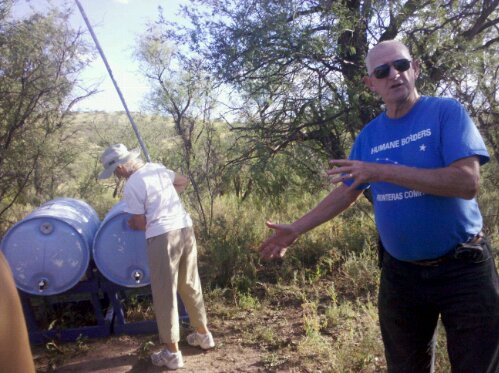
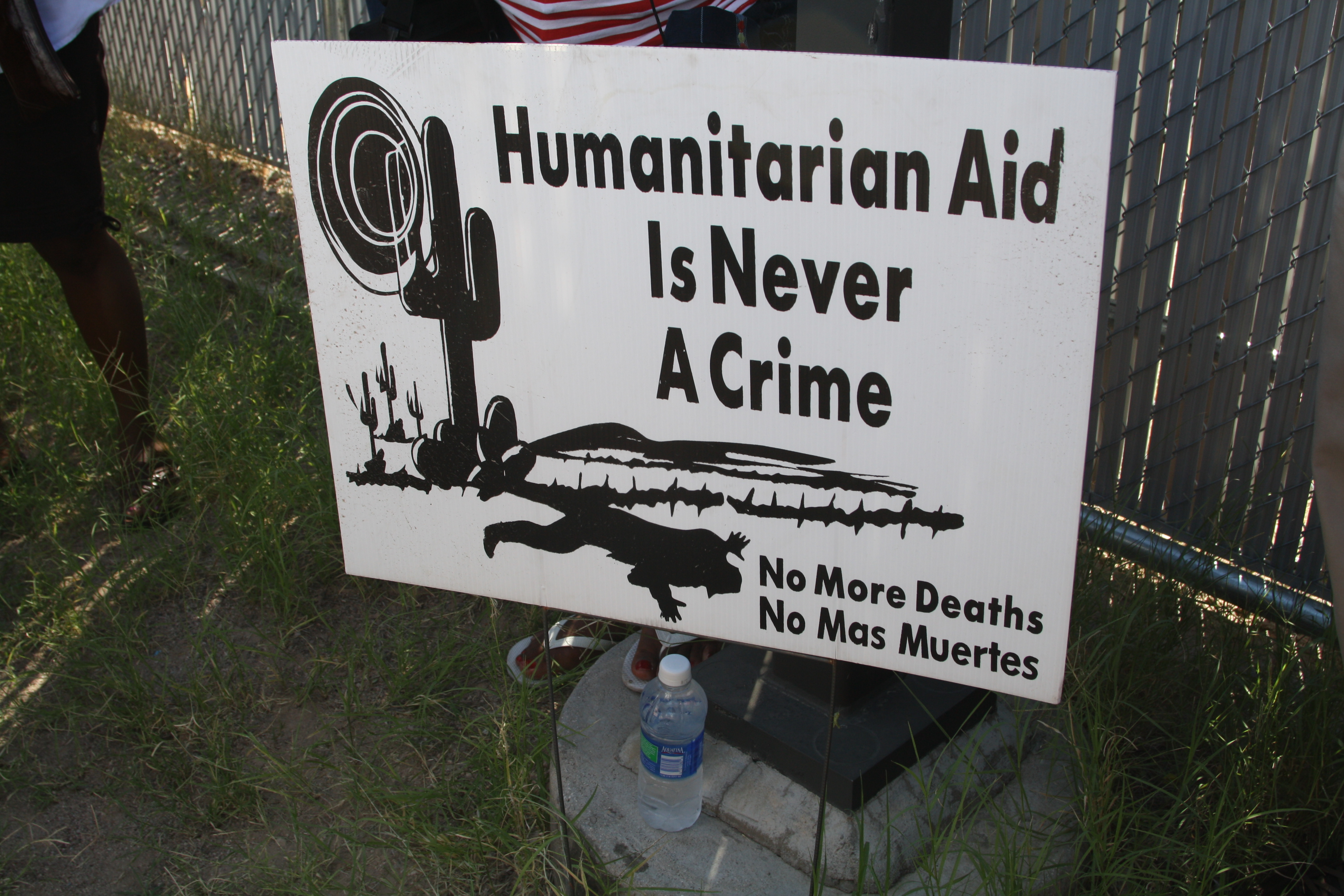
Meet Lois Martin and Gary Wolf. They’re volunteers with Humane Borders, a group in Arizona that puts water stations in the desert so that migrants who are traveling into the US will not die of thirst. Their work is legal — they emphasize this repeatedly because, apparently, some people think it is illegal to give out water to prevent death.

Dehydration is the leading cause of death in the desert and hundreds of people die every year for lack of water in the vast Arizona desert.

There were about 15 of us in the community developers group who visited the water stations. Two among us told how they had crossed these very same borders from Mexico, in the cool of the night, running, one as a girl and the other as a young woman. They are now both documented US citizens.

The Humane Borders volunteers reminded us that people cannot be “illegal.” People are people. Rather, they are people lacking documentation.

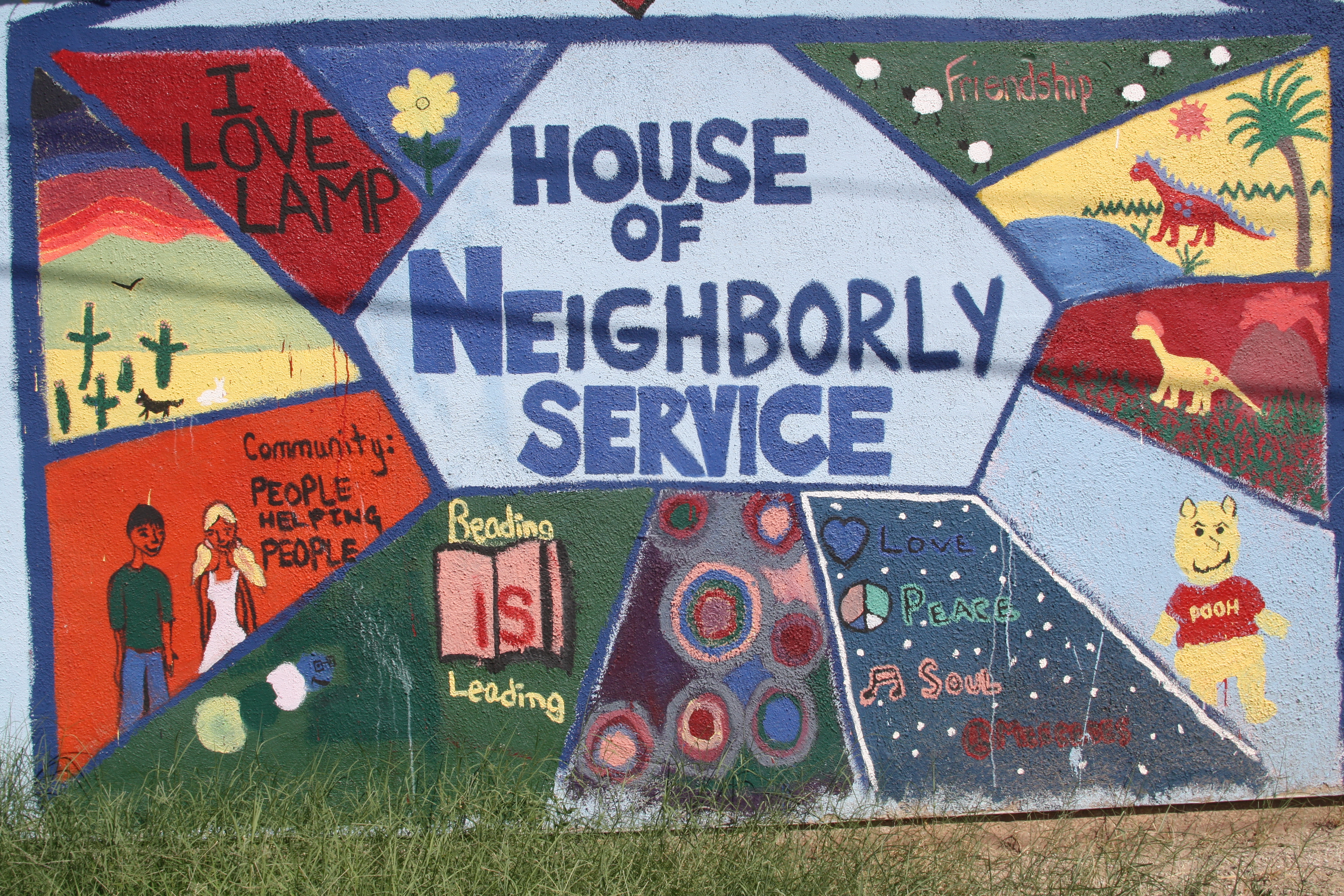
Mural on the wall at Humane Borders

Most migrants come from countries beyond Mexico. Imagine the journey.

This was the first day of the “Let’s Get Radical” event for community developers in Scottsdale, Arizona, when more than 70 community developers traveled to Tucson to visit this group, Humane Borders.

Rev. Robin Hoover, Humane Borders President, First Christian Church Pastor, taking a group to the Mexico/US border, discussing immigration, compassion, providing water.

A handful of our group went into Mexico with the Humane Borders president, across Nogales, AZ to visit the tents of compassion, weigh stations run by Catholic nuns, who minister to those who are ejected from the United States, dumped back on the Mexico/US border, with blisters on the feet and no money in their pockets.  The nuns and volunteers do what they can.

Bishop Minerva Carcano of The United Methodist Church spoke about working in the tents of compassion. She told how she met a family in the tents — a father and two young children, Melvin and Joslyn. The bishop played with the family and laughed with them.

“It is an amazing journey that these brothers take. They take the journey depending on God. We do stand on the word of God. Leviticus 19:  ‘You shall not oppress the immigrant. You shall welcome that immigrant as a citizen. … and you will remember you were an immigrant in the land of Egypt.’

As she left, she gave money for the small family to the father. As she walked away, she heard others say, “Gracias, mi hermano.” The father had given the money to other migrants in the tents.

“I felt I had seen the face of God,” the bishop said. Having so little, that father shared so much. (This, like many stories at the community developers’ event, made us cry.)

Community Developers group -- Mary Beth, Monte Payne, Tonia Rios, Humane Borders volunteer Karl Tucker, Malik Saafir, Rhonda Robinson

I was with the group that visited the water stations. The blue flags that mark their locations may be torn or full of bullets but the Humane Borders workers continue to check the water supply underneath the 100 or so flags in the desert. At times, they move the water stations to optimize giving (and perhaps avoid entrapment of migrants by the minute men or border patrol?)

“Minute men are right-wing whackos….Its an evil, evil, evil mess,” Karl Tucker, our volunteer, said.

We ended the day-long trip with a visit to Sasabe, Arizona. There were no people anywhere, except for about six border patrol officers, one of whom wielded a huge gun.

Community developers approach the wall.

The diminutive, yet powerful Lois Martin requested and the officers agreed, to let us approach the wall.

It was shameful that this is how we, the US, ‘welcomes the immigrant’. We give them a wall and tell them to keep out. Whatever happened to:

“Give me your tired, your poor, Your huddled masses yearning to breathe free, The wretched refuse of your teeming shore. Send these, the homeless, tempest-tost to me, I lift my lamp beside the golden door!”

No, there is no lamp beside a golden door. There is a wall. At least there is water. And people like the Humane Borders volunteers who give small comfort. And in so doing, they save lives.

http://gbgm-umc.org/global_news/full_article.cfm?articleid=5846 is another article about the day to Humane Borders posted on the General Board of Global Ministries website.

10 minutes a day

I work on my unwieldy novel most days for so little time. It’s the Swiss cheese method of writing. You just poke a tiny hole in the task. You punch a moment into that insurmountable infinity.

I read this method in Alan Lakein’s book, “How to Get Control of Your Time and Your Life” a long time ago when I was Barbara Weaver’s assistant in the Women’s Division. Sometimes I wish I was somebody’s assistant again. More often, I wish that I had an assistant!

“The underlying assumption of the Swiss cheese approach is that it is indeed possible to get something started in five minutes or less. And once you’ve started, you’ve given yourself the opportunity to keep going…Swiss cheese is supposed to lead to involvement,” Lakein says. I’m not so sure.

I start my Stopwatch app. And I glance at the numbers. Occasionally, I will go past 10 minutes, but usually, I watch the time flip over to 10:00 and then I go, “Phew.” I put the novel away. The Swiss cheese method has not led me into the zone. I do love to enter the flow of writing — when time passes without being noticed. When writing is bliss. I like that. But it’s okay when it’s Swiss cheese too. It’s something. It’s edible.