Good Advice

The head of school sent forth the 8th graders with this good advice:

1. Embrace change. Learn to love it.
2. Do good. Keep on doing good. When you see something good that needs doing, do it. Don’t wait for others. Especially do good for strangers.
3. Find your own punctuation. That means: Take moments to stop. Think. Be intentional. Eat. Laugh. Share meals.
4. Don’t be tourists. “Walking is a virtue, tourism is a deadly sin,” Bruce Chatwin said. Yes, walk in the hidden places. Dig in.
5. Be a duck-rabbit. This is from Ludwig Wittgenstein. In other words, be paradoxical; be a mystery. When people try to box you in, resist.

While Dominic A.A. Randolph addressed these remarks to soon-to-be high school students, the advice seems pertinent to creative writers, like me. As a writer, I want to    1. love new ways of writing    2. write to make the world better, kinder    3. find new ways to punctuate sentences (or not punctuate — look no period)    4. engage fully, even subjectively    5. be a writer who is paradoxical, counter-intuitive and funny

Randolph also inspired an earlier post which described 3 aspects of community: 1. Hard work 2. Passion 3. Diversity.

https://mbcoudal.wordpress.com/2011/05/07/what-is-community/

I love learning and learning about learning. Having kids and learning alongside of them (and with them) is like being in grad school and grade school at the same time. A mystery wrapped in a conundrum. A duck-rabbit. Both and.

Poem in a Pocket

This morning I stood between the twin beds in the twin’s room and read them Dorothy Parker’s poetry. Other mornings I’ve woken them by singing — Rise and Shine or Good Morning from Singin’ in the Rain or Beautiful Day from U2.

But poetry’s as good as singing for waking the kids.

And Dorothy Parker cracks me up. Waking the kids is an onerous activity and Chris is rarely up for the early-morning wake-up festivities. So I might as well please myself. And Parker pleases me.

I read them Parker’s The False Friends. It ends:

Who flings me silly talk of May shall meet a bitter soul; For June was nearly spent away Before my heart was whole.

I love her smart aleck, wise gal humor.

I was reminded of the power of poetry last night. The girls and I had gone for a swim and shower at the JCC. Where we primped in front of the mirror I noticed someone had left a small button. On the button were the words, “Is that a poem in your pocket?”

That reminded me to carry poetry in my pocket. The idea of a poem in my pocket made me incredibly happy. Or maybe I was happy because I’d been swimming or hanging out with my daughters at the health club after a long workday.

And so I woke up happy. I put a Parker poem in my pocket and I woke my daughters with poetry.

Studying Writing with Madeleine L'Engle

Our first assignment was: pick any character from the Hebrew Bible (Old Testament) and write a story from that person’s view.

My story was literal and dramatic (that seemed to be the tone of the bible and I write what I believe is assigned). But Madeleine fulfilled the assignment with an imaginative and funny story. We both wrote about the woman in the window at the edge of town.

I remember thinking, “That is NOT the way the story goes, lady. But you’re Madeleine L’Engle, so you can change the bible any which way you want.”

I got in her class because I’d been going to All Angels’ Church — I loved the warmth and elegance of the worship, but was less in love with its evangelic and literal zeal. I wrote about this church when I started my Church A Day visits, the post was called: A Beer, A Bra, Then Church: at: https://mbcoudal.wordpress.com/2010/08/16/

Back to getting in Madeleine’s class, when I worshiped at All Angels’ the pastor, Rev. Goode, invited any regular church goers to sign up for her class.

About a dozen of us met in her home, for a couple of summer months. She lived in a big rambling Upper West Side apartment which I loved and felt I could easily move into — she wouldn’t even know. She seemed to have a lot of guests coming and going.

She was getting old — still classy yet pixie. She held court from a big easy chair.

She liked talking about writing and listening to writing. I remember she liked my work. I felt we were kindred spirits, not only as writers, but because we were both married to actors, which gives a marriage a certain gypsy charm.

Another assignment: Write about a recent ethical dilemma and how as Christians we answered that dilemma.

I vividly remember one young man’s story. He was riding a night train in Europe. After the conductor collected tickets, a man who had been hiding, crawled from beneath the young man’s seat. The stowaway asked not to be given up and hid again beneath the seat. The conductor returned, asking, “Have you seen anyone else in this compartment?”

Should my classmate tell about the man hiding beneath his seat? Would you? It was a scary, true story. And the young man said he tried to think, “What would Jesus do?” I don’t remember how he answered. I only remember that my classmate was still plagued by this dilemma, believing he’d done the wrong thing.

Her class allowed us to admit we might be wrong. We had to be honest and imaginative.

I have to get to work now.

I have no idea why I woke up this morning thinking about Madeleine L’Engle and her writing class. That class was probably 16 years ago.

Maybe it was simply a Wrinkle in Time.

Or maybe I thought of Madeleine because yesterday I wrote about another aging mentor, writer and friend, Bel.  http://mybeautifulnewyork.wordpress.com/2011/05/11/bel-kaufman/

Writing in a Community

I started a lunchtime writing group. The last time we met we wrote poems on fragments of Anne Sexton’s poetry. (Brilliant assignment, Tiffany!)

I cried a little as I wrote my piece. When it came my turn to read the poem out loud, I alerted the group, “I may cry when I read this. Don’t worry about me. Don’t hand me tissues. I am okay. I’m just having feelings.”

I read my piece out loud and two-thirds of the way in, I began sobbing. Literally sobbing, sniveling, gasping-for-breath crying. I don’t know about you, but I don’t like to sob — especially in the middle of the workday and in front of coworkers. That is the time I like to joke around about Toddlers & Tiaras or take a walk in Riverside Park.

But there were things bubbling up in me. A sadness around the shifts and losses in my marriage, due to my husband’s Parkinson’s Disease.

Here’s the story: I cope really well. I work out. I write. I share my feelings. I lean on my friends. I feel alone. I love my kids. I love my job. I love my communities. But, at times, I feel and I am alone. And I am sad.

There was something healing about writing about and reading this piece to a writing group — a community of real people in real time and in a real place. We wrote together and then we listened to one another read.

Our meeting is simple. We rotate leaders. The leader picks a topic and then we write for 20 minutes. Then we go around and read what we’ve written. We have written about other things too — our childhoods and our rituals.

There is an alchemy to being a part of a community of real writers. The other day I wrote on my other blog What is Community? https://mbcoudal.wordpress.com/2011/05/07/what-is-community/

It is hard work, passion and diversity. This lunch time writing group has and is all that. We meet again tomorrow at 12:30. Join us.

Dirty Dishes

Friday was a long day. Biked to work, worked non-stop, then stopped at my women’s spirituality group, went back uptown for a late work dinner with colleagues.

I was so happy to walk through the front door around 10. Kissed the darlings. Took off my coat. Headed to the kitchen to fix myself some herbal tea.

Disaster. Total freakin’ disaster. The plate that 15 hours earlier I’d served warm cinnamon rolls on was crusted over and piled high with the detritus from dinner — empty pasta box, dirty plates, cups, milk carton. You get the idea.

I was totally exhausted. While Parkinson’s Disease has made my husband less competent at cleaning up after himself and the family, my kids have no good excuse. I told my darlings to turn off the TV and help me. They did (unhappily) but we chatted (happily) as we unloaded and reloaded the dishwasher.

I told them just because women do the majority of the world’s housekeeping, it doesn’t mean we like it. I don’t. I like herbal tea. I like reading the paper. I like writing in my journal.

Today I continued the chat. “Look, Dad’s less able and I’m less willing. We’re working very hard for the family. You’ve got to work hard too. You’ve got to step up to the plate.” (I love using sports metaphors to talk about creating a smooth-running family team!)

They agreed and made promises. And you know the rest — after dinner they got up from the table to watch a TV show. I called them back and pointed out all the kitchen clean-up still to be done — the pots to scrub, the food to put away, the crumbs on the floor. 

It is a thankless job but I am going to ride the kids until they do more housework for the good of the family. If I do everything for them, I am doing them no good. I am simply increasing their dependency and my stress level. I cannot hire more housekeeping help. (I already have A. coming to clean once a week.) The kids have to pitch in.

Wish me luck.

Getting Confident


Having to attend to one another emotionally is draining. And we need to energize one another. Those who drain us won’t be part of the team again. That’s why I’m trying to stay confident at work.

Two-way streets are tough for those of us who travel only one way — alone. We have to excel collectively and let go of our perfectionist and insecure tendencies for the good of the team. There’s beauty in teamwork, especially when we have confident players.

Mother-Daughter Book Club

We had our first mother-daughter book club a week or so ago. Four mothers and six daughters sat on the floor and the comfy chairs around a coffee table that held wine glasses, juice boxes, and snacks on paper plates.

I love talking about what I’m reading. I love “comparing and contrasting,” a favorite assignment from my middle school English teachers. I love reading and discussing books so much that I even got my Master’s in literature. I missed it.

When my girls were toddlers, I jumped at the chance to start a book club with fellow mothers of preschoolers. Now our kids are middle schoolers. We’ve been meeting monthly for about eight years. We go on a long weekends together once a year. (Last year we went to Napa Valley and the year before to South Beach. For the trip we read a book set in or about that place.)

For our first mother-daughter book club meeting in March we all read Betty Smith’s A Tree Grows in Brooklyn. For our next book we were choosing among these books:

Deenie by Judie Blume

The Egypt Game by Zilpha Keatley Snyder

The Westing Game by Ellen Raskin

The Color Purple by Alice Walker

The Secret Order of the Gumm Street Girls by Elise Primavera

Wind in the Willows by Kenneth Grahame

The Witch of Blackbird Pond by Elizabeth George Speare

And the last book won! I can’t wait to read it and discuss it. I can’t wait to be a mother who talks to her kids about important things, like literature.

When Kids Are Mean to Mom

My preteens have mood swings that take them from an attitude of a toddler to an adult in a flash. Take tonite. 

C. storms into our small NYC kitchen where her father and I are already tripping over each other fixing dinner.

“I’m starving.”

“Good, I’m making arroz con pollo, your fave.”

“I hate it. I am starving. I haven’t eaten anything.”

“Have a strawberry. Have yogurt. Dinner’ll be ready in half an hour.”

“I hate it. I’m starving.”

“Hey,” I said. “I don’t like anyone being mean to anyone else. Including you to me. I told you we’re fixing dinner.” I could feel my patience beginning to snap. I walked away. I didn’t want to yell. I took some deep breaths. She stormed ahead of me, into her bedroom and began to slam the door. I caught the door before it slammed and closed it gently.

Then, okay, yes, I gave the middle finger to the closed bedroom door. (I know, I know, I’m immature too!)

I grabbed my phone. I tweeted my friends, “I’m the nicest person in the world. Why is my daughter mean to me?” I got nice feedback. Like @katejenian “@MaryBethC You are there for your children to be mean to, as you will forgive them, and they know it. They also get over it (I did). :)” and @MegP4 said, “@MaryBethC Oh, can I soooo relate to this. Sorry.” And nycdavidwebb said, “you are indeed a nice person.”

I felt better. Venting to cyber friends cooled off my hot, mad attitude towards my little ingrate.

I heard C. singing in the kitchen. I peeked around. I watched her climb on a chair and nuke herself some old tacos smothered in cheese and black beans. She was making herself some nachos. She was singing, silly, happy. I couldn’t stay mad.

I let it go.

This preteen age is tricky. They have mood swings. They want what they want. And they yell and disrespect people, even me, their mother! Yet they still need me, want me, and cuddle me. It is an age of letting the door slam gently (and then, giving the closed door the finger!) 

I can’t remember, but it’s highly probable I had mood swings too.

A Generation of Disconnected Kids

As I was leaving work tonite, I grabbed a book from my bookshelf to read on the bus ride home. I found these notes I had written about a year ago:

I give my kids what I wish I had when I was growing up — braces, nice sneakers, designer clothes. When one of my darlings walks by me and I’m reading the paper, I drop it, I snatch them close. I hug and kiss them.

If there’s a bagel that needs cutting, let me do it. I’d rather risk injury.

I feel sorry for them. Their dad is kind of sick. Their mom works a lot. But hey, wait! That’s me! I don’t think I should feel sorry for them. Why AM I the only one who sets the table and pours the milk into the cereal bowls?

I’m so tired that it’s easier for me to do what needs to be done than have them step up to the plate. I allow them to be dependent. They need to be more responsible.

Somewhere I got the idea that childhood should be soft and warm and adulthood hard and cold. It is wearying. I am getting tired.

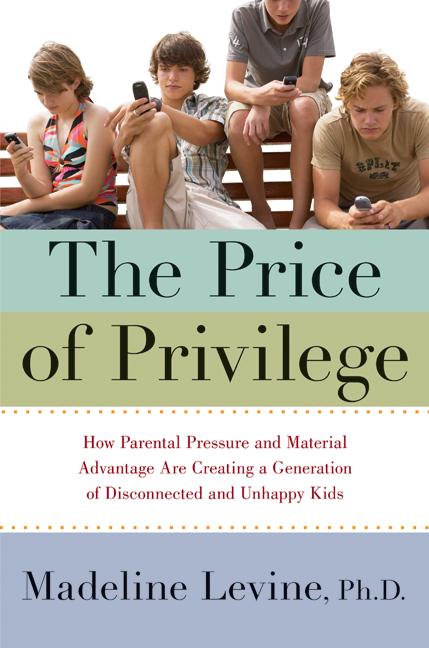
The book that prompted these thoughts, where I found my handwritten notes, is Madeline Levine’s “The Price of Privilege: How Parental Pressure and Material Advantage Are Creating a Generation of Disconnected and Unhappy Kids.”

Here are some quotes near my notes: “Both intrusion and overinvolvement prevent the development of the kinds of skills that children need to be successful: the ability to be a self-starter, the willingness to engage in trial-and-error learning, the ability to delay gratification… Warmth often slides into unhealthy dependency when we turn to our children for the loving connections missing in our adult relationships.”

Wow.

I think my kids are connected, happy and have aspirations towards responsibilty. But I have to nurture them and, at times, correct them.

If I give them warmth, which they need, it doesn’t mean I am sliding into unhealthy dependency. Nor does firm guidance mean I am lacking in love or warmth.

One startling premise of the book is that children of wealthy families are unhappier than children in poor families. Tough circumstances force family members to lean on one another, eat meals together and bond.

This book was a book club pick, although I never finished it and missed the discussion. Still, the premise bears discussing. Just today at work, my friend D. and I were talking about how difficult — and necessary — it is to let kids know your expectations of them. This helps them claim and feel proud of the ways that they have acted responsibly.

There is a happy and healthy middle ground between being your kid’s best friend and being the bad guy. I am finding that middle ground.

The Other Way To Read

I forgot how to read a real book. I am reading “The Other,” by David Guterson. I bought the real book, not the e-book book. (Thanks, Dad, for the bookstore gift certificate!)

And when I got to the end of an early chapter, I closed the book, and reminded myself to remember that I’d stopped there. On an e-book, there’s no need for book marks or reminders to yourself. The e-book remembers for you. You turn it on and voila, you’re right at your stopping-off point.

So back to my paperback book, a day later, I opened “The Other,” and started at Chapter 3 which seemed right, until the end of chapter. The narrator referred to a character as if I, the reader, should already know who she was. But I was yet to be introduced. Yes, I flipped back and realized I’d completely skipped Chapter 2.

I have become so used to reading on an e-book that I’ve lost my knack for reading a real book. It is taking me a moment to relearn, but I will get there. I’m smart like that.

Reading is one of my life rules, my routes to sanity — My Rule #2 is escape through literature. https://mbcoudal.wordpress.com/2011/02/19/rule-2-escape-through-literature/

https://mbcoudal.wordpress.com/