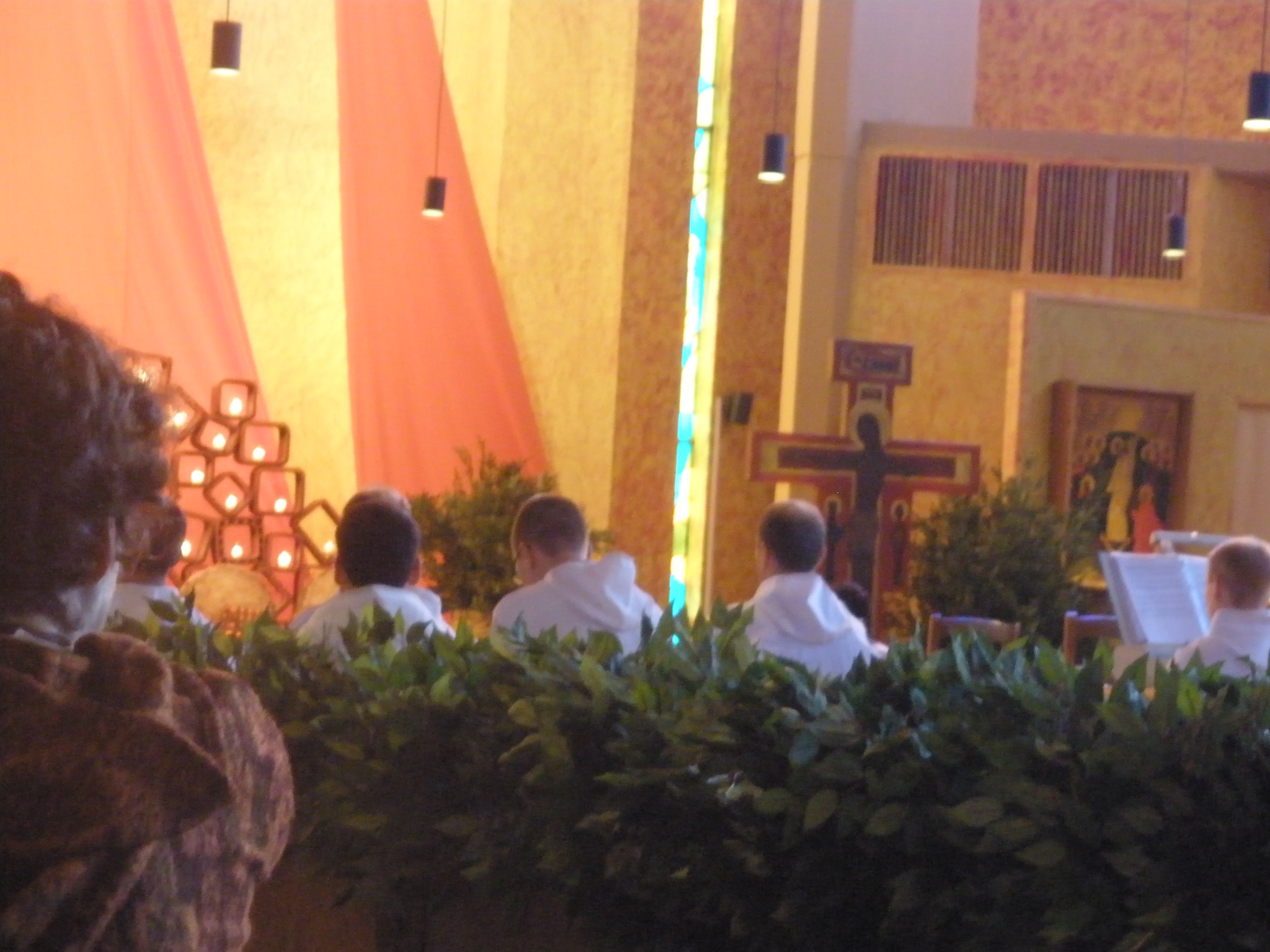
Taizé

We are each in the midst of a community — work, school, or family. Yet, at times, we feel alone. More times than I care to admit, I have written in my journal, ‘I’m so lonely!’ Yet how can I feel so alone when I am so often in a crowd?

What makes for community? How can I create community? Is there a path to becoming more communal and more loving? I looked for answers in Taizé.

Taizé was founded fifty years ago by Brother Roger who professed the power of Christian forgiveness, simplicity, and love. Four years ago Brother Roger was killed in the Taizé church, the Church of Reconciliation, by a deranged woman. After the murder, the brothers and the pilgrims still gathered for prayer. They forgave the woman. They prayed for love, the kind of love Brother Roger professed.

Along with ten members of the Greater New Jersey Annual Conference of The United Methodist Church, I was a pilgrim to the Taizé monestary in Burgundy, France. From October 11th to 18th, I was amidst more than 1,200 young people, mostly German students on autumn break.

I asked Brother Emile, a Canadian brother, “How do you make community? How do you 100 brothers from all over — from Catholic, Protestant, Orthodox traditions — live together so peaceably?”

“Forgiveness everyday!” Brother Emile replied. “Especially the everyday wounds.”

“It helps that we are from different countries. Because one can think, ‘Maybe it’s a cultural barrier and that person just has a different understanding,'” Brother Emile said.

While the brothers shared the value of forgiveness, I believe they also shared other values including:

Following Jesus’s footsteps

Giving unconditional love

Mentoring young people

Singing together

Learning together

Creating silence and space for reflection

Sharing a love of travel and global understanding

Celebrating ecumenism

Remaining open to individuals at times leaving the community to spread the word

Small Groups

In the late morning after a brother’s bible study, the adults met in small groups. At first our group consisted of four Danish people and four Americans. But soon we were joined by a German retiree, a Finnish religion teacher, and a Dutch piano tuner. We answered Brother Wolfgang’s questions: “What would you like to win or achieve in life? What currency does Jesus use to define winning in life?”

We agreed that to trade in the currency Jesus valued, we must exchange more love. We talked about the times we felt loved in God’s kingdom or community. We discussed whether heaven was reserved for Christians. As our times together progressed, we continued to talk about the big questions, such as: What happens when you die? How do we share the Good News? Who is Jesus now?

One evening Brother Alois, Brother Roger’s successor, spoke in the sanctuary before the evening service. He said in life, we need, “love, play, unity.” He said we need freedom and institutions.

“We need institutions. Here, in Taizé we have the institution of the bells ringing three times a day. That is our institution.” Brother Alois emphasized that we must work within institutions to make them more open and less judgmental. I believe that was the gist of his remarks. However, his words were being simultaneously translated from German into English. The Abbott’s remarks were cut short by the ringing of the bells. Brother Alois shrugged apologetically, as if to say, ‘There is our institution at work – bells ringing three times a day for worship.’

The Service

The worship at Taizé was very simple. There was singing, scripture, and silence. Once a day, there was communion. On Saturday night there was a candle lighting service, signifying the resurrection of Easter. At that service, the children were the first to light the candles and pass the light. The small group of children was beautifully diverse. The experience of being led by the children was moving. I wished my children were with me to witness the beauty of the candlelight and song. The singing never failed to inspire awe. The harmonies! And then, there was the silence, which lasted between five to ten minutes at each service. The silence reverberated with meaning and comfort.

On the altar, there was an orthodox-style crucifix. There was a jumble of about a hundred cement blocks with candles within. It’s easy to imagine that the candles symbolized the light within each of us — those of us at Taizé and beyond. We each have a light within and we lean, round shouldered, like cement blocks, one upon another. I think is one clue as to what makes for community — an ability to lean upon one another.

Most of the service, we faced the altar, but for the reading of scripture, we turned towards the center of the church. I was struck by the beauty of hearing Jesus’s message read in several languages.

Something happened at the end of one of the evening services. Instead of processing out, some of the brothers stood like sentinels around the perimeter of the sanctuary. People approached them to confess their sins, tell their stories, or ask for guidance.

On that first night when the brothers were available for counsel, I asked for prayers and healing. I won’t tell you specifically what we talked about. But when the brother laid his heavy hand on my head, I felt truly blessed and protected. I felt I was in community.

The last night at Taizé, after the service, Brother Emile stood beside where I sat cross-legged. I admit I felt responsible for him, because no one was approaching him to ask for guidance or forgiveness (probably because he spoke English first and most at Taizé that week spoke German). So I went to him. I asked for traveling mercies for our group from New Jersey.

Brother Emile laid his hand on my head and prayed something like, “Jesus, forgive your friend, Mary Beth.” Maybe that was his standard prayer because I did not ask for his forgiveness. And this may be another clue as to what makes for community — receiving forgiveness even when you don’t ask for it. I admit I liked that Brother Emile called Jesus my friend.

Challenges

Taizé, like all monastic life I imagine, is not without its hardships. For example, the living quarters are tight. The bunk beds are hard. You receive one large, ladled serving – maybe pasta, couscous, or rice and beans – at mealtime on a plastic plate with one utensil, a large spoon. The seats in the tents for meals and bible study are wobbly wooden benches. In the sanctuary, you sit or kneel on the floor. The sanctuary was warm, but outdoors it was cold.

I went to Taizé to lead a contemplative life. Yet, if truth be told, I also snuck away. I discovered treasures in the neighboring French countryside. I savored a precious cup of French coffee at a café and time away to write in my journal.

Yet never once, while on my pilgrimage to Taizé, did I ever complain in my journal, ‘I’m so lonely.’ I was a part of something bigger. I was a part of a communty. That made me feel so good.

How We Get Our News

I sent this email to about a dozen colleagues.

I like following trends at the Pew Research Center.

If you get a little time – 20 mins. – it’s worth it to watch this – Tom Rosenstiel on “The Future of News” from NPR.

He says a lot of what I’ve been thinking about journalism. It’s especially relevant for those of us doing media for the United Methodist Church. 

News is immediate, brief, interactive, unbundled, diffuse, browsed, international, community-based.

http://pewresearch.org/docs/?DocID=108

Blooming in Chautauqua

When we stayed in Chautauqua last summer, my sister pointed out a hydrangea and remarked, “Probably, that perennial has bloomed here every summer for more than 100 years.” Indeed, in Chautauqua, gardens, people, and ideas have blossomed for a very long time. Like a perennial, Chautauqua sprouts, grows, ages, appears to die, then blooms again.

History

When Chautauqua Institution was founded in 1874 by several Methodists, their aim was to encourage Christians to engage with the world in a rigorous and intellectual way. This spiritual, learning and arts center in Western New York was a response to the era’s histrionic emotionalism exhibited at evangelical meetings.

Chautauqua became a movement. From its inception as a place to engage Sunday School teachers in substantive Bible studies, it has become what it is today — a mecca for people of faith who seek to deepen their understanding of life’s meaning through religion, the arts, culture, and the humanities.

It’s hard to imagine that at one point most U.S. citizens knew about or had attended Chautauqua or one of its events. In 1924, its peak year, the traveling Chautauqua circuit visited 10,000 communities and more than 40 million people attended Chautauqua programs.

As an ecumenical and interfaith institute, Chautauqua continues to stand for “earnestness and breadth of vision and it is again becoming a leader in meeting the new religious needs of today.” (From an article entitled, “Aggressive Christianity at Chautauqua,” in the weekly Chautauqua newsmagazine written August 23, 1913.)

Tens of thousands of people continue to visit Chautauqua during its nine-week summer season. In 2009, I was one of those thousands of Chautauquans looking for rest, revitalization, and religious reconnection.

Fenton Deaconess Home

When I mention to friends, even church friends, that I had a great time in Chautauqua last summer, most of them stare at me blankly. None of my friends had heard of Chautauqua. So I’ve taken it upon myself to spread the word.

I learned about Chautauqua Institution when I worked in the finance department of the Women’s Division about six years ago. I learned the Women’s Division owns two summer homes there: the Fenton Memorial Deaconess Home and The United Methodist Missionary Vacation Home.

I longed to visit, but the photos in the brochure did not show any children. Among my three children, not one is a shrinking violet. However, Marva Usher-Kerr, fellow staff, encouraged me to visit with kids in tow. Since then, my children have grown up a little (even though I told them not to). Last spring, Becky Louter, deaconess office, also nudged me to make a pilgrimage to Chautauqua. The kids and I could stay in the deaconess home.

I reasoned that my kids might be ready. So as part of my professional leave from Global Ministries in the summer of ’09, my sister and I spent a week at Chautauqua. We took over the Fenton Deaconess Home with our combined six children between the ages of 6 and 12. Almost all of us had a single room at the Fenton Home.

The registration letter recommends a donation to the Fenton Home of about $39/day a person. The Fenton Home has six single rooms and one double room. The cost was well worth it! However, deaconesses can stay in the home and receive a free gate pass. (The gate fee to enter the institution is pricey, about $354 for the week. There are fees for parking and for the Boys’ and Girls’ Club, too.)

My 9-year old twin daughters had never before slept in single rooms. They showed their maturity by making their beds and tidying up their cozy rooms every day, tucking their stuffed animals under the white bedspreads.

Penny Krug was the deaconess hostess at the red-brick home. She and her lovable husband, Charlie, were completely unfazed by our little brood. Penny provided good company, delicious lunches and breakfasts, a beautiful (and tidy!) home to share, and the daily newspaper with our coffee at breakfast-time.

One day we were all excited at breakfast to discover that my six-year old nephew Joey’s picture appeared in the newspaper. There he was, eating cake, celebrating the birthday of the Chautauqua Symphony.

The Fenton Deaconess Home is located near Thunder Bridge, so called because bikes rumble over the bridge. Next summer (and I do hope to make it back) I will try to bring bikes. But I won’t need to bring bike locks. No one locks their bikes at Chautauqua. The trees near the Fenton Home were eminently huggable. I hugged the trees and smelled the flowers every day.

We made good use of the tennis and basketball courts and playground near our home. We made lots of friends on the playground, including a Brazilian missionary family. At a women’s ministry luncheon I met Dean Maxine Beach from Drew Theological University. The chaplain for the week was Rev. Barbara Lundblad, who officiated at my marriage 14 years ago.

Classes, Lectures & Kids’ Clubs

The week was a chance to catch up with old friends and make new ones. Chautauqua offers almost any kind of class that one can imagine. I had considered joining a women’s sharing circle, a digital photography class or a history of Chautauqua architecture survey. But I settled on two standbys: watercolor painting and non-fiction writing.

After my morning art class, I met my sister for the lecture at the 7,000 seat ampitheater. The theme for the week was, “What Makes Us Moral: An Abrahamic Perspective.” The first lecture was given by Elie Wiesel, Nobel laureate, author, and survivor of a Nazi Concentration Camp.

Other lecturers at various venues that week included: Bishop Gene Robinson of the Episcopal Church, Harvey Cox of Harvard University, Dr. Leila Nadya Sadat of the International Criminal Court, Dr. Robert Michael Franklin of Morehouse University, Dr. Ralph Williams from the University of Michigan; and Dr. Michael Gazzaniga from the Center for the Study of the Mind, University of California.

While we listened to the morning lectures, our children attended the Boys’ and Girls’ Club, the oldest daycamp in the country.

On the first day of day camp, I asked my oldest, “What did you do today?”

“We went sailing,” my son answered. A first!

Other activities with the children included: juggling by the Gizmo Guys; a Star Trek movie at the cinema; the Bat Chat, a scientific discussion on bats; a Pas de Deux ballet from the North Carolina; and a comedy performance by Jason Alexander.

One rainy day we jumped into the indoor YMCA-like community center pool. We left the small-town life one night to eat at a nearby Italian restaurant. Most other nights we ate at the snack bar near the town center by the Bestor Plaza fountain. One night we dined at Hurlbut United Methodist Church for an old-fashioned Thanksgiving feast. There, we kept our young server very busy. Little Joey traded his bright green pistachio pie for a gooey cherry pie.

Going Back

Towards the end of the week, my sister and I found ourselves listening to a lecture on discernment while doing a jigsaw puzzle on the wide porch of the Methodist Home, another United Methodist residence. I felt we’d come home. We chatted with the friendly hostess, Karen Douds and her husband Bob Douds.

While we did attend many lectures and activities in Chautauqua, this memory of sitting on the porch, just hanging out with my sister was a highlight. It felt right, like we were pieces in the big puzzle. We fit in. Even with our kids, we had become like those perennial flowers, blooming in Chautauqua.

To learn more about the Chautauqua Institution, visit their website at: http://www.ciweb.org/

Forward Them On

Living in New York City, I thought I’d seen it all but I hadn’t. Not until 1995 when I went to the Beijing women’s conference, the largest gathering of women in history.

So many women – so many ages, races, ethnicities – all of us, trying to make the world a better place.

I went with my comedy partner, Emmy Gay. We performed street theater outside of the Once and Future Pavilion, the technology tent. We called ourselves the Ebony and Ivory of Stand Up Comedy.

Before we left, we produced and performed comedy fundraisers at places like Surf Reality to piece together enough money to pay the deposit for our trip.

The day I left, I kissed my new husband good bye. “I’ll send you a postcard,” I promised.

But I did better than that.

I sent missives to my husband, not through snail mail, as we’ve come to call the handwritten form, but a new form of communication I discovered in China: email.

From the Apple tent, I emailed my tech-savvy father in Florida who then faxed the email to Chris, my Luddite husband who was working at the Depot, the family summer stock theater in upstate New York.

I felt like a wartime reporter, dashing off important, breathless, and newsy missives: 

I heard Aung San Suu address the SRO crowd from her house arrest in Burma! I simultaneously translated her words into French for a woman from the Congo.

I saw Betty Friedan!

I met Hilary Clinton and Pat Schroeder and they encouraged me and women from all over to run for elected office! They told us not to be afraid of politics.

When I returned to New York, I sold video footage that I’d shot and articles I’d written. I covered the cost of the trip which was about $2,000. But the experience was, as they say, priceless.

The kind of women I met and the commitment and creativity they had inspired me. They broke barriers of what women looked like; what women could do. Life was more varied than I could ever have imagined from my sheltered life on the Upper West Side of New York City.

When I was at the conference, I occasionally saw a middle-aged woman with her daughter. I wondered if the ruggedness of the experience – the long flight, the rain, the mud – was too hard on a girl. At the time, my husband and I were trying to have a child. I wanted a daughter desperately.

I am now a middle-aged woman with daughters of my own. I wonder if I could or would take my daughters to a UN women’s world conference.

I hope in their lives my daughters have the kind of experience that I had. I hope that my girls will learn of the beauty and power of women in all their diversity, the intelligence of women, the good will and sisterhood of women from many countries, the vast array of possibilities for women and girls.

And I also hope that they have someone nice at home waiting for them – mother, father, sister, brother, husband, partner, son, daughter, or friend – eager to hear of their adventures; read their emails; forward them on.

I hope that my daughters and son will travel the world to make friends and promote peace. Then, of course, I hope they come home, safe and sound, enlarged by the world, as I have been – that they, like me, will be made bigger as they see the world grow smaller.

oh yay me!

Today I finished my YA novel with the fabulous and fun NaNoWriMo. I wrote 50,000 words in less than a month. I’m proud of myself. I actually cried when I finished. I was relieved and happy. But now I’m feeling untethered. That’s good. I think..

Of Love & Alzheimer's & WSJ

This is a personal email I sent after reading this article in the Wall Street Journal
 Dear Dr. G.,

I am writing to you as a member of The United Methodist Church and not as the staff writer of a United Methodist agency. My husband has Parkinson’s Disease and I attend a support group for spouses of the chronically ill.

It’s great that the United Methodist Church was mentioned in the article in the Wall Street Journal on Love and Alzheimer’s!
In a loving, kind, and diplomatic way, I ask you to reconsider that the marriage vows of “sickness and health” apply to marriages where one of the spouses has serious mental compromises. I believe that this view has caused the well spouses to become unhealthy, unhappy, and uncaring for their own basic needs, contributing to the stark statistic of earlier deaths of the caregiving spouse.

A lovely older gentleman, Gil, in a support group I attend has been often near tears about his wife’s demise with Alzheimer’s. She is currently in a nursing home and has no recognition of her husband. He has found friendship, love and solace with another woman, who often visits the nursing home with Gil. Our support group has been heartened to see Gil happy and capable of now dealing with his wife much better.
I believe that within Christian denominations – as in the Jewish faith quoted in the article – there is room for more compassion and understanding as to the safe and life-affirming decisions that a well spouse like Gil may make about his own need to continue with life, even as his wife’s life continues on a difficult and challenging trajectory. The truth is she is not the same person, she does not even recognize him. It is very difficult for him. I applaud his new love, while also applaud his deep commitment to his wife. Life is complicated. I have compassion.

Thanks for reading this. – MB


I felt great when I received this email….
Thank you, MaryBeth

I greatly appreciate your letter and your compassion.

I do agree with you, personally. In the article, I was asked the stance

of the UMC on this matter.

I reported what the UMC states regarding marriage. Although I may

differ with the official church position on some matters (including its

views on homosexuality), as a staff member of an agency of the church, I

am obligated to share what I believe the position of the UMC is. And as

such, in the interview, that is what was reported.

I am hopeful that the UM Committee on Older Adult Ministries will

address this issue and bring some form of legislation/resolution to the

next General Conference.

In the meantime, please know that I, too, am sympathetic and

compassionate; but, sometimes, official church policy does not always

reflect our sense of compassion.

Again, please know that I appreciate your letter very much, and I, too,

wrestle with these and other issues that impact the spiritual well-being

of older adults.

If I can be of further help, please let me know.

Grace and peace,


R.G.

Started Nanowrimo

Oh it is so hard. Here is me whining. It’s too hard. What am I doing?  I wanted to finish the 2,000 words every day before noon. And sat with my notebook at the kitchen table, writing before the kids had to get up. They were late for school and complaining of sore throats. I might’ve written 500 words…

And now I’m at work and have to do work-type writing. Ah well, the solution is always – MORE COFFEE. 2,060 words done, 47,940 to go…

Met the Publishers

Of Adirondack Explorer. A lovely cocktail party Thursday night overlooking Lake Champlain from a white house perched on a hill.

Really charming magazine about hiking, nature, promotion of the Adirondacks. Yesterday, I leafed through the magazine from poolside at Camp Normandie. It looked like my Rattlesnake hike story would fit in. I doubt they pay much. But both Ben and I took photos from the top of the mountain. I’d like to rework my story over the next day or so, then send it in.

Even if they pass on that story, maybe there’s another that would work!

One More Thing

Wow! Great issue of UMR – July 24, 2009.

Who followed me? How did you know?  Because that was obviously me you wrote about in “When Busyness Sabotages Ministry, Q&A Interview” with Mary Jacobs.

“Overdosing on overcommitment?” Yes. I call it being oversubscribed.

My mother jokes I have “One More Thing” syndrome. She coined the phrase when I’d taken her and my three kids to the Bronx Zoo one summer afternoon.

As we were leaving – hot, humid, tired, crabby – I spotted the gorilla house. “One more thing, everyone, let’s stop and see the gorillas.”

One More Thing may be amusing when you are at the zoo, but at work it’s another thing. When you have to finish glancing through your high school boyfriend’s vacation pictures before you get to the article that was due yesterday, you’re in trouble.

Facebook is perfect for one more thing.

My friend and the kid’s babysitter Dierdre and I promised each other we wouldn’t go on Facebook or on our cell phones for 24 hours which is the only reason I’m getting this letter to the editor done.

I think many Facebook users have acquired this unique form of One More Thing, or ADD.

I was having tea with a good friend I hadn’t seen in months. She was up at our country house and we were sitting at the kitchen table. I kept wanting to check Facebook. I was feeling restless, just talking. And we were talking about good, deep, juicy stufff  – our boys’ puberty, a dear friend’s death, family finances.

I had to literally tell myself, “Mary Beth, sit still. This is what life is about, sitting at the kitchen table, talking to a dear friend.  Not swapping witticisms with an internet friend.”

Because the internet friend is like a photo in your wallet. You can take it out and show it off, glance at it. You can even delete their remarks (not that I would ever do that!)

But the real friend at the kitchen table? Well, she might go off on a tangent. I can’t click her off. Any way, I should – I want to – hear what she has to say. “X (a 6th grade boy) introduced Y (another 6th grader) to internet porn.”

Oh no. I really do NOT want to hear this. But I should pay attention. Even if I would rather read about my cousin’s baby’s first trip to the pediatrician or my former student’s flight to Uganda. Yes, they are interesting.

I would like to write about this topic more. But the right here and right now beckon. I have to make breakfast. Then, if I am lucky, I may spend some time just sitting at the kitchen table, catching up.