Reversals

In Poetics, Aristotle said — yes, I’m smart like that, quoting Aristotle — we move from ignorance to knowledge, from enmity to friendship, from neutrality to commitment.

Lynne Barrett taught this juicy class on plot at the International Women’s Writing Guild this week at Yale.

In stories, she said, everyone has to have a piece of the puzzle. No one character can hold the whole story.

Lynne gave us the timeline from the movie, Casablanca (which I’ve never seen) in which Bogart’s character moves from nonchalance to commitment.

The flashbacks in the story move the story forward. People don’t just ruminate on their past for no reason. The lover’s past (in Paris!) sparks an understanding that propels them to take action.

In all narratives, a reversal is necessary. Cinderella goes from low status to high status. I always taught this in my drama classes, that this is what makes for comedy — a high-status character becomes low-status — or visa versa.

This is why Lynne said the story of Spitzer is a better plot than the story of Schwarzenegger. He fell from the top, not when he’d left office.

But the reversal is not just “who’s up and who’s down.” A secret become public. A single person becomes married.

This class nudged me to reconsider the lame plot in my young adult novel from last year’s NaNoWriMo (national novel writing month).

When I mentioned to Lynne, I had a novel, written in one month, she said, “Yes, Chris Baty, the founder of NaNoWriMo, wrote the book. No Plot, No Problem. No plot? Big problem!”

Incidentally, Barrett taught with my friend Dan Wakefield at Florida International University.
Book Proposal Questions

Melissa Rosati ended her workshop with these questions:

  • Is a book really the right first product for me? I love books. I have already blogged. So, yes.
  • What do I want the book to do for me? Make me a ton of money, earn me some street cred, get my distinct voice out there in the marketplace of ideas.
  • What is the relationship you want with your target audience? To empower people to share their ideas through writing. To inspire writing that leads to personal transformation. But, hmmmm, in terms of relationship, that’s a tough one. I don’t know. How committed does an author have to be to her readers? I’ll answer their emails, comment on their updates, teach workshops, attend readings, read their writing. But, let’s face it, all relationships take time. Do I have the time for another relationship?
  • If you do not have business experience, who are your trusted advisers? This is also a tough one for me. I do not like asking for help. I like being the helper. I’m not sure my peeps are business peeps.
  • What’s your budget? How much are you willing to risk? Ummm, $150 maybe?

These questions come from the workshop The New Rules of Book Proposals which I stumbled into late because the parking garage was literally a mile from the International Women’s Writing Guild classrooms on the Yale University campus. (And having a book published wouldn’t make the parking lot any closer.)

I wish I caught the beginning of the class because I have a lot to learn about book publishing.

Writing the Details

Here’s one of the sparkling gems from Southern writer Pat Carr’s Memoir and Fiction Writing class.

Set the scene with three or four details. Here are ten ideas of what Pat means by sensory details and then an example from me on my story set on a playground.

  1. Odor – wet sand
  2. A time of day or season – end of summer
  3. Temperature – warm and humid
  4. Sound – children laughing
  5. Important object – small charm bracelet
  6. Dominant color – beige
  7. Dominant shape — circles
  8. Something that can be touched – curly hair
  9. Taste – rain in the air
  10. Certain slant of light – late afternoon sun

I love number 10. Pat was inspired by Emily Dickinson. Love Dickinson: “Tell all the Truth but tell it slant.”

Light is so important, I think, as I write from a sun-soaked bench cloistered in a square at Yale University attending the International Women’s Writing Guild conference.

Pat Carr’s writing exercises, like this one, can be found in her book Writing Fiction with Pat Carr. Her new memoir is One Page at a Time: On a Writing Life.

Drowning in Literature

I’m gonna drown myself in a book. Not just any book. A good book. A book with a fine bouquet.

Paperback or Kindle. From a box or bottle. Bought or borrowed. It’s all good. It all works, gets me out of my own head and into a different space.

I love love love love love reading. I can read everything and anything.

I took this picture last August at my friend's summer house on Saranac Lake.

When I’m down I grab a book and I down it.

I don’t care if it’s self-help (need it!) chick lit (love it!) or trash (gimme!).

I have been feeling a little down this week — maybe it’s transitioning the kids from school to summer or a slight anxiety about Chris’s health or simply not enough sunshine.

So I start with an appetizer, the front section of The New York Times, then I move on to the main course, right now reading Franzen’s Freedom. For dessert, I might read Parker Palmer’s Let Your Life Speak (Thanks, Juliana for lending!).

I get lost in reading. I have to have something to read with me at all times — in my purse, beside my bed, in my bike basket. Something to comfort, transport, drown me.  Reading is my great escape.

And it is my Number 2 Rule — Escape Through Literature. I’m going to read a lot tonite, but first I have to finish watching the movie Chris borrowed from the library, The Heart Is a Lonely Hunter by Carson McCullers.  That’s right, I’m drowning myself in a movie based on great literature. That counts too.

Keep It Brief

For greatest impact, when writing a blog post:

  1. Say it simply. “Hello.”
  2. Then get out. “I must be going.”
  3. Use short sentences. “Just do it.”
  4. Keep the words to one syllable. “Mr. Gorbachev, tear down this wall.” – Ronald Reagan
  5. Use short, punchy sentences. “In modern war… you will die like a dog for no good reason.” – Ernest Hemingway

Maybe this is why Twitter is so fun. I have to be lean in my writing. I have to convey a lot with just a little — 140 characters.

I love Twitter. I love its brevity. I love getting to know a person just from their short status updates. The man who says good morning from Japan, the woman who lists what everyone’s reading, the writer who posts opening lines for short stories.

I like to skate on the surface and sometimes click on the link and go deeper.

But sometimes — like right now, there’s not enough time to go deep.

This photo has nothing to do with the post. I took it at Bossey Ecumenical center in Switzerland.

There’s profundity in simplicity. So keep it brief.

Hello. I must be going.

Happy Bloomsday!

Grab some James Joyce. Read a section from Ulysses.

It all takes place on 16th of June and yes a day like others and yes a day like today and here we are in June in bloom and the sun and taxicabs as bright as dandelions and summer breathing down our neck like pearls…

Tonite I am celebrating Bloomsday with friends at the Irish American Bar Association at the rotunda at the Supreme Court in NY. (Thanks to my Irish attorney friends in book club).

We are promised readings from Molly’s soliloquy and general bawdiness.

I look forward to discussing the First Amendment — and how does that freedom relate to Anthony Weiner? And who among us is the first to throw stones at Weiner? I would like to know. Because, God knows, no one wants their tweets, updates, private messages, instant messages, blogs, emails, combed through too carefully. Not me.

And yes I am not a preacher nor a politician. I am a writer. And what power does a writer have?

Oh I don’t know. As the invitation to the Bloomsday celebration stated, “James Joyce did not just give us one of the greatest works of world literature. He also gave us a landmark ruling in First Amendment jurisprudence.”

Thanks to the Irish American Bar. Thanks to the Boston Globe for this article:  http://www.boston.com/bostonglobe/ideas/brainiac/2011/06/its_bloomsday_l.html and this awesome picture of Marilyn Monroe reading Ulysses.

And thanks, of course, to Joyce himself for this:

“God of heaven theres nothing like nature the wild mountains then the sea and the waves rushing then the beautiful country with the fields of oats and wheat and all kinds of things and all the fine cattle going about that would do your heart good to see rivers and lakes and flowers all sorts of shapes and smells and colours springing up even out of the ditches primroses and violets nature it is as for them saying theres no God I wouldnt give a snap of my two fingers for all their learning why dont they go and create something I often asked him atheists or whatever they call themselves go and wash the cobbles off themselves first then they go howling for the priest and they dying and why why because theyre afraid of hell on account of their bad conscience ah yes I know them well who was the first person in the universe before there was anybody that made it all who ah that they dont know neither do I so there you are they might as well try to stop the sun from rising tomorrow the sun shines for you he said the day we were lying among the rhododendrons on Howth head in the grey tweed suit and his straw hat the day I got him to propose to me yes first I gave him the bit of seedcake out of my mouth and it was leapyear like now yes 16 years ago my God after that long kiss I near lost my breath yes he said I was a flower of the mountain yes so we are flowers all a womans body yes that was one true thing he said in his life and the sun shines for you today yes that was why I liked him because I saw he understood or felt what a woman is and I knew I could always get round him and I gave him all the pleasure I could leading him on till he asked me to say yes and I wouldnt answer first only looked out over the sea and the sky I was thinking of so many things he didnt know of Mulvey and Mr Stanhope and Hester and father and old captain Groves and the sailors playing all birds fly and I say stoop and washing up dishes they called it on the pier and the sentry in front of the governors house with the thing round his white helmet poor devil half roasted and the Spanish girls laughing in their shawls and their tall combs and the auctions in the morning the Greeks and the jews and the Arabs and the devil knows who else from all the ends of Europe and Duke street and the fowl market all clucking outside Larby Sharons and the poor donkeys slipping half asleep and the vague fellows in the cloaks asleep in the shade on the steps and the big wheels of the carts of the bulls and the old castle thousands of years old yes and those handsome Moors all in white and turbans like kings asking you to sit down in their little bit of a shop and Ronda with the old windows of the posadas 2 glancing eyes a lattice hid for her lover to kiss the iron and the wineshops half open at night and the castanets and the night we missed the boat at Algeciras the watchman going about serene with his lamp and O that awful deepdown torrent O and the sea the sea crimson sometimes like fire and the glorious sunsets and the figtrees in the Alameda gardens yes and all the queer little streets and the pink and blue and yellow houses and the rosegardens and the jessamine and geraniums and cactuses and Gibraltar as a girl where I was a Flower of the mountain yes when I put the rose in my hair like the Andalusian girls used or shall I wear a red yes and how he kissed me under the Moorish wall and I thought well as well him as another and then I asked him with my eyes to ask again yes and then he asked me would I yes to say yes my mountain flower and first I put my arms around him yes and drew him down to me so he could feel my breasts all perfume yes and his heart was going like mad and yes I said yes I will Yes”
I’ve blogged about James Joyce before. About how his writing inspired an epiphany — when I looked up and saw a bird circle. https://mbcoudal.wordpress.com/2011/01/03/my-3-words/

Everything’s Fine

Putting this spin on my life is exhausting. I was thinking about this as I scanned the Michael J. Fox article and looked at his photo on the cover of Good Housekeeping when getting my nails done yesterday.

Sometimes it’s not fine. Sometimes I want to go, “Bad deal. Need a do over. Not happy. Nope. Not working out here.”

I feel pressure — from Michael J. Fox? — to make the difficult seem easy and the abnormal seem normal. So what if my husband has Parkinson’s Disease? I should just grin and bear it (as Tracy Pollan seems to do. You don’t hear her saying, “It’s tough living with this dude who has Parkinson’s Disease.”)

Look, Michael J. Fox is an amazing person doing amazing stuff but not every person with Parkinson’s can perform at his level. Perhaps Fox’s nobility and engagement in life (and his more abundant resources of physical therapy and money and access?) make me and other families with Parkinson’s feel a failure. Sometimes, the disease actually kicks your butt and you are not happy and smiling and ready for the cover shot. You are not always looking up.

Occasionally someone will say to me, “I don’t know how you do it. He would drive me crazy.” And for that I say, “Thank you!” Because the people who say, “He looks great. Can’t even tell there’s anything wrong.” make me feel bad, like I shouldn’t notice his crazy behavior or at times embarrassing demeanor. And to those of you who are right now saying in your head, ‘Mary Beth, it’s worse for him.’ Yes, you’re  right. And I know that. And I’m sorry and I feel sad about that. I try for compassion on a daily, hourly, momentary basis. But this is my blog and my truth.

How positive should I be? How much is my positive attitude denial? How optimistic can any caregiver be? How encouraging should we be when faced with a disease in the family? And can we acknowledge in all honesty that times can be difficult?

And of course times can be great. And I look for and find joy. I try to follow my own rules to live by and find a deeper meaning to my life.

I do have a lot of gratitude for the people in my life, especially for my husband. That doesn’t mean that I don’t have a lot of frustration too. It’s a dance of honesty, encouragement and denial. And to all of this I say to Michael J. Fox’s smiling face on the cover of the magazine, “Everything’s fine, except when its’ not. I’m always looking up, except at times, when I look down. And life is made of moments of happiness and sadness; health and illness. It’s all part of the fabric of this life.”

Blogging — Going A Different Way

On Faith

I love how easy it is to change directions on WordPress. I changed the name of A Church A Day blog to My Rules https://mbcoudal.wordpress.com/ when I realized visiting a church a day was too much of a commitment. (Although I just won a journalism award for that blog, so I will probably go back to A Church A Day when the kids go to camp this summer.) I also want to stick to My Rules because I want to be accountable to the 7 life rules I made up for myself.

On Fitness

I changed the focus of my running blog http://runningaground.wordpress.com/ to health when I found out I had basal cell cardinoma. But I still love the idea and name of Running Aground. I am logging, blogging, slogging my way to fitness.

On Writing

I changed this blog http://gettingmyessayspublished.wordpress.com/ to The Connected Life — a much better title than Getting My Essays Published. At first, this blog had a private setting because I wanted to keep track of where I was sending my essays and where they were, or were not, getting published. It seemed a personal and boring endeavor, the pursuit of publication. But then I wanted to comment on so many things about social media. I’m not really in love with this blog’s URL or the name. It’s kinda meh.

On NYC

My favorite of my blog titles is My Beautiful New York. This is the only title I haven’t changed since I started almost two years ago. I still love the name My Beautiful New York.

The title says what a blog title should say: Here’s something delicious. Here’s what I’m passionate about — or at least musing on. For a few months My Beautiful New York was mostly pictures downloaded from my phone.

When I post and want to refer back to an earlier post, I sometimes wonder Which blog did I write that for? Then I Google MBCoudal and a tag. 

And then there are times I wonder which blog to post on — should I post my musings on My Beautiful New York or My Rules? Like those several posts about the sidewalk art. They seemed like quintessential New York stories, but ultimately, I decided they had more to do with an epiphany or synchronicity. And that jibes more with My Rules.

Also there is this questing of PostADay2011, posting every day of 2011. The tag PostADay2011 is getting too big in my clouds. It’s dwarfing my other tags, so I’m going to have to untag PostADay2011.

I’d do it now, but I’m going to watch a movie with my kids. I love my kids even more than I love blogging. I do love blogging, especially because you can change their names. Kids? Not so much.

How Lucky — To Work So Hard!

My fake spouse reassured me, “It takes a long time to become an overnight success.”

We were at a call back for a Kodak commercial. I was auditioning for the part of a young mother. I didn’t get the part, but I got that awesome advice!

I had been bitching about my slow-moving talk show career to the actor who was auditioning as the father. I said, “You know I worked so hard on my cable show, Mary Beth & Friends, and honestly, I am surprised I haven’t become the new Katie Couric.”

This was years ago. I never forgot my pretend husband’s wisdom. It kept me going. Success takes time. Fake husbands (and actors) can be so smart.

But now it seems the whole world is discussing this wisdom:

Luck is out. Hard work is in.

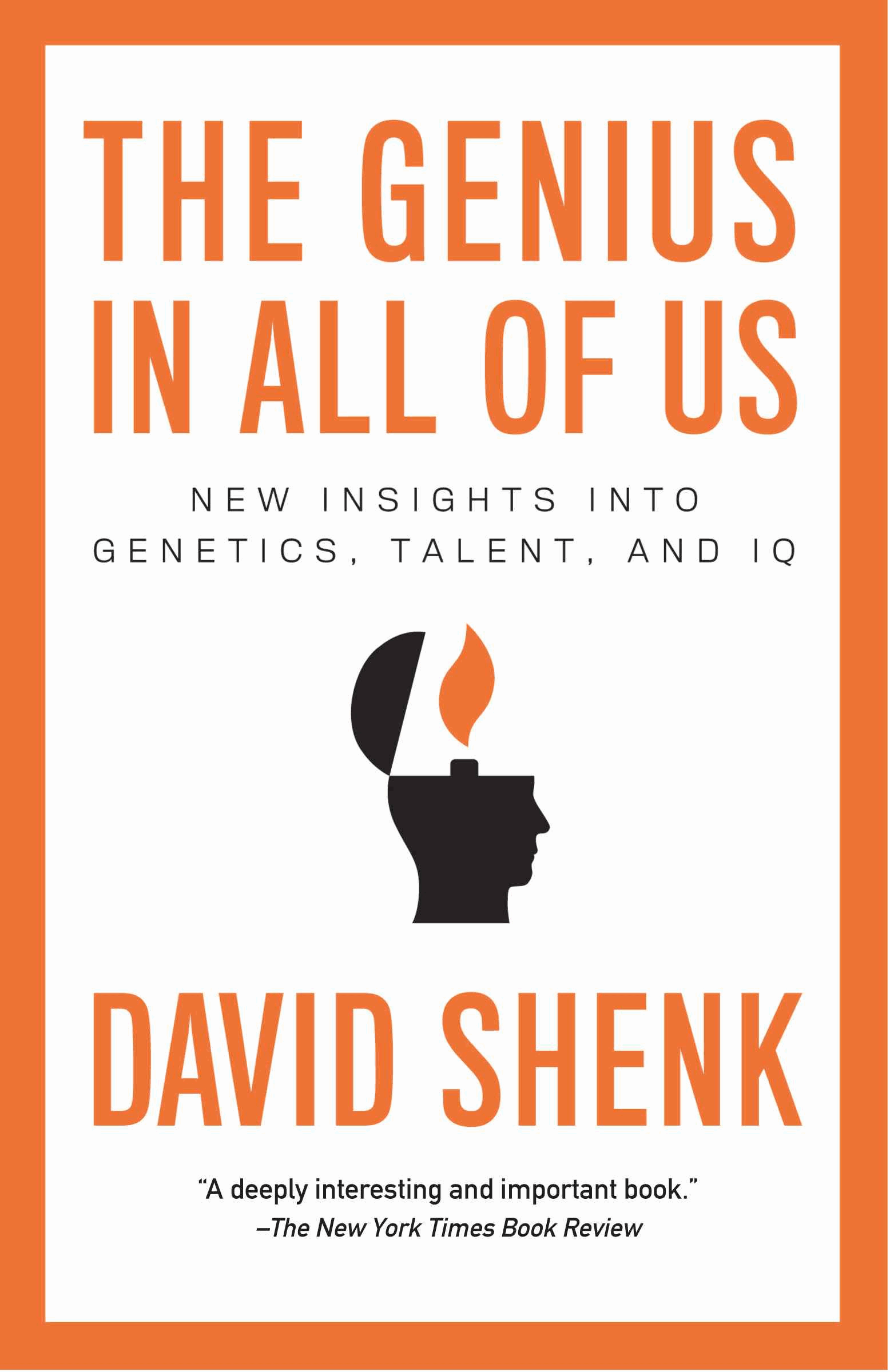
Last night, I was listening to the Ted Talk http://www.youtube.com/watch?v=xE6lWGzO_7A from David Shenk, author of The Genius in All of Us. http://geniusblog.davidshenk.com/

Here’s what I got. Genes don’t matter a hill of beans unless you work hard. There’s no such thing as born smart!

This is a difficult revelation for me – me! The daughter of a genius (okay, two geniuses)! I always felt I had a slight genetic, intellectual advantage — swimming as I was in the Mensa gene pool. But no, sorry, not so.

My working 3 jobs, auditioning for commercials, and producing and hosting my own cable show probably mattered more to my current success (ahem!) than my brainy family tree.

I was thinking about this today, when from the LinkedIn group, LinkEds & writers, Indy Quillen, emailed her introduction.

Indy said, “Many years ago, when I excitedly showed my martial arts teacher my first place trophy, he smiled and said, ‘See how lucky you are when you work hard?’ I’ve never forgotten that lesson!”

Love that!

I don’t know how to fit in my awareness of the importance of hard work to my Rules for Living.

Maybe Rule Number 3? Remember your hoops of steel (priorities) — even when you think success should occur magically and quickly. Success takes time.

And hard work is 1 of 3 parts that makes up community:  https://mbcoudal.wordpress.com/2011/05/07/what-is-community/

CBS Producers

Producers John P. Blessington and Liz Kineke from CBS Religion and Culture Series spoke to New York’s Religion Communicators Council at lunch today in a conference room in the Mormon temple near Lincoln Center.

The two talked about their love for producing television documentaries on topic’s like this year’s line up — unemployment, the environment, immigration, and pluralism — all from a faith perspective.

Melissa Crutchfield's hands at a memorial for Sam Dixon in Haiti. A UMNS photo by Mike DuBose.

The two won a 2011 Wilbur award from the RCC for their documentary, “Haiti: Religion’s Response to Disaster,” which featured my colleague, Melissa Crutchfield, disaster relief exec at UMCOR, (you can hear her on Youtube at: http://www.youtube.com/watch?v=H-TEg7om4y4). I didn’t see the Haiti documentary but I think it included the story of our beloved UMCOR colleague Sam Dixon who died after being trapped in the collapsed Hotel Montana in Port-Au-Prince.

Blessington spoke about making the decision to focus on Haiti, even though, “We knew there would be fatigue on the issue of Haiti.” The producers didn’t shoot new footage in Haiti, but relied on B-roll from Church World Service and other faith-based relief agencies.

The discussion was mostly in the form of a Q and A. I asked if the producers would consider another topic that is often seen as heated and confrontational in culture and religion — sexuality as a gift from God. I mentioned the cover story in today’s New York Times http://www.nytimes.com/2011/04/19/us/19gays.html about the struggle of evangelical college students to affirm their sexuality identity.

But Blessington said they couldn’t cover that. Any television show on sexuality and religion would irritate too many viewers he said. Hmmmmm..

That’s too bad since their documentaries seems in-depth and compassionate. And on compassion, Blessington mentioned that he loves the Charter for Compassion. And who doesn’t? How can you not love a charter that overleaps religious differences to unite the world through the golden rule? http://charterforcompassion.org

The CBS Religion and Culture series website is pretty lame, but they’re working on it. You can check out when their documentaries will be released and in which local markets at: http://www.interfaithbroadcasting.com/rc.aspx

As always, the couple of dozen religious communicators in attendance were pretty interesting people — Christian Scientist, Mormon, Jewish, Catholic. I chatted with a guy who is producing events called Laugh Out Loud to end bullying through laughter.

So the luncheon started with a discussion on Haiti and religion, and ended with laughter and bullying. And that’s my report from this month’s RCC luncheon.