Every day I wake before the kids. I put on coffee.
In New York City I write at the kitchen table with a view of a wide airshaft. Usually there are construction materials piled in a corner back there. On Tuesday and Saturday mornings, garbage pick-up days, I hear the porters wheeling bins of garbage. Sometimes I notice a light in the windows in the backside of another apartment building. I wonder if someone’s just had a baby, is going to the gym, has an early breakfast meeting, or is getting dressed. I wonder what they’re doing up so early.
But then I go back to my writing, submerge myself in my own world.
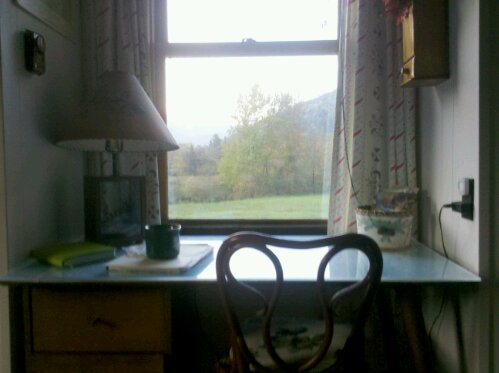
This was my view from the Mountain Meadows Bed and Breakfast in Keene Valley, the Adirondacks.
When I am up in the Adirondacks, I still wake before the family. I make some coffee. Or like the other morning, I woke up at Mountain Meadows, a sweet little Bed and Breakfast in Keene Valley. I had a lovely writing spot.
My mind wandered. I wondered about nature, not about people. I thought Wow, is that a hawk? Maybe it’s just a crow. Sunlight moves across the mountain in a parallelogram.
I don’t write. I just wonder. Sometimes beauty inhibits my creative flow, but feeds my soul.
In the creative writing workshop I taught yesterday, we wrote haiku. This traditional Japanese poetry looks surprisingly simple — seven syllables, then five, then seven. But we found it challenging, a habit of writing we are unused to.
I told the class to think of the poem’s structure like the cage around a songbird. You have to confine your poem, your bird, your meaning, within the frame. Within the constraint, the songbird can sing freely. And then the poem can flow like a song, traveling far from its cage.
I gave us about 10 minutes to write our haiku. Here are a few of mine.
I have been teary
Hoping to be understood
Fearful of shadows

Somehow I miss you
Your crazy way of kissing
I live on longing

Need to swim far out
Farther than you can catch me
Splashing, laughing, far
I took this photo in Montreal. Coffee in another country always tastes better!
The Coudal family drinks a lot of coffee. More coffee than you and your family, I bet. Not that it’s a contest.
I love coffee. When I started blogging, my first post was about how much I love coffee. (I’ve rewritten this.)
I started drinking coffee at NYU. My ex-husband Jim got me hooked. Jim put sugar and milk in his coffee. If it spilled in his saucer, he slurped it up. I thought that was cool and kind of rebellious.
I just added milk. That was in the ’80s. Back in the day before hazelnut, mocha latte, grande, etc. My ex and I split up eventually. (The slurping from the saucer probably didn’t help. Things that once seemed cool became annoying.) But I never split with coffee. Once for Lent, I considered giving coffee up. But I didn’t want the headache.
At the New Age Spa, in Neversink, New York, a few years back, I heard they didn’t allow caffeine.
On my first night there, at the communal dining table, a frizzy-haired woman slipped me a pack of instant coffee across the table. She was very sly.
“You’re new here right?” she asked.
“How did you know?” I asked. I’d just arrived from the car.
“You’re wearing a cashmere sweater and pearls. Look around — Everyone else is in sweats.”
I looked around. She was right. I could see I was going to like this place.
“I’m checking out tomorrow morning,” the woman said. “But you can have my extra coffee packets. Don’t let anyone know.” She looked around, her eyes squinting.
I never used her packs of Sanka, but just knowing that I had the little packet coffee in the back pocket of my sweat pants comforted me.
Coffee would be there for me if I needed it. And I do need it.
Coffee loves me unconditionally.
Recent studies show that coffee keeps women from depression. Check out Consumer Report Study on Coffee. Four or more cups a day? Fine, you’ll be 20 percent less likely to be depressed. So, go ahead. Have another cup of coffee. Better yet, have four. I dare you. Just try to keep up with me!
Siesta Key Beach -- the world's most beautiful beach
I don’t want to be too dramatic. No, not me. But on the JetBlue plane ride home from Florida on Sunday, we hit an air pocket and we suddenly dropped far and fast. It felt like we dropped 100 feet. Some people gave out a quick short scream — like we were on a roller coaster ride. I didn’t scream. I even thought, Good for you, MB, for not screaming and adding to the general terror level around here!
I had just closed my laptop on my tray table. My seat mate’s Diet Coke flew all over my arm and my tray table. And I thought, if I live and my hard drive needs replacing, I’m so screwed with the guys in my workplace IT department.
The seat belt light ding-ed on. Once we leveled off to normal turbulence, the pilot was on the loud speaker, assuring us that other planes ahead of us had also experienced this weather.
“So we’re not alone,” my seatmate, Win, said.
We were in the 5th row. I looked back, down the aisle, and it was littered with ice.
Wyn said he had his pilot’s license. He assured me that the kind of clouds we now saw outside the jet’s window, long and thin, were less dangerous than the clouds, big and fluffy, we’d just flown through.
“You’re scared,” Wyn said.
“Yes,” I said. “I can’t have anything happen to me. My kids need me.” I tried to breath. I explained that at times, I was a single parent because of my husband’s Parkinson’s Disease.
We stopped talking. To distract myself from my clammy hands and shortness of breath, I turned on the TV. I channel-tripped across a couple of dozen channels. There was nothing on. Nothing. Nothing that comforted me or distracted from my thoughts — we were about to die. There were home decorators, chefs, political pundits all yapping. But nobody was saying, “You are going to be okay. Don’t worry. Life is deep and rich. You’re still a part of it.”
What did comfort me? The real people around me, like Win, who was steady and unflappable; the flight attendants and their calmness; the idea that planes are designed to fly, even through turbulence and big air pockets.
I noticed the flight attendants seemed to be ministering to someone laid out in the back of the cabin. That didn’t comfort me.
Once we landed, I thought, I don’t want to fly again for a very long time. Unfortunately, I’m going to have to fly again in a few weeks.
I worried about my laptop, but when I turned it on again, thank God, it booted up.
Business as usual. Just keep flying. One day at a time. We’re not alone.
It is not inadequacy that is my enemy, it is my belief that I should be above inadequacy.
Perfectionism is the enemy of art.
On a few summer afternoons, my father and I painted on the porch of the Big House. We’d just come back from painting classes in Burlington, Vermont and we could experiment with new techniques.
The feeling of a paintbrush in my fingers thrills me, but my paintings? Not so much.
I fail to make art or share it, because I know it’s not perfect. Not yet. I do not want to expose myself to other’s criticism or hear their good and helpful ideas.
I think I must throw it all out there, acknowledge my work is a work in progress. As is my life.
I remember this slogan from a 12-step meeting, “high perfectionism, low productivity; low perfectionism, high productivity.” If my work is good enough and done, that is far better than perfect and never done.
I found my kids’ classrooms and tried not to embarrass them by drawing attention to my enthusiasm for learning.
As reported in the Times magazine article (What if the Secret to Success is Failure? by Paul Tough), the head of school at Riverdale, Dominic Randolph, is passionate about developing character and resilience. On Parents’ Day, Randolph spoke about his passion for learning. Here are some of Randolph’s remarks and my responses:
1. Grammar, syntax — this skills are important. But more important is voice. Voice is mystical. “Finding voice and developing it is like tending to a campfire in the night; it is easily bulldozed.”
Love this. I can have skills but I need craft, which leads me to my unique voice. Craft only shows up when I write daily. Writing, like meditation, is a practice, not an achievement. Voice is difficult to attain and easily dismissed.
2. For skills and knowledge to stick — and our writing to be compelling, simple, elegant — we need emotion and story.
Humans are wired to love stories. There is something in our brain chemistry that begs for a beginning, middle and end. We are always in pursuit of closure and resolution to our stories, but we need and love the pursuit.
Love this picture of kids at Riverdale Country School. Getting out of the classroom and into the sunshine.
3. Learning is hard. We are all in it together. We need to coax and encourage one another to share our learning.
Yes, learning may seem to be a solitary endeavor, but humans are social animals. We need the camaraderie of a shared challenge or pursuit. Pursuing learning is innate, like hunting and gathering.
4. Learning is experiential. So we move the science class to the bank of the Hudson River.
Get out of the dark interior of your thoughts, your classroom, your computer station; get into the realm of sunshine, river and mud. Invite your senses to partake in learning. Our minds will remember more when our bodies are engaged.
After hearing Randolph speak, I was inspired to unleash my enthusiasm for learning and creativity, even if this enthusiasm is a source of constant embarrassment to my kids.
How did Washington Square Park get so pretty and manicured? It wasn’t like that when I went to college there in the mid ’80s.
At the front of the auditorium stage, President John Sexton sat on the floor and talked about his passion for NYU and New York City.
Here’s some of what he said:
“If you wanna lie on the grass and not smell pot, you should go to Columbia.”
Sexton said he was “good at noticing things, good at storytelling, good at inspiring people of high intelligence, good at coaching people to be a team.”
“We’ve got this wonderful locational endowment, structural endowment, and attidunal endowment.” By attidunal Sexton meant, “Forty percent of New Yorkers are immigrants, born in other countries. And we don’t believe in a Golden Age. We believe the best is yet to come… And these immigrants all identify themselves as New Yorkers. The city is a genuine community of communities.”
Sexton did harken back to the Good Old Days of his Brooklyn Catholic upbringing during the time of the Vatican Council and ecumenism. “There is much richness to be gained — not to look at the world through a single window, but to see the many facets in a diamond.”
When asked about the NYU Abu Dhabi and Shanghai campuses, Sexton got defensive. He bragged about the elite core of students in Abu Dhabi and defended their freedoms. He said the construction workers are housed as well as soldiers in US Army barracks (which actually doesn’t sound that good to me).
One older gent pushed Sexton on NYU’s choice of locating a school in the MidEast, asking Sexton to consider this: instead of making NYU so global, how about making it less expensive for the middle class? (The gent got applause.)
As part of his defense, Sexton said he sneaks away just about every weekend for a 14-hour flight to teach a class at the campus there. (That doesn’t sound that fun to me either.)
I drifted out of Sexton’s lecture to get to my next class, leaving NYU’s president and my fellow alumni to hash out the situation. Perfect. NYU, like NYC, is “a complex and cacophonous world,” as Sexton said.
Outside the lecture hall, these guys (and one woman) were playing pétanque. So cool. I felt like I was not in New York City at all, but in the South of France. Even though I love and live on the Upper West Side of Manhattan, life is much more exotic and European in the Village.
At least this mom does. I love to travel for work, not having to cook, clean up, wake anyone, or remind anyone to go to bed.
I do worry about the kids. And yesterday, I got a call from the school nurse that one of my darlings was crying, feeling overwhelmed by school work, dad’s illness, and maybe, I think, missing me a little.
I thought, Dangit, I stayed away so long. (Been gone from Sat. to Thurs.) I am heading to the airport in a few minutes and once I get home, I will try to put the house back in order. And if there are tears, I can dry them. And I do feel fully restored to do the job of mothering, working, and writing after work travel.
I was at a retreat center for work, I love that I go to retreat centers, like Life Enrichment Center in Fruitland Park, Florida and next week, Stony Point, in Stony Point, New York.
I love that work travel is a retreat. And that at the back end, I got to sneak in a visit with my family in Sarasota. Life is good.
After I walked the labyrinth, I watched the sunset.
I am at the Life Enrichment Center in Fruitland Park, Florida, covering a missionary event.
After the labyrinth and the sunset, I hung out in my retreat room and watched Away From Her, a movie with Julie Christie who is awesome as Fiona — so great-looking, especially when cross-country skiing and going crazy!
You can tell that Fiona’s Alzheimer’s is getting worse by the way her hair gets messier. Her husband, Grant, played by Gordon Pinsent, also has way too much hair for an older person. He is unbelievably devoted. Not to ruin the plot for you, but Grant, the caregiving spouse, has a passionate moment with another caregiving spouse, Marian, played by the fabulous Olympia Dukakis.
You can see their happiness in this brief encounter — the sheer ecstasy. This encounter supports Pat Robertson’s advice — to love your spouse, to get good care for your spouse and then divorce your divorce. I never thought I’d defend Pat Robertson, but after seeing Away From Her, I can understand where he’s coming from. Go for it, Marian and Grant!
But then there is my life, which is not a movie. As a caregiver of a spouse with Parkinson’s Disease, I feel, at times, very lonely and too hard-working. Of course, I am loving, supportive and grateful for my husband’s contribution and creativity. More than anything, I appreciate the way he lovingly parents our kids.
Unlike Fiona and Grant, we do not have great hair. We do not cross country ski. We work; we parent; we lose patience; we laugh; we cry; we take out the garbage. Our lives do not fit into a neat movie plot; it does not always make good sense. So to figure it all out, I love to travel for work, watch the sun set and walk the labyrinth.
I love that people are discussing the reasons and ways we educate children. The New York Times magazine on September 18 features Dominic Randolph whom I have loved listening to and talking to at Riverdale Country School about how children can become global citizens and good stewards of their gifts and passions.
I know one purpose of school is to develop a student’s thinking, but what about developing a student’s soul? Is school responsible for that? As we grow up, we all have to hit life’s curveballs. To do that, it’s more important to have resilience and relationships than high test scores and awards.
Don’t get me wrong — I love being an intellectual. But I don’t always love going through life with brainiacs. For example, I have one extended family member who delights in correcting others. He’s not the most fun to be around or the one I turn to when I need encouragement; and he’s not the one my kids run to when they’ve not seen him for a while.
The family member who gets the biggest hug is the one who is human, who listens well, who is quirky and artistic, who acknowledges mistakes, who shares a passion for learning, who lays on the grass and looks up at the sky, exhausted from a family soccer game. (And their grandmother — they love her too. Simply because they know she loves them.)
As a teacher and parent, I have to share with my kids what I consider important — compassion, a passion for learning, a global perspective, and a commitment to hard work.
I have to take the time even when I am busy. Like many New York parents, I am way too in love with the rush of achievement. And I probably convey this to my kids.
I also love being a good citizen, taking out my ear buds; listening to the breeze and shooting the breeze. I think education is about that too.
I’ve written about Dominic Randolph a few times on my blogs —
I hate to admit it — because then it would seem I am all about achievement and not simply about sharing my passion — but once again, I have scooped The New York Times. If you read my blogs, Dominic Randolph is old news to you, but if you read the New York Times magazine this weekend, you can discover even more about Randolph’s thinking about a Riverdale education, of which, I am a huge fan.
 Every day I wake before the kids. I put on coffee.






 100 Days of Poems and Pics