This morning on Twitter, I posted, “Just ran 1.5 miles in 19 mins. Beat that. 😉 #mamavation I am in the#slowlane” And I received several re-tweets and “That’s great!” and “I’m slow too!” comments.
So there! When you admit you’re slow, you’re suddenly popular. Ha! And you always thought the fast girls were the beloved ones!
I haven’t been running much since a few weeks ago I developed some kind of heel spur or heel plantar fasiitis problem. (I’d like to go on and on about it right now, but I know that griping about minor injuries is really annoying so just suffice it to say, I’ve become lazy or I’m babying myself.)
I have been going to Pilates/Yoga at lunchtime at work and playing an occasional tennis game.
Haven’t been riding my bike to work lately either. I did write in here about how the pedal fell off, didn’t I? See, my bike fell in love with this other bike in the basement (the Gary Fisher bizatch). And she didn’t love him back and somehow my bike just doesn’t feel like going out for a ride any more. He’s buried behind a bunch of other more popular bikes in the bike room collecting dust. I guess my bike has to just go slow, admit it on Twitter, and then he’ll become popular again.
This morning, I felt great after running (except for my heel!). I didn’t run far or fast, but I definitely got to the endorphin-kicking-in phase. I think the endorphins release at exactly the same moment the back of my neck gets sweaty. That is when I tell myself, “Okay, you’ve gone far enough. You can stop now.”
My advice? Go only so far as to break a sweat and then stop at Europan cafe. Carry the spoils home from the battle — the bacon/egg/cheese sandwiches and bagels for the kids. Add your coffee. Sunday morning. Life is good.
Mary in a grotto! The cave walls are like walls in a zoo — they look real and touchable. But get a little closer and they look a bit fake. Also, it’s just weird to see cave walls in a church, even if they are recreating Lourdes, France in Upper Manhattan.
I was on my lunch hour, hungry for a moment of peace. Family life and work life are way hectic at the end of September. And Michael DeBorja had Facebook messaged me the suggestion to visit this church! (Thanks Michael)
The odor of incense totally hit me when I walked into the sanctuary. There is also the wow effect of a cave wall in church and the vast, wide space and the echo-ey domed ceiling. This church totally reeked. I was thrown back to my first grammar school — St. Joan of Arc in Skokie, Illinois. It’s kindergarten on the Holy Day and the crowning of the May. I recalled wanting desperately to crown Mary and not being chosen. Hence, I’ve spent my life pursuing and getting snagged by the Good Girl syndrome.
Mary doesn’t help — with her unattainable tranquility and alabaster skin (what product could give me that smooth sheen?). Mary is also always alone. Ah, and in this church, there were five older women, a diverse group too, all sitting alone. One wore a white veil on her head.
Their aloneness struck me as sad. But maybe, like me, these women, are surrounded everyday by people and they need this moment of solitude. Maybe it is an active aloneness. Like Anne Morrow Lindbergh said about solitude by the sea, “The loneliness you get by the sea is personal and alive. It doesn’t subdue you and make you feel abject. It’s stimulating loneliness.”
For some reason, I felt compelled to bless myself with holy water as I left. In churches I’ve visited before, I never felt the need. But yesterday, I did. It was a hot day in the city and cool water on my forehead would feel good.
I looked for the water founts and found them. I walked to the Morningside entrance to dip my fingers in. I was overcome with gratitude for my life. I walked down two blocks thinking of nothing but gratitude for everything and everyone in my life. And I named you all. It was a chant, “Thank you God for …..”
Today, when I looked up the church online to be sure I got the name right I discovered on Wikipedia the water is sent from Lourdes, France by special arrangement. I am glad. I am an unabashed Francophile and love all things French, especially the language. Around Mary’s halo are words, that begin, “Je suis….” I couldn’t read the rest. But I’ll take, “Je suis!”
If you love Mary — and who doesn’t? — this is the church for you! The Church of Notre Dame at 114th and Morningside.
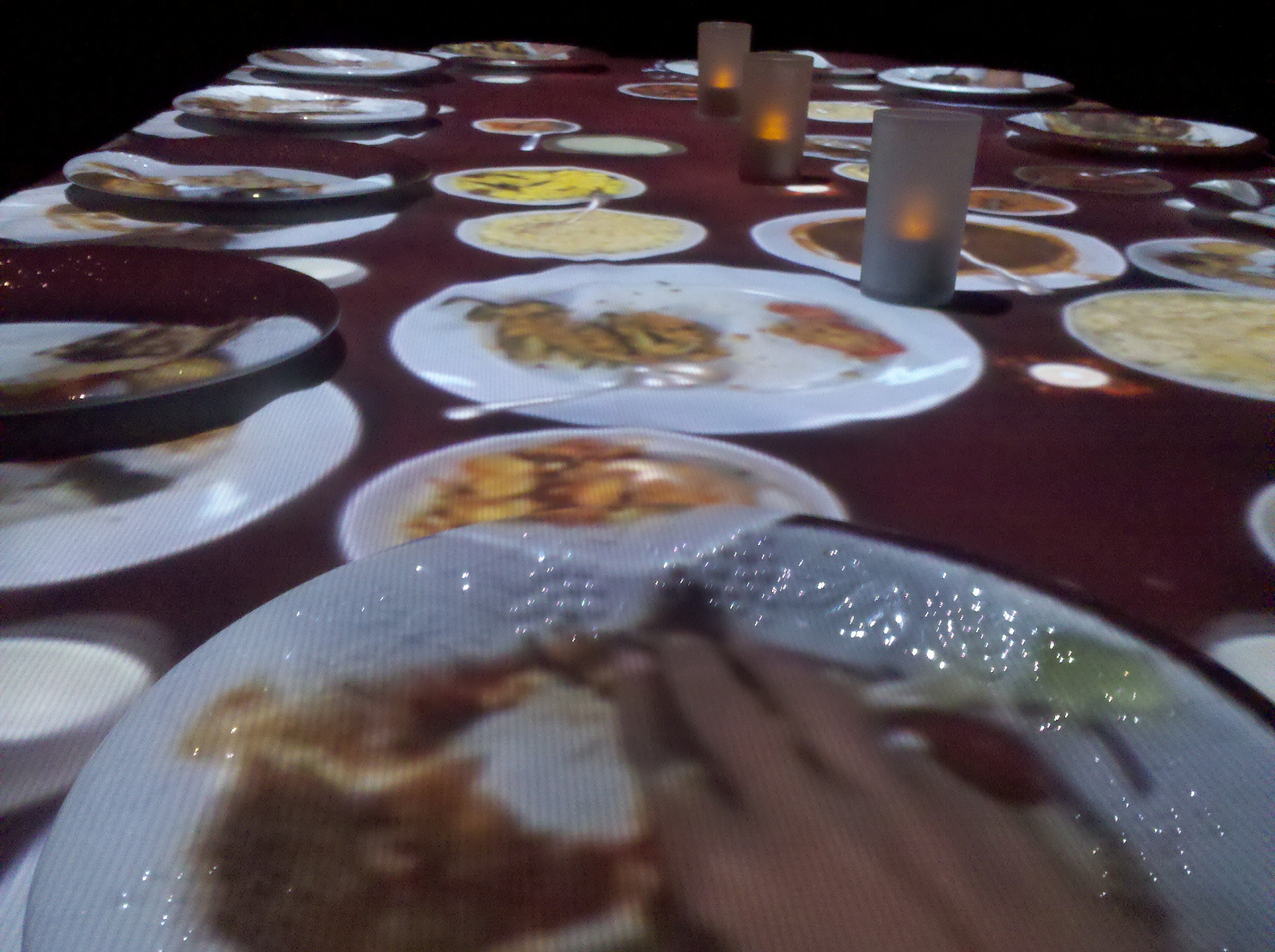
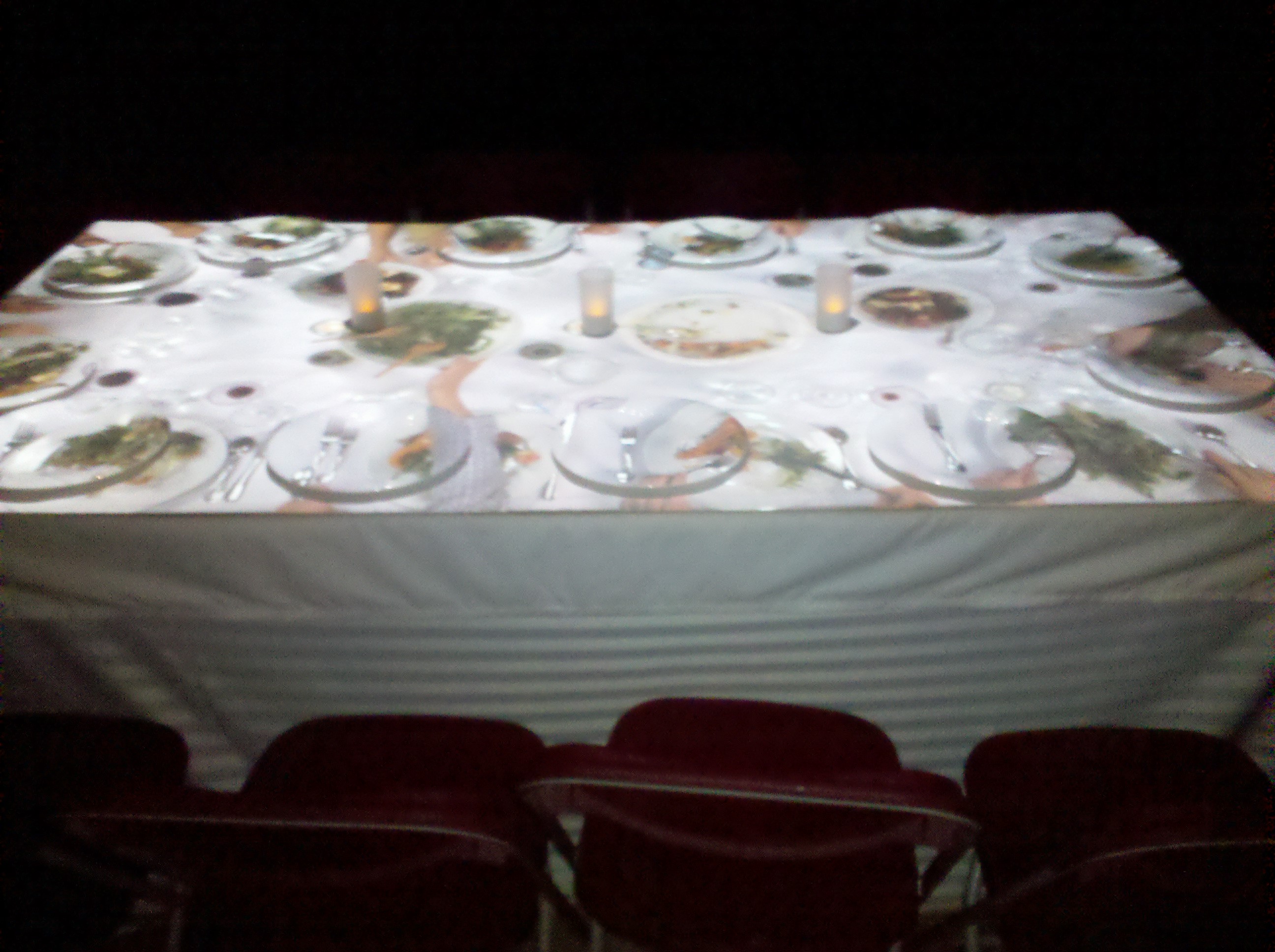
Welcome to the table! It looks delicious. All set up for you at St. John the Divine. The sign encourages you to “Please Enter, Sit & Touch.”
“Really?” I hung back. I was the only one in this little chapel. Should I really sit at the table? It looked nice, well lit, sounds of dishes clattering and conversation. I was a little hungry. The food was spread on the table. I was thinking this must be some kind of Judy Chicago-inspired womanist art piece.
So I sat. And pretty quickly noticed that the meal shifted and floated in front of me. The meal on my plate was just a projection on the table.
So cool! I was on a quick lunch break. I had to return some overdue library books (“Happy At Last: The Thinking Person’s Guide to Finding Joy.” Really good!)
I love the Poets’ Corner of St. John the Divine. I had rushed in on my lunch break, sandwiched between two meetings, to experience the beauty of the words etched into the floor. I LOVE Walt Whitman’s ‘Song of Myself’ and wanted a quick moment of peace to reflect on the quote you can find there:
“I stop somewhere waiting for you.” (Is that not breathtaking!)
But I couldn’t find the Poets’ Corner, haven’t been there in a year. Instead I stumbled upon this table — Terry Flaxton’s “In Other People’s Skin,” multimedia art thingy.
As I was leaving the table in the chapel, amused and lighter, I encouraged a couple of young blonde tourists, (German or Scandinavian maybe?) to “please enter, sit & touch.” They looked confused. I pointed to the sign. They still hung back, like I had done.
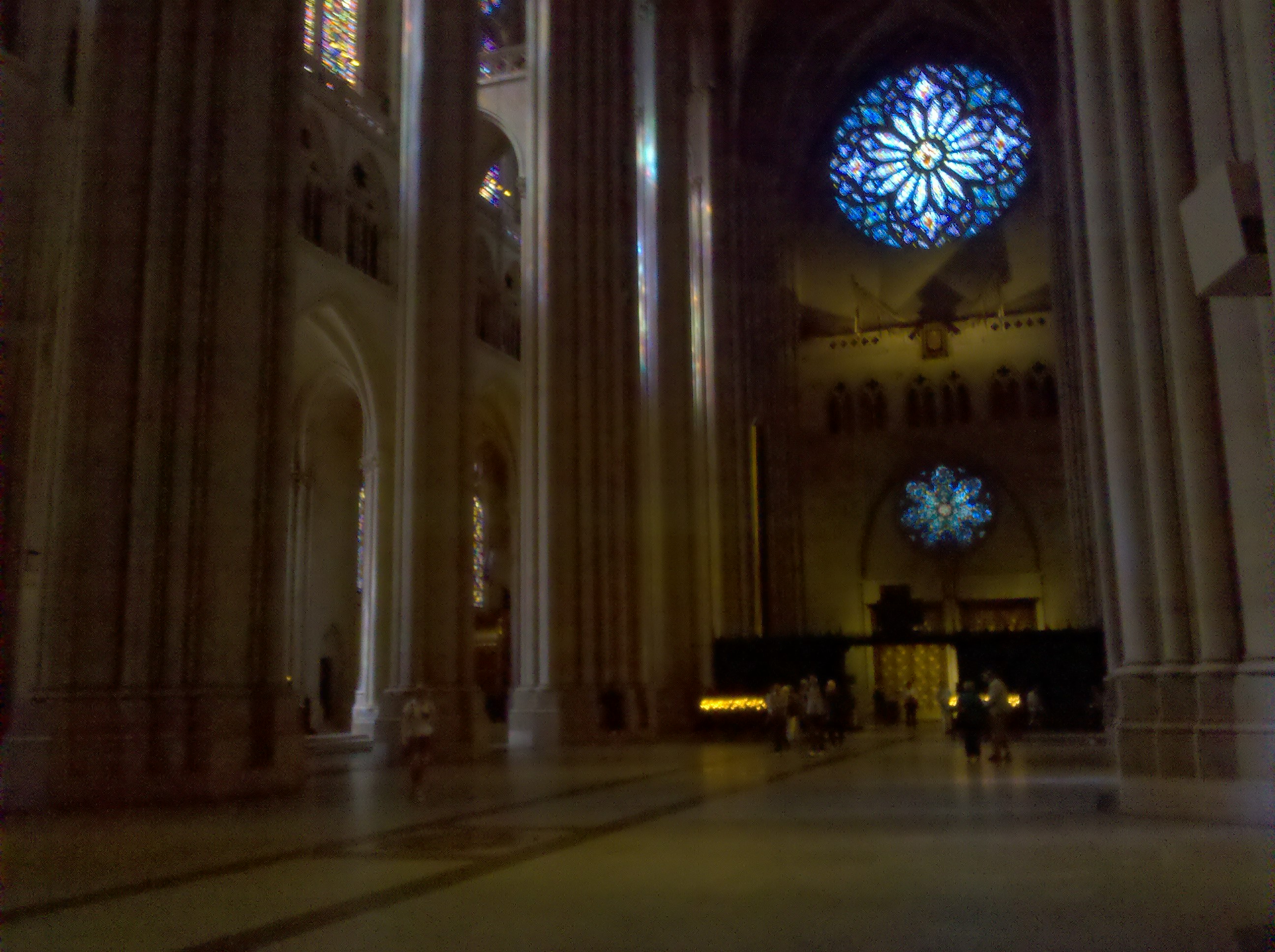
The space at the cathedral is vast, echo-ey, inspiring. As a rule, churches don’t usually encourage touching and fully participating. Experiencing a church is usually a spectator sport.
But this table, at St. John’s, although it is unreal, is set up for you. It is cozy and warm. Well worth it.
I had been reluctant to fully experience the table. But when I did sit, I sat at the head of the table. Trust is difficult. But ultimately rewarding.
I love churches so much, that I stayed overnight at Rutgers Church on Friday night.
I was a chaperone for the youth group, about 17 kids from ages 10 to 17, for a church lock-in. We played Charades, made candle holders, played whiffle ball. We sang together in the sanctuary with the lights off. (My kids and I tried to teach the group the song, “Sanctuary,” which we sing really well! Is that bragging? So be it.)
Our pastor Andrew spoke a little during the sanctuary time. He had made barbed wire to show us and talk about. We discussed barbed wire’s purpose — to keep people and animals out. Andrew talked about growing up in a country surrounded by barbed wire.
He talked about how we have to be the candle light within the swirl of barbed wire.
“This is the symbol for the organization, Amnesty International. They take a stand for people who are in jail needlessly. The light means a lot to people who are living in barbed wire countries or who are living in barbed wire. We can be their light,” said Andrew.
When we blew out our candles we were asked to take the light within us. To keep a light for human rights burning. The fun of the sleepover, the depth of it shone through. The kids and parents are such a great group.
Church is community, I’m coming to see. It is not simply sitting alone in a dark place midday praying. It happens at night and when one is away from the sanctuary too. It happens when we try to take sanctuary with us, create it for ourselves, our neighbors, the world.
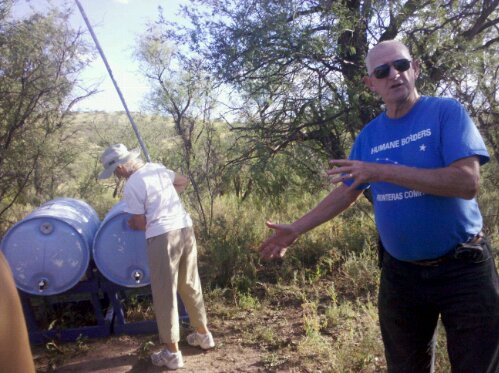
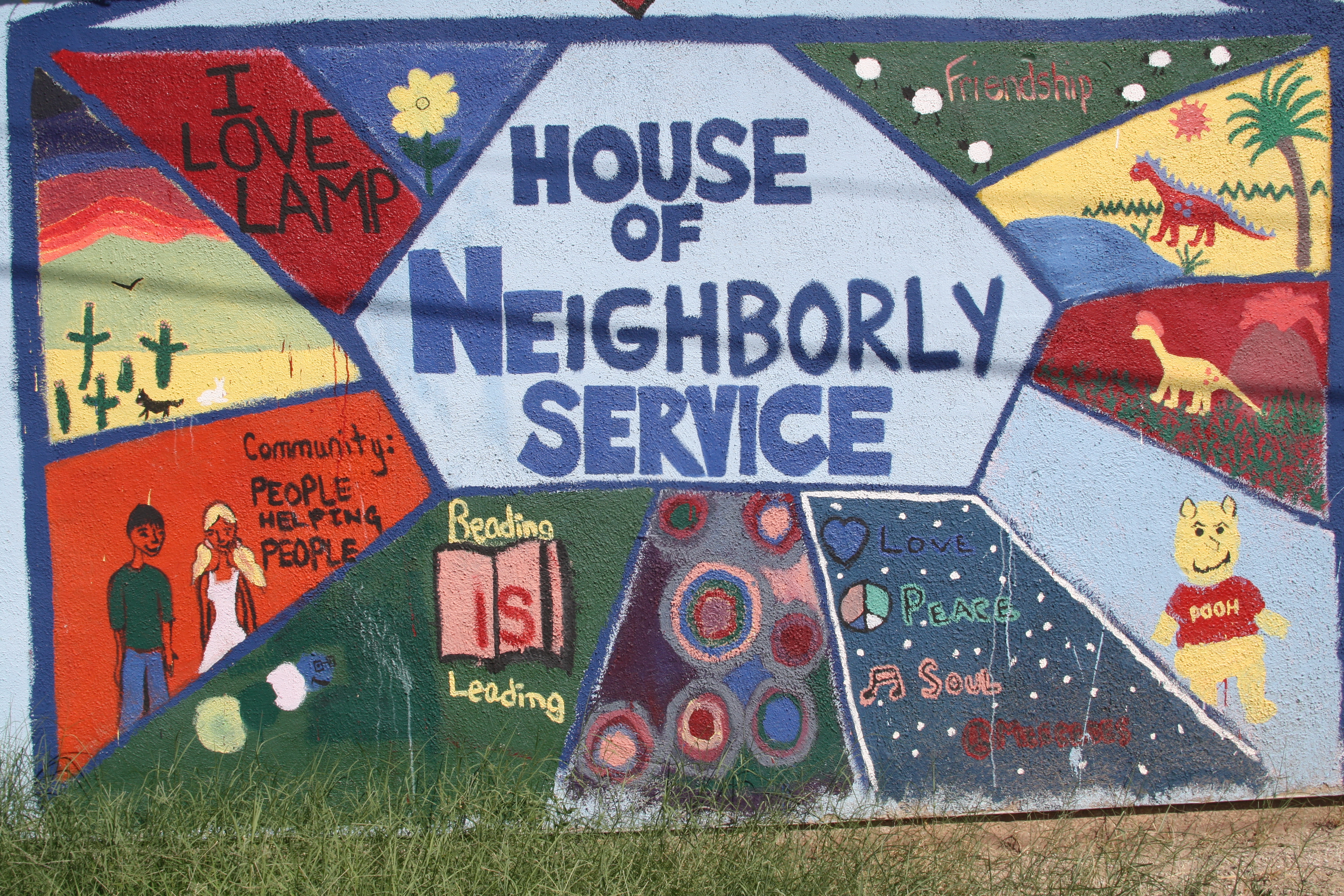
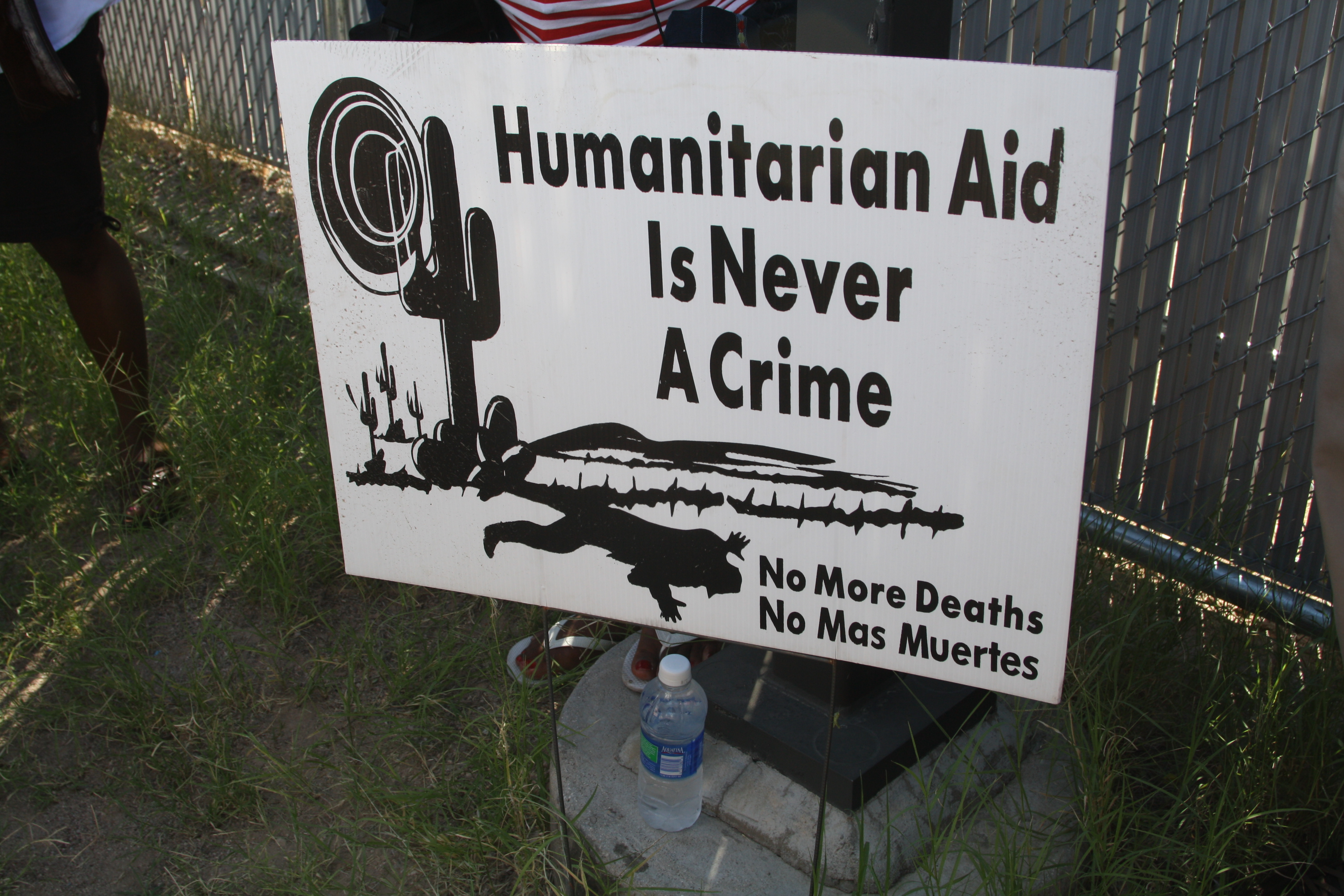
Meet Lois Martin and Gary Wolf. They’re volunteers with Humane Borders, a group in Arizona that puts water stations in the desert so that migrants who are traveling into the US will not die of thirst. Their work is legal — they emphasize this repeatedly because, apparently, some people think it is illegal to give out water to prevent death.
Dehydration is the leading cause of death in the desert and hundreds of people die every year for lack of water in the vast Arizona desert.
There were about 15 of us in the community developers group who visited the water stations. Two among us told how they had crossed these very same borders from Mexico, in the cool of the night, running, one as a girl and the other as a young woman. They are now both documented US citizens.
The Humane Borders volunteers reminded us that people cannot be “illegal.” People are people. Rather, they are people lacking documentation.
Mural on the wall at Humane Borders
Most migrants come from countries beyond Mexico. Imagine the journey.
This was the first day of the “Let’s Get Radical” event for community developers in Scottsdale, Arizona, when more than 70 community developers traveled to Tucson to visit this group, Humane Borders.
Rev. Robin Hoover, Humane Borders President, First Christian Church Pastor, taking a group to the Mexico/US border, discussing immigration, compassion, providing water.
A handful of our group went into Mexico with the Humane Borders president, across Nogales, AZ to visit the tents of compassion, weigh stations run by Catholic nuns, who minister to those who are ejected from the United States, dumped back on the Mexico/US border, with blisters on the feet and no money in their pockets. The nuns and volunteers do what they can.
Bishop Minerva Carcano of The United Methodist Church spoke about working in the tents of compassion. She told how she met a family in the tents — a father and two young children, Melvin and Joslyn. The bishop played with the family and laughed with them.
“It is an amazing journey that these brothers take. They take the journey depending on God. We do stand on the word of God. Leviticus 19: ‘You shall not oppress the immigrant. You shall welcome that immigrant as a citizen. … and you will remember you were an immigrant in the land of Egypt.’
As she left, she gave money for the small family to the father. As she walked away, she heard others say, “Gracias, mi hermano.” The father had given the money to other migrants in the tents.
“I felt I had seen the face of God,” the bishop said. Having so little, that father shared so much. (This, like many stories at the community developers’ event, made us cry.)
Community Developers group -- Mary Beth, Monte Payne, Tonia Rios, Humane Borders volunteer Karl Tucker, Malik Saafir, Rhonda Robinson
I was with the group that visited the water stations. The blue flags that mark their locations may be torn or full of bullets but the Humane Borders workers continue to check the water supply underneath the 100 or so flags in the desert. At times, they move the water stations to optimize giving (and perhaps avoid entrapment of migrants by the minute men or border patrol?)
“Minute men are right-wing whackos….Its an evil, evil, evil mess,” Karl Tucker, our volunteer, said.
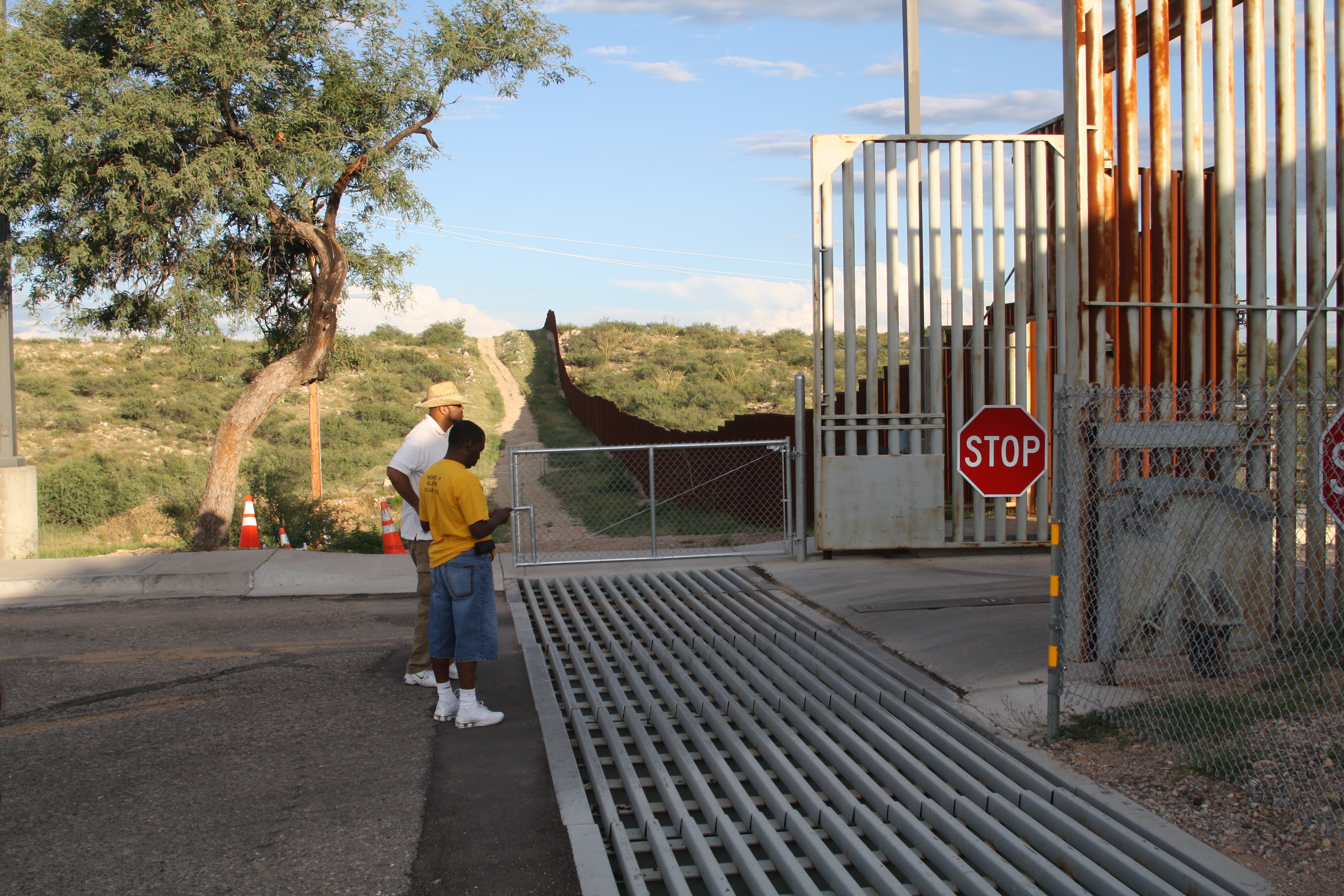
We ended the day-long trip with a visit to Sasabe, Arizona. There were no people anywhere, except for about six border patrol officers, one of whom wielded a huge gun.
Community developers approach the wall.
The diminutive, yet powerful Lois Martin requested and the officers agreed, to let us approach the wall.
It was shameful that this is how we, the US, ‘welcomes the immigrant’. We give them a wall and tell them to keep out. Whatever happened to:
“Give me your tired, your poor, Your huddled masses yearning to breathe free, The wretched refuse of your teeming shore. Send these, the homeless, tempest-tost to me, I lift my lamp beside the golden door!”
No, there is no lamp beside a golden door. There is a wall. At least there is water. And people like the Humane Borders volunteers who give small comfort. And in so doing, they save lives.
My young adult novel, “The Missing Twin,” went missing. I had been using my Swiss Cheese method of writing — punching a hole in the ‘durn thing for 10-minutes a day for several weeks. I’d written it in the flurry of NaNoWriMo last November and been editing in dribs and drabs since then.
I want to write another novel this November so I desperately want to put last year’s novel, “The Missing Twin” to bed. But the editing is hard. And my baby won’t go to bed, she’s not even sleepy.
NaNoWriMo was simply one of the best writing experiences I’ve ever had. It was communal. Tens of thousands of people are writing a 50,000-word novel for 30 days. You can chat with people on Twitter who are going for the same word count. But, alas, writing is more than word count. Sadly for me, because I can pile up words pretty quickly. I type superfast. Even faster than I can think. But editing takes time and thought.
I have to get back to telling you about missing my “Missing” novel. But it’s hard to write right now because the flight attendant is pleading on the loud speaker, “Is there a doctor? Nurse? Medical professional on board? We have a medical emergency.” Sheez, this is stressful, wondering what’s going on. Hoping it’s not serious. But the urgency in the flight attendant’s voice says it is.
Okay, stay focused. So, I thought I packed my novel in my bags when returning to NYC on Labor Day. I’d been traveling with the white binder back and forth up to the Adirondacks every weekend of August. I would do my 10 minutes a day, then put it away. I’d read and marked up about two-thirds of the blasted thing. But I couldn’t find it anywhere in the apartment.
Update on the medical emergency: the flight attendants are getting the big black CPR Kit box out from the luggage rack. I’m kicking myself for not ever training to become an EMT. There seemed to be no doctors or nurses on board just two young-ish, reluctant people, a 20-something Asian woman and a 20-something clean-cut White guy, came forward shyly. Medical students, I’m guessing.
So, the other day on the phone, I asked my husband, Chris, to look around the Big House for my novel. (He was directing the play, “Good Night Desdemona/Good Morning Juliet” at the Depot Theatre and stayed in the North Country.) I thought I left it on the floor near the couch in the bedroom (all important things lands on the floor near a couch!).
“No. Can’t find it,” he said.
Update: The flight attendant and the medical-type people appear to be giving oxygen to the young man in medical distress.
Just before the flight took off, I checked my messages. Chris left me a voicemail, “I found it. The white binder was on the floor in the closet.”
Chris found my “Missing” novel. (He’s good at finding lost things!) It’s got to come out of the closet! I kind of wished I’d lost it for good. Then I’d have a good reason to abandon it.
I do want to find out how it all ends. So I guess, I’ll return to reading, rewriting, editing the novel. Right when I get back from this business trip.
Final update: “He’s doing better,” says the young woman to the flight attendant who’s now carrying pillows back to the galley where the medical and flight team are huddled. Thank God. Turns out this teenager hasn’t eaten or drank anything for several days.
Advice for the traveler: Everyone, please hydrate before you fly.
And keep your novels close at hand.
This is where I am as I upload this, early morning Scottsdale, AZ.
It’s a best-kept NYC secret, bustling with life. The bustling is done by the Cabbage White Butterflies who never got the memo that summer’s officially over now that school’s started. No, the butterflies don’t know. They flit in Riverdale on September 11th at Wave Hill, an easy-going, beautiful, educational, art/nature place.
All the things you love — art AND nature — wrapped into one FREE afternoon — Yes, free! The kids and I arrived at 11:55 am, just in time to discover that the center is free until noon on Saturdays. (Should I mention that the free morning is thanks to Target? Yes, I will because they also support the bustling hip, trendy MoMA Friday nights! Thanks, Target!)
The family art sessions are always fun. Always. I did wonder as we stepped into the big, dark cottage and saw all the toddlers and elementary school kids wielding glue sticks whether my three (freshly pressed) middle schoolers would still dig the magic of family art and the loose and loving guidance on some funky crafty nature project. But hooray, they still dug it! (H. did mention, “I never want to come back here in my entire life.” But rest assured, he’s big on hyperbole and I, who am also given to exaggeration, stayed strong. I replied, “We’re coming every Saturday for the rest of your life.”)
The first assignment for the family art session? Friendly and gorgeous Ilse instructed, “Take a walk around and collect dead nature specimens. Then, return to the cottage and make little accordion books that will fit neatly into your little decorated nature treasure boxes.”
I remembered around Thanksgiving one year at Wave Hill, we made corn husk dolls, taught by young Native Americans. Another time we looked at pictures of Matisse’s cut outs and tried to cut out flowers likewise.
The leader then was a lovely guy named Noah, who Ilse informed me retired in the Spring. He was always gentle and enthusiastic and welcoming. Ilse said, “I’ll send your regards to Noah.”
But I don’t think he specifically knew me or my kids. I think he was just one of those souls who treat everyone like a long-lost friend. (Any way, Thanks Noah!)
The new staff, Ilse, is, like Noah and wonderful Martha Borrero, who is still there, welcoming, glad to see you when you walk into the space.
As usual, we pushed the boundaries of time. Martha rang a bell to let us know that it was 1 pm and family art time was ending. We were still creating, gluing, drawing, cutting out shapes, filling our little nature boxes. We finally tore ourselves away.
We ate at the café outside. I love museum cafes. Museum cafes are a bit pricey but delicious. And eavesdropping is so much fun. The guy behind us was saying, “I have time. If I don’t find a girlfriend right now, it’s fine. I have to pay my bills, get out of debt, become more responsible.”
The kids talked about whether burning money is a federal crime. I don’t know. I don’t have all the answers. As my 4th grade teacher used to say, “What am I? A walking encyclopedia?”
We departed by way of the gift shop, where we bought local honey and honey sticks, the kids’ favorite sweet treat.
September 11th is a very tough day for people like me who love New York City. The reason we love and live in NYC is that there are magical gems throughout the city — places like Wave Hill, full of butterflies and breezes, views of the Palisades and the Hudson River. What’s not to love?
Next year’s 9/11, the 10th anniversary, is going to be hard. I’m already planning to take the kids to Wave Hill again. If you want to go with me, let me know.
The front doors were locked. So were the side ones. I didn’t see a bell to ring. Maybe the Jewish New Year, Rosh Hashanah, has the churches closed in solidarity. It’d be nice if religions were in solidarity with one another. I’ve had my religious tolerance reinforced as a member of United Methodist Woman and the Religion Communicators Council, and working at the Interchurch Center.
I think people who embrace religion in their lives have more in common than they realize. We are all searching for meaning. Any religion is a leap of faith and a personal decision.
I am proud of all the United Methodist and Christian groups that have preached and taught tolerance since Sept. 11th.
My friend Sarah worked with Faisel Rauf (the founder of the Cordova Center near the World Trade Center) on a performance piece about religious tolerance at the theater that’s a part of St. Paul and St. Andrew’s Church in ’03, (I think that was the date). She said the Imam and his wife were wonderful, kind, regular, all about building bridges of understanding.
I’m meandering. My point is I tried to get into the West End Collegiate Church around 6 pm but the doors were locked, probably unrelated to Rosh Hashanah.
I’d been cleaning all day. I’d wanted to get to a museum with the kids, but there was too much to do. Living in an apartment, we have no attic, garage or basement to stash and dash. Minimalism is a goal.
The girls started school yesterday, but they are off for the Jewish New Year today. Tomorrow too.
When the church was closed I went back to the park to hang out on my usual park bench near the playground. My daughter and her friend were rollerblading. They were holding hands. Have I mentioned how much I love that? I hope they never stop holding hands.
I dropped off the girls at Middle School at 8 am. Help, I have 3 children in Middle School! Yes, these are the years commonly known as the greatest years of a person’s life! My most vivid memory of Middle School was having to wear my brother’s hand-me-down red, white and blue Converse. So embarrassing. Every single day, total embarrassment.
I also remember making a movie, “Looking Back,” about the Depression with my homeroom. And, yes, I must mention Mr. Dennison’s counseling group where we rapped after school about our issues from a Transactional Analysis point of view. (Yes, I’ve always loved self-improvement.)
But this post wasn’t going to be about me. I was talking fondly about my girls going to Middle School. So yes, I got choked up dropping them off. (That’s about me, too! My feelings!) Especially verklempt when we were a block away and I saw they were holding hands!!! I love that!!!! (I love exclamation points too!!! They probably discourage exclamation points in Middle School!!!)
No time for sentimental good byes. The girls literally ran away from me once we hit the schoolyard. They gave me the bum’s rush. And I was left with the other bums (parents), empty-handed on the sidewalk. I said to myself, “It’s a good day to go back to church. To pray for all the teachers and students.” Besides, I had a little time to kill before work.
At the first church, “The New Pleasant Church,” on 81st, the gates were open, but the door was locked. It looked like it had been turned into a theater any way. I would’ve enjoyed going to the theater, had even that been open, but No.
So I went to the Holy Trinity Church on West 82nd. I sat by myself in there. Very vast and wide and dark. I noticed the statues of Mary. How can Mary look so calm all the time? Where do churches get that placid Mary? Where’s the Hysterical Mary? Where’s the Mary who has 3 kids in Middle School?
I asked Mary, “How do you do it? Look so calm all the time? What’s the secret?”
She didn’t say. She just smiled beatifically, the way she does. Not really helping me out. She could use some Transactional Analysis and learn, like I learned in Middle School, that it’s okay to express your feelings. “I’m Okay, You’re Okay.”
Mary stood there. Candles at her feet and a fan beside her.
The Jamaican horn-player was testifying to a handful of people. He wore a yellow polo shirt. “It’s easier to build someone up than to criticize,” he said.
The church seemed on its last legs. On 57th between 9th and 10th, the church had peeling paint and rotating fans. It was super hot.
I think it was a Brazilian Church because the Brazilian flag was draped over a pew in the back and a sign outside listed a 7 pm Brazilian church service. I wandered in around 7:50.
I had been walking in the city after my writing class. My classmates and teacher liked this new writing project, A Church A Day, especially they liked me mentioning the people I met.
I had reported in class that many of the men who guarded the church doors, the guys who allowed me access to the sanctuaries, seemed just one step away from the soup kitchen themselves. The church caretakers had seen it all but were were still good-hearted and hard-working.
The Jamaican speaker at the Brazilian church last night was no exception. “I play in the subway. That’s my job. When the police come up to me, I move on. Then they’ll say, ‘Weren’t you just here yesterday?’ ‘I have to make a living,’ I say. It’s tough to make a living as a musician. I have 3 students. I pray for 20.”
At one point he asked the congregation, “What does faith mean?” A few people called out, “Jesus’s love.” “Forgiveness.” He waited. I said nothing. He said, “You in the back, say anything.”
That was me — the one in the back. My tongue was tied. I didn’t feel comfortable speaking. I wanted to say something, to help him out. But I wanted to give the right answer. I liked his sermon. But I didn’t know what faith meant.
I smiled. I hoped that I looked European, perhaps slightly non-English speaking. He moved on. I couldn’t help thinking he was disappointed in me.
Then later he asked, “Who is there for you? No matter what? Who will always be there?”
I shouted out, “Your mother!” A few heads turned. He did not acknowledge my answer. I think the question was rhetorical. The correct answer may have been God and not mother. I’m not sure. I slunk down in the pew in embarrassment, feeling ridiculous — unable to answer when called on, shouting out the wrong answer when I was not called on.
It’s hard to understand the rhythms of worship. There were several Hallelujahs shouted out during the sermon. It seemed okay for everyone else to yell out randomly. Like when he’d ask, “How am I doing? This is my first sermon. But it won’t be my last.” “Hallelujah!” someone yelled.
Even though I felt inept, I dug this guy. I liked, “Knock and the door will be opened. But you have to knock. No one is going to come knocking on your door.” And he said, “For me the ultimate sin is laziness. You need faith, honesty and hard work.” “Hallelujah!” someone called out.
At 8:15 the service was over. I wanted to tell the speaker I liked his message. But I felt shy and didn’t want to engage. Maybe they’d try to get me to come again. I couldn’t commit. I want to visit a lot more churches. I walked back out into the hot summer night.








 I am proud of all the United Methodist and Christian groups that have preached and taught tolerance since Sept. 11th.


 100 Days of Poems and Pics