Why I Write

We do not write to be understood. We write to understand. – C.S. Lewis

This was one of the quotes from Writing for the Soul, a workshop led by Rev. Lynne Hinton in Albuquerque, New Mexico at the United Methodist Association of Communicators. She has written 14 novels. Yes, 14! Oh, to be so prolific.

Tomorrow, Nanowrimo starts so I’m hoping to write one more novel this month!

In Rev. Hinton’s workshop, we began with free writing à la Julia Cameron’s admonition in The Artist’s Way to write three morning pages — which I have been practicing for about 15 years. Every morning, I hand write three pages of brain drain. But give me free rein later in the day to tap into my unconscious and I’m, oh so happy.

Lynne gave us an exercise where we chose random words, picked like wild flowers from our unconscious, to add to word prompts, like these (but not these, exactly!):

Diamond _____

Shelter _____

Instant _____

Prayer _____

Barcelona _____

Boo _____

Avoid _____

Teacup _____

Angel _____

School _____

Write _____

Create _____

Ocean _____

Sun _____

Venice _____

June ____

Moon _____

You get the idea. We wrote our own couple of dozen words down the page on the blank lines. From our written words or the provided prompts, we made sentences on bits of paper. Then we shuffled our sentences and wrote them down in a poem format.

How fun! Our internal censor didn’t even know we were writing a poem, we were just playing around! Writing is play!

It’s impossible — at least, for me — to attend a writing workshop and not make new friends. I find the adage so true —  A stranger (or a fellow writer) is just a friend I haven’t met yet.

Often in writing workshops, my friends and I drop into such a deep level of sharing that we cry when we hear each other’s work. I felt this way hearing the poems of my fellow writers, Jessica Connor, Beth Buchanan, Kerry Wood and Isaac Broune. I was blown away as they unearthed playful and meaningful poetry from their unconscious.

I am so grateful for the wisdom of fellow writers, writing teachers and my own ability to tap into my unconscious on a regular basis. Going a little crazy in my writing keeps me sane!

Getting the most out of writing conferences

Gill and Coudal at the National Arts Club

Yesterday I was studying memoir with the International Women’s Writing Guild at the National Arts Club. It was a great group of women in New York’s most beautiful brownstone.

This morning I was journaling about how much I love writing conferences and being in community with other writers. I also love Twitter chats around the hashtags #blogchat and #wjchat (web journalist).

Writing is a solitary endeavor so communing with other writers online or in person inspires and energizes me. I fill my soul with other writers’ stories and feel less lonely and more courageous when I return to my writer’s desk to write my own story.

Here is advice on attending writing conferences:

  • Sit in the front, pay attention
  • When a volunteer is called for, raise your hand
  • When a question is called for, have one ready
  • Make one friend
  • Tweet one quote from the speaker
  • Tell someone about your big secret project
  • Share the struggle, share the joy — be honest

I mostly took my own advice:

  • I sat in the back, but I paid attention
  • When a volunteer was called for, I read something funny about marriage and work being overrated (got some nice laughs)
  • I made a friend who is heading to Abu Dhabi to report from a falconer conference
  • I tweeted, “Writers make the invisible visible” -Eunice Scarfe #iwwg
  • I told Judith Glynn about my secret project
I love IWWG women’s writing workshops because, beyond the juicy substantive information, i.e., Eunice shared a ton of unknown delicious memoirs, there is always depth, laughter and understanding among women writers.

The International Women’s Writing Guild is a fabulous group that has empowered me as a writer, by giving me mentors and a sense of belonging.

My Country Song

At our lunch time creative writing workshop, Dan Licardo, an awesome musician and novelist, talked about songwriting.

He said a song can include rhyme. The message of a song can be more direct and easily understood than other types of writing. So I tried my hand at songwriting on my lunch hour. Here’s how my song went:

creative commons
Your face reminded me of the sun
Bright and sweet and always on the run
You run so fast, you run so far
You run and steal my Chevy car
I called my daddy, I called the cop
But they couldn’t find you
Not even in the hills of Vermont

I took my gun, I went on the run
I run down to the Virginia-ay shore
And there I found you with a two-bit whore

She had her legs and arms around my baby
I squinted my eye, I pulled the trigger
But you said, “Honey, Honey, I mean maybe?
Give me ‘nother chance?”

I’m seeing red,
And that floozy in the motel room
She got up and fled
But you lay there all weak and sad and mad
Like the moon, behind a cloud,
You went all bad

Honey, you went bad on me
Now I’m going bad on you
Because there’s just some things
My man ain’t supposed to do
The first is steal my Chevrolet car

That’s the first step you took 
just a little too far
The second is you left me all alone
With the babies and the dishes
You think you really flown?

Ha, you ain’t seen nothing
Sniveling on that bed
Pale and begging and, oh so red

Caught red-handed, I put down my gun
I take my car keys, then take your clothes
Just for fun

Don’t come back like the morning sun
Don’t come back when you’re broke
‘Cause my babies need a pappy
Not a two-bit joke

Plus I’m a little honey 
who needs a little bit a love
So I got me an ad on Craigslist
Gonna find some new sun shining from above

So that’s the woman’s part of my song. And then the man’s part comes in:

In the field there was a daisy
But you only saw me like I’m crazy
Yes, honey, I did you wrong
I took up with a honey on the wrong side of town

But you knew I loved the nightlife
I loved the song and the show
I told you that when we married, oh so long ago

When the babies started coming
And you just wouldn’t stop
I tried to re-enlist in the Army
And head back to Iraq

But they didn’t take me
You know I loved your hair, long and red
And I’m sorry that you caught me
With your sister in that cheap motel bed.

We thought we were done for
But you spared me and that debt I will repay
Just one more thing
Can you send me some bail money?
And then I’ll be on my way

Haiku

Hope

In the creative writing workshop I taught yesterday, we wrote haiku. This traditional Japanese poetry looks surprisingly simple — seven syllables, then five, then seven. But we found it challenging, a habit of writing we are unused to.

I told the class to think of the poem’s structure like the cage around a songbird. You have to confine your poem, your bird, your meaning, within the frame. Within the constraint, the songbird can sing freely. And then the poem can flow like a song, traveling far from its cage.

I gave us about 10 minutes to write our haiku.  Here are a few of mine.

I have been teary
Hoping to be understood
Fearful of shadows

Somehow I miss you
Your crazy way of kissing
I live on longing

Need to swim far out
Farther than you can catch me
Splashing, laughing, far

Working Moms Love Business Travel

At least this mom does. I love to travel for work, not having to cook, clean up, wake anyone, or remind anyone to go to bed.

I do worry about the kids. And yesterday, I got a call from the school nurse that one of my darlings was crying, feeling overwhelmed by school work, dad’s illness, and maybe, I think, missing me a little.

I thought, Dangit, I stayed away so long. (Been gone from Sat. to Thurs.) I am heading to the airport in a few minutes and once I get home, I will try to put the house back in order. And if there are tears, I can dry them. And I do feel fully restored to do the job of mothering, working, and writing after work travel.

I was at a retreat center for work, I love that I go to retreat centers, like Life Enrichment Center in Fruitland Park, Florida and next week, Stony Point, in Stony Point, New York.

I love that work travel is a retreat. And that at the back end, I got to sneak in a visit with my family in Sarasota. Life is good.

My Salon

I never asked what all these commenters thought. I never really asked what anyone thought except for the writers in Joanna’s and Charles’s classes, where I had workshopped the story.

And yes, I wanted to know what an editor thought.

I’d sent the story to the Salon editor late Wednesday, thanks to the query challenge from Robert Lillegard. (See the comments at: http://gettingmyessayspublished.wordpress.com/2011/08/30/the-westport-workshops/)

SH replied on Thursday over my lunch hour. I got her email while sitting in the hairdresser’s chair. She said my story “had potential.”

Nice! A new hair cut and a potential piece at the best literary and intellectual site online.

SH asked if I’d intended to publish under a pseudonym. No. She’d begun a line edit. She had legitimate questions about chronology and adding a “message moment.” That is, a moment to give the experience a meaning, an Aha! She was right.

I worked on the story; she worked on it. In a few hours, we were done. But commenters don’t take hours, months, years to write their comments. They dash them off.

I was surprised by the comments. At seven am, on Friday, I read the first seven. Then I stopped reading. I have very little experience with negative comments. The people who’ve commented on my blogs may spin out their own thoughts, but they don’t rip me.

I asked a couple of people what the comments said. My aunt (Ellen Wade Beals) emailed me; she said some of the comments were funny, some complimentary, and some snarky. One friend told me a lot of the commenters are commenting on each other’s comments. I didn’t need to go there. (And my sister emailed me with one direct message: don’t comment back!)

My only experience with negative comments was long ago on my article in the New York Times City section in the form of a letter to the editor. It was from an ASPCA representative quibbling with the way I’d represented their agency in my funny essay about the squirrel trapped in my airshaft. Fair enough.

At that time I took pride in the ASPCA’s letter to the editor. Aha! A letter to the editor meant my NYTimes story hit a nerve or was controversial. And now, I’m trying to take pride in the comments (that I’m not reading) on my Salon.com story. It’s a badge of courage to be criticized, commented on, and then survive (to blog about it.)

My cousin Susan Elster Jones sent me an amazing email last night. She said, One of my best professors once told me that the work isn’t really finished until you share it. And the more uncomfortable that feels-probably means the work is really strong. Thank you for sharing!

So, go ahead, comment away. Sure, I’m feeling defensive, sensitive, uncomfortable, but also proud, strong, happy. Uncomfortable.

The Westport Workshops

Went well.

I love when people open up — give me stories about your divorce, depression, cancer treatment, or dysfunctional childhood. And then half-way through your writing, lay it on me about how you handled the whole thing with faith, resilience, humor, or alcohol.

Better yet, write about your most embarrassing moment — the time you felt so humiliated you thought you’d never crawl back into civilized company again. You’ve got an epic fail? You’ve got an epic tale.

The stories of our struggles are the ones that will get published, get a laugh, get a tear, get a friend to open up on her crappy/crazy/resilient/hopeful life.

I’m not saying we wrote about any of these things (Maybe we did, maybe we didn’t!) at the Westport Creative Writing workshops, which I offered the last three Saturdays of August 2011 at the Heritage House.

But even if we did, I wouldn’t tell you, because the rule in my writing classes is confidentiality.

I will tell you generally what we wrote about — in the first class, among other topics, we wrote about a safe place from our childhoods; the second class, we wrote about our mentors from high school; the third class, with Hurricane Irene on her way, we wrote about riding out a storm (literal or metaphorical).

At the first class, we had 6 people, then 3, and then at the last class, 8. Hooray! It felt great. There were so many brilliant writers with brilliant life stories. It was an honor to be a part of and facilitate a creative writing experience for non-writers and professionals alike.

I believe there is something healing and transformative about writing your life story. It is sometimes unbelievable, but never never dull.

I will offer these “Story of Your Life” workshops (inspired by Dan Wakefield’s book of the same name) again.

Next 3 Saturdays Writing Workshop

Excited to be leading The Story of Your Life at the Heritage House in Westport, New York this Saturday morning. At this community center, I’ve struck a yoga pose and smiled at the plein air art shows. All in one place, my favorite things: yoga, art, and, now, for the last three Saturdays in August, from 10:30 to noon, creative writing.

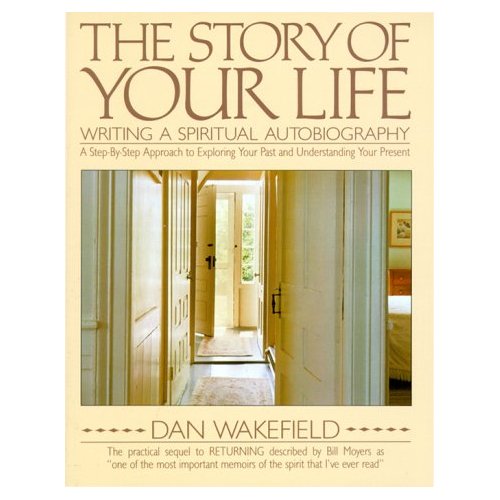
This is Dan's book that inspires the workshop, The Story of Your Life.

The Heritage House http://www.westportheritagehouse.com/ was once a federated church, Baptist and Methodist. Now it is a visitor center and home to a community art show, the title of which I love — The Spirit of Place. I want to build the spirit of place into the writing workshop.

The Story of Your Life is inspired from the workshops led by my friend and mentor, Dan Wakefield, who also wrote a book by the same name. http://www.danwakefield.com/ If you’re anywhere in the Adirondack region, please join me in this place.

I sent this blurb to some Adirondack newspapers so I hope we get a few people:

Write about your life — from childhood through the present day –- the small, quiet moments and the large, public events. In this creative, supportive, and fun workshop, you will discover threads of humor and meaning through writing and sharing your writing.

This hour and a half workshop is intended for the experienced, casual, and non-writer. ($10/class)

The workshop is led by Mary Beth Coudal, a writer and teacher, whose essays have appeared in the New York Times, Self magazine, and other newspapers, magazines, and websites. Mary Beth blogs about creative writing at: http://gettingmyessayspublished.wordpress.com (that’s this blog, heh). She also writes about the spirit of New York at: http://mybeautifulnewyork.wordpress.com/ and she writes a lot more than that too.

And now I’m writing this blog in the third person, the first sign of narcissistic tendencies, so I must stop writing and start reading. As the saying goes, enough about me, What do YOU think about me?

Reversals

In Poetics, Aristotle said — yes, I’m smart like that, quoting Aristotle — we move from ignorance to knowledge, from enmity to friendship, from neutrality to commitment.

Lynne Barrett taught this juicy class on plot at the International Women’s Writing Guild this week at Yale.

In stories, she said, everyone has to have a piece of the puzzle. No one character can hold the whole story.

Lynne gave us the timeline from the movie, Casablanca (which I’ve never seen) in which Bogart’s character moves from nonchalance to commitment.

The flashbacks in the story move the story forward. People don’t just ruminate on their past for no reason. The lover’s past (in Paris!) sparks an understanding that propels them to take action.

In all narratives, a reversal is necessary. Cinderella goes from low status to high status. I always taught this in my drama classes, that this is what makes for comedy — a high-status character becomes low-status — or visa versa.

This is why Lynne said the story of Spitzer is a better plot than the story of Schwarzenegger. He fell from the top, not when he’d left office.

But the reversal is not just “who’s up and who’s down.” A secret become public. A single person becomes married.

This class nudged me to reconsider the lame plot in my young adult novel from last year’s NaNoWriMo (national novel writing month).

When I mentioned to Lynne, I had a novel, written in one month, she said, “Yes, Chris Baty, the founder of NaNoWriMo, wrote the book. No Plot, No Problem. No plot? Big problem!”

Incidentally, Barrett taught with my friend Dan Wakefield at Florida International University.

Book Proposal Questions

Melissa Rosati ended her workshop with these questions:

  • Is a book really the right first product for me? I love books. I have already blogged. So, yes.
  • What do I want the book to do for me? Make me a ton of money, earn me some street cred, get my distinct voice out there in the marketplace of ideas.
  • What is the relationship you want with your target audience? To empower people to share their ideas through writing. To inspire writing that leads to personal transformation. But, hmmmm, in terms of relationship, that’s a tough one. I don’t know. How committed does an author have to be to her readers? I’ll answer their emails, comment on their updates, teach workshops, attend readings, read their writing. But, let’s face it, all relationships take time. Do I have the time for another relationship?
  • If you do not have business experience, who are your trusted advisers? This is also a tough one for me. I do not like asking for help. I like being the helper. I’m not sure my peeps are business peeps.
  • What’s your budget? How much are you willing to risk? Ummm, $150 maybe?

These questions come from the workshop The New Rules of Book Proposals which I stumbled into late because the parking garage was literally a mile from the International Women’s Writing Guild classrooms on the Yale University campus. (And having a book published wouldn’t make the parking lot any closer.)

I wish I caught the beginning of the class because I have a lot to learn about book publishing.