Goodness to the Rescue

Today is my twin daughters’ 18th birthday. I am focusing on the good.

I have had so many good things in my life — good people, good work, good communities. And yet the world, and this country especially, is full of so many challenges. We have a lot of work to do. We have to lay down our arms. We have to keep building on and remembering to look for the common good. Our constitution guarantees that we promote the “general welfare.” Let’s promote each other, rather than tear each other down.

Yes, we humans probably each have an innate desire to show off. Maybe we once needed this to survive — a social evolutionary tactic to ensure that human existence persisted. But we need to make sure our neighbors persist too. We need to look out for our fellow human beings, even and especially, if and when we disagree with them.

We latch onto this myth that the accumulation of great wealth — of things — will make us happy. That ‘things’ will make us good or loved or better. This is not true. It is not the things in my life that bring great joy or deep meaning. But the people — children, family, extended family, friends, colleagues — that truly matter.

I have always tried to be good. I am sure that I suffer from some sort of Good Girl Syndrome. However, I would rather be good, look for the good in life and in the lives of those around me, than see only the bad. I know this world is difficult for young women today. This is a tough time in the U.S. to turn 18 — there are so many admitted predators leading institutions, including the commander in chief. But there are also great and good people all around — leading our families, schools, churches, faith communities, cities, states. They are persisting, not just for their own sake, but for the common welfare.
I am not giving up on the good.

Now that my daughters are 18, they can no longer threaten to sue me and go to court for emancipation, as they like to tease.

Seriously, I am reminding my girls to persist for the sake of good. Truly, the future is female. Let’s celebrate the ascendancy of good girls and good women everywhere. Happy Birthday! May our goodness and greatness dominate the world!

College Visits

My 12th-grade girls are starting to narrow down their college choices. Even though they are twins, they do not necessarily want to go to the same school.

College visits are so educational. Like at Smith, our tour guide described how students could receive grants. And so she, having just completed research about how exercise increases brain function, petitioned the school for treadmills in the library. And now, there are treadmills in the library, which has helped students study better, longer, healthier.

Young people are so inspiring.

This is why it is awesome to be a teacher and a parent right now. The leadership in the U.S. is sorely lacking. People need inspiring, moral leaders. (Those who claimed to want to drain the swamp are the new swamp monsters, yesterday’s CNN opinion piece says).

Young people will soon take over. In some places, like at the Smith library, they already have. And they are not giving up. (That is our family motto, “Never give up.”)

At many other schools this summer, we visited the beautiful libraries. This is a perennial highlight of the college visit: the library.

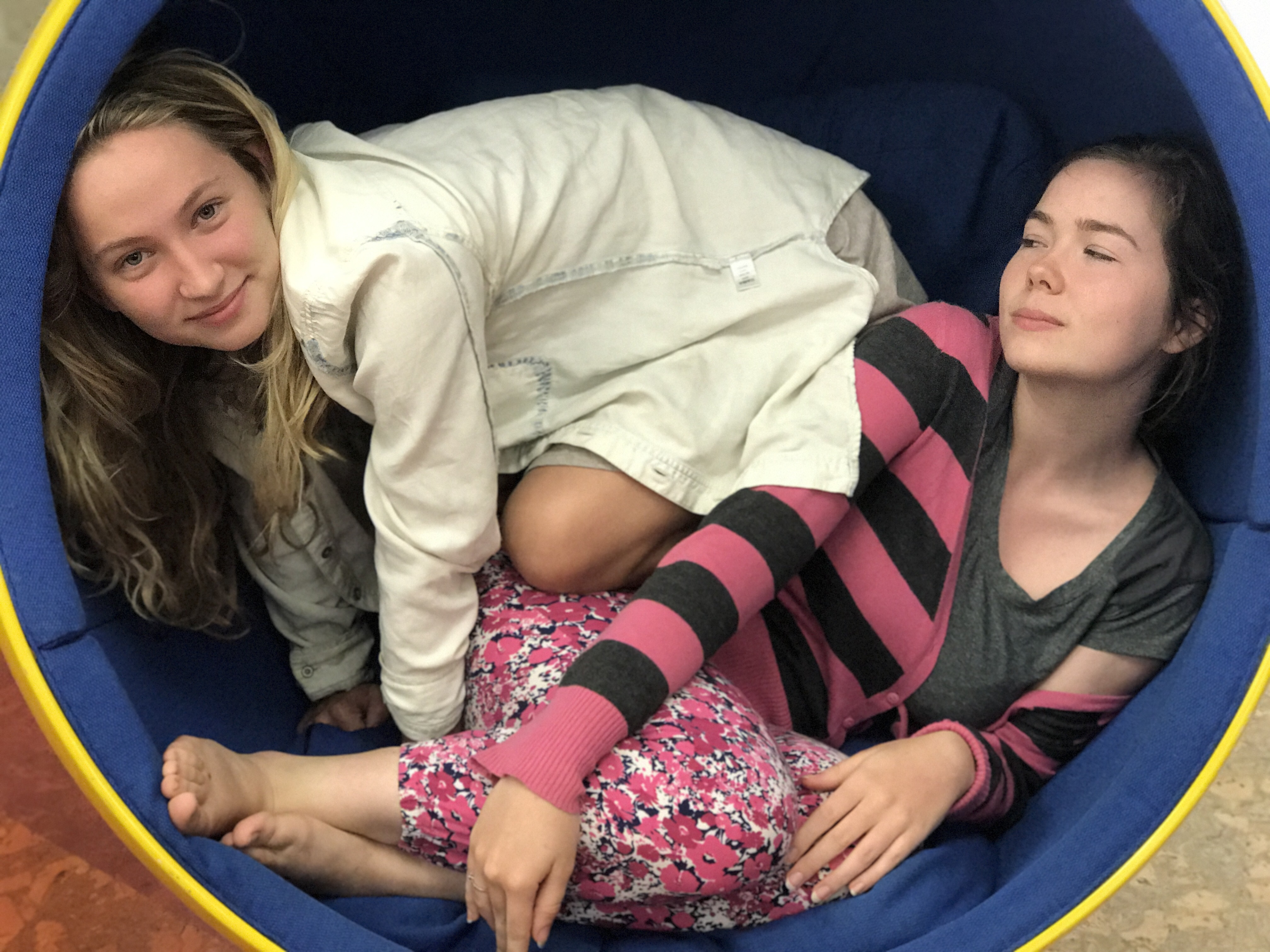
At Oberlin College, my girls crawled into a womb chair in the library. But it was not my womb chair. From my comfy nook, they emerged nearly 18 years ago, kicking and screaming. Only suddenly, they will be plunked down from their childhood into new places of growth, new libraries.

To be inspiring and to be inspired. To take over and to never give up. I hope.

img_0951
The womb chair where the girls tried to get into their in utero positions.
img_0939
We also visited a spot on campus where you could decompress by playing with kittens.
img_0961
College visit with our great friend Alex.

Lift Each Other Up

Why is it so easy to tear each other down? I don’t get it.

I like to walk down the crowded Manhattan streets and say (in my head) to each person I pass, “Good for you.” or “God bless you.” It’s my little rebellion in the world of Might Makes Right. My radical, unconditional kindness.

I reject the idea

someonethat the fastest, sharpest, meanest person gets to speak loudest, longest, have the most power.

I tell my students, most often in creative writing classes, “It’s more important to be supportive than right.” We do not need to have all the facts exactly right — we have dubious Google for that — but, Good God, we need to support each other. For when we stretch ourselves in our writing, when we share our vulnerability, when we ask for help, we are opening ourselves up to growth. We may make mistakes but we will grow.

How did asking for help get such a bad rap? I know I do not like to ask for help but when I have, I’ve been so pleasantly surprised by the outcomes. And the crazy thing is this: even if I do not get what I wanted, I get something else. I get something. It’s what it’s all about — lifting each other up. Asking to be lifted. Lifting.

Do not be so fast criticize. Be fast to praise. To support. To love. To admire. Just for today.

And for today’s inspiration: I give you: the Dreamers.


Make Sense

I am glad I live in New York City where you are not allowed to have a gun unless you have a special license. Although maybe that makes no difference. Across the country, there must be more checks on guns. It is out of control. Good God.

When I was in Dublin, I chatted with a guy at a bar. He was the night manager of a small hotel and he told me about how he missed his estranged daughter. And we talked about other things. And when he found out I was from New York, he told me that he used to want to visit the states, especially New York. But no more.

“I might get killed by random gun fire if I go to the U.S.” he said. Because apparently, the U.S. now has a horrible international reputation as a lawless, gun-toting country.
“I’d rather go to China,” the Dubliner told me. “Safer.”

“No, no,” I assured him. “New York City is safe. It’s only in a few places where they allow guns. And only a few places where these gun massacres occur. Not New York. Not big cities.” I, of course, was wrong. Not just today. But other days.

I tried to call the NRA just now. The number was busy.

As a mother, I feel I have the right to call and tell them, please, please, please, advocate for safer laws to protect innocent people. Use your lobbying money to help get the government to keep people safe. No more semiautomatic guns.

Let’s make sure all people who just want to experience the happy community vibe of a country music concert or a Miami dance club can enjoy these experiences without worrying that they will die.

I am a member of the Moms Demand Action for Gun Sense in America, founded by Shannon Watts, a fellow mother and a real hero. I connected to this group to know that I am not alone.

I also turned to my beloved United Methodist Women. Recently, I’ve been working on a project and had to get a quote from Bishop Oliveto, who is another hero of mine. Here were her words after the Colorado Springs horrific shooting:

These moments, when we feel deeply the loss and see clearly that such loss could have been prevented, place us on  the sacred ground upon which our commitment to heal the brokenness within our community rests. It is imperative that as we grieve we find ways to move through it in ways that empower us.

How do we grieve? How do we attempt to heal our brokenness? Who are your heroes? How are you making a difference? To whom do you turn to make sense of the world?

img_1215
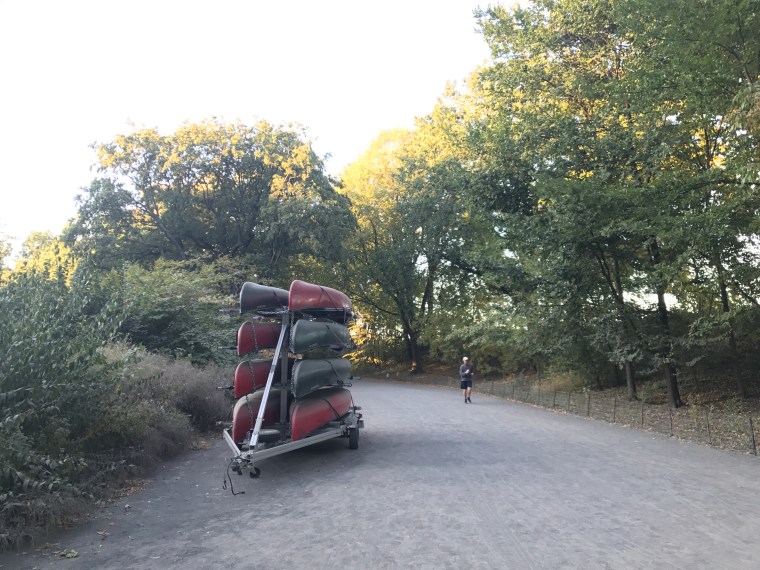
I don’t know why but I love seeing these canoes on the bridle path every day I walk or bike through Central Park.
img_1210
The Guggenheim. The dappled Central Park light, so pretty.

Laugh More

Take yourself less seriously. Find the good. This was my vow today.

I am trying to write every day. See, I feel stretched pretty thin. And writing balances me out. And here is a truth about me: The more I do, the more I get done.

From the library I borrowed the Adam Grant and Sheryl Sandberg book Option B: Facing Adversity, Building Resilience, and Finding Joy. The book reminded me to notice — not just my gratitude — but the ways in which I make a contribution. This resonates for me. What about you?

I do a ton of stuff for my family. There is so much emotional labor of parenting, planning. Right now as my girls begin to apply for college, I have so much to keep in my head — to remind them, without being a bisatch (spelling? bizatch? Aw, you know what I mean.)

I need to acknowledge my contribution. I need to ask, not, Why me? But hey, Why not me? Since I’ve got a heap of work, emotional and otherwise, I might as well enjoy it or do something with it. Or be the best self I can be.

These were some of today’s thoughts as I biked through Central Park. I went to church, had brunch at Vesleka in the East Village, paid some bills, and saw two plays: Small World and No Wake, both at 59 East 59th. Both, really good. I did my thing. I made a contribution.

Central Park is beautiful in every season. But especially in the autumn.


And in the early evening

Day 3: A Dystopian Tale

“Good. We’ve got them locked in. Don’t let them out,” said the older one, William, who sat down against the red door, fanning himself with his gun.

The two men, one young and one old, wore black suits with long red ties.  

Inside the Red Door lounge, the two dozen women were quiet as they were told to be. They rested against one another. A feeling of hopelessness,

“We’ve got the IWQC on lockdown,” said Jackson into his blue tooth.

You see, the year was 2019 and the IWWG, the International Women’s Writing Guild, had become the IWQC, the Interior Women’s Quilting Club. Guilds were not allowed, but clubs were. Women were no longer allowed to write. Newspapers and websites were banned any way. And so the writing guild had become, ostensibly, a quilting club.

Although it was only three years after the new administration, women were no longer allowed to gather for any reason but to beautify their homes. They were required to stay in their kitchens, laundry rooms, or jobs unless they had a craft that they wanted to practice, such as quilting .

Jackson had tipped off the government when one morning he collected his family mail. You see, men were the only ones allowed to use the postal service, just as they were the only ones allowed to access health care.

His mother’s printed newsletter had arrived in the mail. It said the conference would include a gathering of leaders at the Red Door to proceed to a final session at the nearby Rose Garden. Jackson had become suspicious. And he wanted to impress the older men. He had pressed his mother who finally admitted this group of quilters were more than they had appeared. These women at the Red Door were the heart of the Resistance.

Now Jackson’s mother Jill stood by the door where her son was holding her and the other women hostage.

“Honey, Jacky, this lounge here is getting too hot. And we are getting cranky.”

See, the women, although they had been held hostage, had still managed to form a circle to develop a group process over how to deal with blame each other the thermostat malfunction. Hours earlier, Elizabeth, a menopausal woman in the throes of a hot flash, had pushed up the AC up so high that the system had shut down completely.

“Please let us out, sonny.”

“I will,” Jackson said, required to lie. Required to lie to everyone, he could only tell the truth to his fellow white men who wore long red ties.

Jackson himself, reminded of how hot he was, loosened his red tie.

“Are you lying to me?” his mother asked.

“Maybe,” he admitted.

“Honey, you never liked wearing a tie. You always liked a bow tie. Remember that black checked tie you used to wear with the pastel checked shirt? You even wore that to the President Obama celebration in Millennium Park. How old were you then?.”

Jackson smiled. “I was eight. Yes, that was great.” He remembered the beautiful diversity of the evening, so different from the current gatherings he’d had to attend, only white men in their long red ties with their suits too big, in attendance.

“Did his bow tie look like this?” Paula, the club’s president, who had been eavesdropping, asked. She dug into her basket of fabric. Paula knew they had to get out of the Red Door Lounge by midnight when the March for Justice would begin.

Jackson looked through the window in the red door at Paula’s handful of fabric.

“Yes, it was just like that!” he exclaimed. “Geez, I’d love to have a bow tie like that.”

Paula knew Jill’s son Jackson had always been a little vain. “You can have it!”  Paula shook the black checked fabric, as if were a red cape before a bull. Jackson glanced at the other red-tied man, William, who snored peaceably, slumped against the wall.  

Jackson opened the door a crack to reach for the fabric. But Paula thrust her small trimming scissors into his hand. When he pulled back in pain, she kicked open the red door.

Paula grabbed the older man’s gun. She fired a shot into the ceiling.

“C’mon ladies, some of you stay and tie them up. The rest of you follow me to the Resistance! We meet at the Rose Garden.”

Several women descended on the two men, tying them with quilting fabric onto the chairs. The women bound the men’s hands with their own long red ties.

Roaming the campus of Muhlenberg College now, the women quilters were free to be writers once again. They high-fived one another. They ran down Chew Street to the Rose Garden. There, the women met other women, immigrants, people of color, children, people with disabilities, all gathering there to take back the night. And the country.

For her part, Paula threw the gun in the Rose Garden fountain. A little later, Jill freed her son Jackson. She led him to the gathering by his hand.

Years into the future, Jackson would remember the beautiful diverse scene at the Rose Garden in Lehigh Valley. He would never forget that he played a part in the Uprising of Women Quilters, a day almost as historic as President Obama’s Election Victory Speech in Millennium Park.

I started this in Paula Scardamalia’s class on Writing as a Goddess and nearly finished it in Anne Walradt’s Creating with Comedy. (It’s still not quite done!) Mom gave me the idea for the story, but instead of the narrative being comical, it took a Handmaiden Tale twist. In any case, I turned my fears for America into dystopian flash fiction.   


Day 2: The Writer at Work

“This period of my life is like..”

A True Detective story full of blood and wayward characters.
I am the western cop, trying to wrangle my people. Trying to stop time. Trying to figure out the killers and the troublemakers.
Seeking justice.

In Eunice Scarfe’s class, “The Writer at Work: Old Words and New,” this morning, we were asked to write from the prompt, or the catalyst: “This period of my life is like…” Here is more of my free write.

This period is a blue period.
A blue egg in a Robin’s egg nest. My nest, my home full of bustling, flitting activity.

This period is brimming with coffee and hilarity.
And worry.
Did I mention worry?
Worried about everyone’s health and how will I face my own ageing? Is that important?

Frida Kahlo had her birds

frieda.

Her own comfort. her man. her art. her illness.
I have my people, my worries.

I’m grateful — there it is, popping up like a weed — my gratitude.
I cannot stop journaling until it pops up. This gratitude for people. for places. for New York city. for shelter at this retreat from this United States political storm. I am hiding, nesting.

A bird has its nest.
a bird like me needs to fly. But there is so much to worry about. And there is so much to be grateful for.
Does a bird worry as she flies?

Does a bird have gratitude?

***

I read part of this  — and another essay I started about how the Coudals resemble the Kennedys — to Mary Alice Hostetter who wrote the beautiful Modern Love essay, “Dear Dad: We’ve Been Gay for a Really Long Time.”

I was reminded by Eunice of Natalie Goldberg’s advice, ‘Get your own story straight.
We all have a story.” And we were invited to ‘write so as to stop the breathing of our audience.’

“if you can tell it, you can write it,” Eunice Scarfe said.


Day 1: The International Women’s Writing Guild

Writing is a sanctuary, a church. This is a paraphrase from the brilliant, deep Susan Tiberghien, founder of the Geneva Writers’ Group.

Am writing from the back of the room at the 40th conference of the Guild.

I am here. At Muhlenberg. Today.

Thinking of my mornings, every morning, my coffee, and the light through the dusty kitchen window. The cupboards I should wipe down.

My cup of coffee — in the mug from Taize or from Westport, NY.

I write to say I am here. I write to say I have arrived.

I journal to figure out my day, my story, my list of things — so many things — to do. Journaling in the morning is my church too. My meditation. A place free of judgment. A moment of Ahhhhh.

Living in a dynamic, whirlwind family — the teenagers, bound for college, the husband, declining yet still active, an actor with Parkinson’s.

I am still here, I say in my journal, I have not lost myself entirely. When I write, I do not disappear.

I refuse to lose myself.

Now I am in Alyce Smith Cooper’s class, the Use of Creating the New Narrative of Compassionate Inclusion.

“How do you lift your voices and sing?”

A Girl Plays Football

“Hey, the Packers are going to beat your Cowgirls!” a student said.

And I corrected the student, “Don’t put down a team by calling them girls.” See, I believe in gender equality. I am a follower of leaders like Dr. Martin Luther King Jr. who believed that everyone should have equal access to opportunity.

Last year there was an ad on during the SuperBowl. It was about running like a girl. Did you see it?

The commercial spoofed the stereotype that girls could not run well. But they can. The ad showed that many kids thought the phrase, “run like a girl,” was an insult. But it’s not. It’s the opposite. Run, fight, throw like a girl. That takes courage. We all must do things that require courage. We all must be unconventional.

I’m going to tell you a little story.

This is the story of a girl who played a lot of two-hand touch football with her brothers and cousins. Her Uncle Tom N. was a great coach in Park Ridge, Illinois. One boy who went on to play college football and become a coach himself said Mr. N. was the best coach he ever had. Uncle Tom was patient, kind, smart. But he made one big mistake at a family party.

See, at this big party with lots of cousins, Uncle Tom was throwing a nerf football around the dining room to only the boys. But one girl jumped up and caught it. An interception. Yes. the girl.

“Hey, you’re pretty good. Too bad you’re a girl. And you can’t play football.”

“I can play,” the girl said.

“No you can’t. But just to prove it — If you want to try out tomorrow for the team, you can. But I won’t give you any special consideration because you’re a girl or because you’re my niece,” he said.  “Don’t feel bad if you get cut — Only half of the boys who try out make the cut.”

So this girl showed up with her little brother John to try out for the Mighty Might football team, the Vikings. She was very scared. But she did not let on.

She did her very best. There were tires on the ground and she hiked up her knees and hopped in and out of the tires. And there was a catching practice. And she caught it just like she always did when playing with her brothers or her cousins – one hand on top, one hand on the bottom and she hugged it to herself and ran fast. Faster than the boys.

And during the scrimmage of the touch football – they didn’t have their equipment yet — she was so scared of getting tagged, she ran even faster. She played her heart out. She even got to throw the ball and she jerked it back next to her ear just like she always did. ‘Cause see, she played like a girl – a fast, athletic, capable girl.

After the tryout, when her father picked her and her brother up from the tryout, she told him that she and John had done well. She felt proud. She felt like a winner.

And that night they got a phone call. The girl made the team, but her little brother John didn’t. (In fairness to John, he did not make the age cut off. It had nothing to do with ability.) But she never went on to play in a team. She just wanted to prove that she could make the team. And she did.

And that girl was me. So, never say, a girl can’t play football, because she can. She just might not want to.

When I was a girl, schools did not really implement Title IX yet. You know what it is, right? It’s a law that says public schools have to give equal funding to girls’ sports as boys’. And there were other ways that schools, when I was little, weren’t fair. I loved wood shop, but I could only take shop one quarter of the year and three-quarters of the year, I had to take cooking and sewing.

title-9

That didn’t seem right. So in middle school, I ran for and became the first girl president of Lincoln Junior High. I’m not sure if I made much of a difference. But there was an article in the local newspapers and maybe some minds started to change through my small acts of resistance about what girls could do.

Although women are not represented very well in the government in the U.S., in many countries half of the elected officials are women. In churches too, we have come a long way but we have a ways to go. As a girl, before Third Grade, I attended Saint Joan of Arc school in Skokie, Illinois and I could not be an Altar Boy. In Communion class in Second Grade, I asked the priest, Why can’t women be priests? And I’m still asking that.

So my message is: we must judge one another on the content of our characters and not on the way we look.

We can do better. We must do better.

  1. Girls are just as good as boys.
  2. Do not judge a book by its cover.

In English class we talked about how cool it is when a character is not how they, at first, appear. Take Chewbacca in Star Wars. How does he look? (Wait) Big, scary, mean. But you couldn’t have a better friend — a gentle giant.

Dr. Martin Luther King talked about we need to do in a sermon that is often called “A Tough Mind, A Tender Heart.” He talked about a creative solution to resist inequality. Thank you to Rev. Andrew Stehlik of Rutgers Church for his sermon on Martin Luther King, Jr. weekend, which inspired me.

Dr. Martin Luther King said:

Jesus recognized the need for blending opposites. He knew that his disciples would face a difficult and hostile world, where they would confront the political officials and protectors of the old order.  He knew that they would meet cold and arrogant men whose hearts had been hardened by the long winter of traditionalism. So he said to them, “Behold, I send you forth as sheep in the mist of wolves.”

And he gave them a formula for action, “Be ye therefore wise as serpents, and harmless as doves.” It is pretty difficult to imagine a single person having, simultaneously, the characteristics of the serpent and the dove, but this is what Jesus expects. We must combine the toughness of the serpent and the softness of the dove, a tough mind and a tender heart.

That was what he said. We must have soft hearts. We must give everyone a chance and we must be aware of the potential in everyone. We must encourage everyone. We must ask, Why? Why can’t we all be equal? Why should we put someone down for how they look? Or whether they are a boy or girl?

What can we do? Resist the status quo. Do not become lazy or timid when you hear someone put another person down. Or when you hear a boy call another boy, ‘a girl’ as an insult.

And this goes for ourselves too. Do not put yourselves down.

I tell you:  be more loving. To each other and to ourselves. Dr. Martin Luther King Jr. said that. So did Jesus. Dr. King said we have to love everyone, even those who were hating on us. He said, “Through nonviolent resistance we shall be able to oppose the unjust system and at the same time love the perpetrators of the system.”

In other words, love the hater but reject the system that encourages hate.

At the end of his sermon, Dr. King said,

When we are staggered by the chilly winds of adversity and battered by the raging storms of disappointment and when through our folly and sin we stray into some destructive far country and are frustrated because of a strange feeling of homesickness, we need to know that there is Someone who loves us, cares for us, understands us, and will give us another chance.  When days grow dark and nights grow dreary, we can be thankful that our God combines in God’s nature a creative synthesis of love and justice that will lead us through life’s dark valleys and into sunlit pathways of hope and fulfillment.

I want to end with one more upshot to my brief career as a football player. After that Vikings football season, between fifth and sixth grade, I took a summer school class on newspaper reporting. I wrote about my experience playing football. And a lot of other students, and even teachers and parents, said they saw my article in the school paper and they liked it. It made them think. And that summer school class probably inspired me in high school to work on the school paper, and, years later, to become a professional writer.

I saw that writing might start to change people’s minds –and I would not have not known that, had I not tried out for the football team. So take a risk, try something new. Just because everyone says you’re good at football doesn’t mean you can’t knit too. In fact, when I was a girl, there was a football player named Rosie Grier and he was a writer too, He wrote a book, Needlepoint for Men.

He was unconventional. So was Dr. Martin Luther King Jr. So was Jesus. You should be unconventional too.

This is a slightly revised version of a chapel talk I gave to elementary school students after Martin Luther King Jr. weekend.
Health Care for All

I believe in covering children for health care. I believe in health insurance for families of disabled people and those with preexisting conditions, like Parkinson’s. My husband has Parkinson’s Disease and he has been on Social Security Disability for years. He has also taken early retirement.

These supports were important to us as a family – they kept us afloat as I changed jobs from writing to teaching. As I started a small business. And as Chris received less work as an actor.

I feel ashamed to see Congress stripping away the Affordable Care Act (also known as Obamacare). They voted down support for young people on their parents’ coverage, veteran’s health, and CHIP, Children’s Health Insurance Program. They gutted programs at 1 in the morning when they thought no one is looking.

I am looking.

It is hard to look. I am still in such a state of shock for our country and, these days, I turn away more often than not.


I’m in a pretty hectic job; our daughter is going away to a semester school; my family house, Skenewood, is sold; my son is home from college. And every night I have to help put dinner on the table. I cannot do everything. But I can do some things.

I am going to the women’s march in DC next weekend.

I’m not giving up. I’m saying my piece. My peace. I’m seeking peace.

I believe in Obamacare, in health care for all. I believe in looking out for the marginalized, especially children and people with disabilities. Having health care has helped me and my family survive. I believe it is a right not a privilege. We can do better.