What is mission? Mission can be short-hand for missionary service. It can also mean an organization’s sole purpose or driving force. Both meanings apply to mission as used in Connect in Mission, a phrase used to promote the work of Global Ministries, one of the 13 boards and agencies of the United Methodist Church and the one agency charged with training, sending, and supporting missionaries.
Recent trends in missionary service reflect a greater awareness and respect for cultural context, simple living, communication, diversity, and love of the poor. These trends may seem forward-looking, yet the changing tides of missionary service refer back to the life and work of Jesus Christ.
Context and Partnership
Firstly, modern missionaries have to shake off the stereotype that a missionary is a zealot bound to harm indigenous peoples by cultural domination. After the Civil War in the United States and indeed all over the world, missionaries separated families, denigrated lives, traditions, languages, and cultures.
Today’s missionary walks with humility, love, and respect, learning about the world as they serve. Global Ministry executive and former missionary Jodi Cataldo, traveled to lead a Bible Study in Mongolia. What made an impression on the Mongolian people was “the love and compassion for the children and her dedication… The teacher’s excitement spilled over into the Vacation Bible School sponsored by a team of volunteers from the Ulsan Korean Methodist Church working in partnership with the teachers of the Gerelt United Methodist Church. Street evangelism was combined with singing and dancing, Bible stories, learning centers, ‘Olympic’ competitions, and a puppet show that captivated the hearts of 160 children,” said missionary HyeYun Hong Seo, who is from Korea and serves in Mongolia.
The journey of a missionary is one of accompaniment. Missionaries live the Gospel message. They walk the walk; they don’t just talk the talk. Their goal is not to incite the evangelized to confess their sins. Rather, the journey is an on-going and reciprocal living out of the Good Samaritan story. The message? “Go and do likewise.” (Luke 10:37) Missionaries connect people to the Gospel within a living context that has personal meaning as well as engagement with social justice, intellect, and spirit.
The modern message is not about conquering minds for Jesus Christ. It’s about living as Jesus Christ did. “It’s a lot like washing feet. You’re down on your hands and knees touching filth, grime, and all kinds of disgusting muck and mire. It’s not clean work,” says Rev. Jim Walker who ministers with the disenfranchised in Pittsburgh, Penn. In his book, Dirty Word: The Vulgar, Offensive Language of the Kingdom of God, Rev. Walker contends that the mission of the church is not about the found, but about the lost. The goal of mission is to remember Jesus, “who made himself nothing,” said Rev. Walker.
Simpler Lifestyles
The trend towards denying materialism resonates especially with young people. Among the many venues for young people to serve as missionaries within the United Methodist Church, there are US-2s who serve for two years in the United States and Mission Interns who serve in the US and internationally for three years. These young adults get paid very little, yet are motivated “to do justice, and to love kindness, and walk humbly with your God.” (Micah 6:8)
“Living as a missionary isn’t much different from living as a student so making the leap from one to the other isn’t that difficult. The truth is that you’re not making money in either profession and you’re almost always up for a free meal. It’s really not about the money, it’s about the learning when you’re a student, and again in the real world sense when you’re a missionary,” said Crickett Nicovich from Mississippi, who served as a young adult missionary from 2005 to 2008. She worked as a Mission Intern in South Africa with SHADE, a faith-based mission for displaced people. She is presently an Outreach and Advocacy Associate at RESULTS Educational Fund in Washington DC.
Rachel Harvey, a former US-2, said, “I grew up in a working class family. Choosing to be a US-2 and live on 200 dollars a month (when my rent, food and transportation was covered) wasn’t a huge issue because I’d seen my mom do it my whole life and still journey with family members living paycheck to paycheck. As a Christian, seeking to emulate a radical freedom fighter like Jesus, it was safe for me in our capitalist culture to be a US-2 because it gave me a reason to live below my means. The challenge for me came when I finished my service and was offered a salary with benefits above a living wage — that was when (economically) the challenge of being in community with someone like Jesus really hit me.” Ms. Harvey, from Pennsylvania, served as a young adult missionary from 2004-2006 as the director of CoffeeLoft.org in Vermillion, South Dakota. Ms. Harvey now serves as the Associate Executive Director of the Reconciling Ministries Network in Chicago, Illinois.
“Living a life of poverty is probably the least we can do in order to create a world where we are aware of the impact we have on the economy and others around us. I’ve seen many friends move away from a life of fulfilling everything that they want, and instead moving towards a life of simplicity. This movement towards simplicity certainly could cause a trend of more people looking at how they can help rid the world of injustice one step at a time,” said Laura Ralston from Illinois, who served as a US-2 from 2005 to 2007 with Saranam, a homeless outreach ministry with Central United Methodist Church in Albuquerque, NM. Ms. Ralston is currently a Youth Director at Central United Methodist Church.
Communicating Through New Channels
Mss. Ralston, Harvey, and Nicovich communicated their thoughts on missionary’s simpler lifestyles through Facebook. They, like many young adult missionaries, use new modes of communicating to share their message. Through Facebook and blog entries, readers can experience first-hand the daily challenges and joys of being a young adult missionary. These are also venues for sharing photos. When readers visit Joseph Bradley’s blog, a Mission Intern from Texas who is serving in Cambodia, they can learn about a taxi driver’s radical kindness and Mr. Bradley’s overall affection for and understanding of the Cambodian people.
On Mr. Bradley’s blog, http://jbradcambodia.wordpress.com/2010/01/ he links to eight other young adult missionaries, all of whom share their daily lives as missionaries.
Mr. Bradley was commissioned as a missionary in the fall of 2009 in a worship service that was broadcast live as a webcast http://new.gbgm-umc.org/about/us/mp/. Hundreds of viewers from around the world logged on to watch this commissioning service. People also look to the internet to see United Methodist news and stories at UMTV.org. Webcasts, blogs, and Facebook messages are new ways of connecting in mission, as are Twitter and Skype.
Rachael Barnett, an executive with The Advance, talks frequently to the recently commissioned missionary Shannon Goran from Tomball, Texas, who is serving as a director of student ministry at several universities in L’viv, Ukraine. The two talk through Skype, a free internet calling service, whereby the two can see one another as well as hear one another through their computers.
Pastors, too, use on-line tools to convey to their flock (and anyone else interested) what mission means. On Twitter, Rev. Mike Slaughter of Ginghamsburg Church in Tipp City, Ohio, recently sent this message to his 580 followers: “Missional church engages world in places of real need 2day; doesn’t waste time/resources fueling complex programs/structures #changeworld”
Some churches and people lack email access, so missionaries continue to send letters through the mail. They are required to send three newsletters to the Mission and Evangelism unit of Global Ministries and to their supporting churches yearly. Many supplement these letters with email updates.
Either through the internet or the mail, one trend emerges: relationships matter. In fact, the quality of relationships matter more than the missionary’s experience of a place. While in the past, missionaries relied on their physical presence to evangelize, to help, to heal, and to teach; future missionaries may not need to be physically present to spark this transformation. The words, witness, and accompaniment of missionaries through new modes of communicating make a difference.
More Diversity
The missionaries of Global Ministries are truly global. Almost half of the 185 international missionaries come from countries outside of the United States and serve outside of the United States. The majority of people applying to become United Methodist missionaries are not from the US.
No longer are missionaries solely people of European descent traveling from the US to their missionary assignment somewhere in the so-called “developing” world. It is now common for people from the Southern hemisphere to do their mission work in Northern or so-called “developed” countries, like the United States. (Due to tougher immigration laws, however, this cross-pollination of the mission field poses special challenges in procuring working visas for the non-US citizen missionaries who come to serve in the US.)
Shorter and More Varied Ways to Serve
Gone are the days when missionaries boarded a boat to cross the Atlantic Ocean to serve for 30 years in a far-off land. The world of 2010 is smaller. Also, missionaries serve in local and global capacities for shorter periods of time.
Present-day missionaries change assignments more frequently than missionaries of the past. The goal of missionary work is to work oneself out of the job. When this happens, a new assignment is needed. For example, Kathleen Masters worked as a missionary for decades — in the Solomon Islands, Georgia in the US, Uganda, Zambia, New York, and West Virginia. She is now a Global Ministries executive in New York.
The usual duration of service for standard support missionaries is three years. Continuation of service depends on many factors, including the finances of Global Ministries.
The variety of venues in which missionaries may serve has changed. One new category of missionary service is the global health missionary. Dr. Eduardo Maia is one such missionary. He is originally from Brazil and serves as a physician and surgeon with Chicuque Hospital in Chicuque, Mozambique. In connection with the church-wide focus on global health, one facet of Dr. Maia’s work is to help eliminate preventable diseases, such as malaria.
To fulfill global mission partners’ requests for help, United Methodist Volunteer in Mission teams (UMVIMs) help for short periods of time. Often, these volunteers develop a heart for mission and commit to serve on a regular or long-term basis. In recent years, the number of mission volunteers has exceeded one hundred thousand.
Theology and Leadership from the Poor
The myth of the church as being led by a handful of people in robes is collapsing. In fact, the people who lead The United Methodist Church are not the pastors or even the laypeople in the pews, they are the people working in the fields, learning in the classrooms, serving in the restaurants, and living under the bridges.
The church is made up of people who are not insular or insulated; the church is made up of the marginalized. Jim Walker talks about this ministry: “What we offer doesn’t come from our expertise or from some committee but from the work of the Holy Spirit, being up to something, touching and transforming lives.” While in the past, Christianity may have emphasized sin and confession, this spirit of accompaniment and love is replacing a moralizing, Christian certitude.
In 2010, the renewed Christian missionary movement truly seeks to connect in mission by living as Jesus did. In so doing, one learns that God still loves the world. The challenge for missionaries and for the mission-minded? To continue to evangelize the church as they evangelize the world.
To support any of the missionaries mentioned in this article, such as HyeYun Hong Seo in Mongolia, Shannon Goran in the Ukraine, Joseph Bradley in Cambodia, or Eduardo Maia in Mozambique, please consider partnering with them through a Covenant Relationship. About three thousand United Methodist churches in the United States have covenants with missionaries around the world. To learn more about how you or your church can set up a covenant relationship, link to www.advancinghope.org or email: covenant@gbgm-umc.org
Mary Beth Coudal is the staff writer for Global Ministries. She would like to thank her colleagues Jerald McKie, John Nuessle, Antonietta Wilson, Fred Price, Rachael Barnett, James Rollins, Beth Buchanan, Kathleen Masters, Jodi Cataldo, and Gail Coulson for their conversations which contributed to the understanding of the missionary trends noted in this article. This sharing of ideas marks yet another trend in the mission movement of the General Board of Global Ministries — greater collaboration.
I wrote this article for New World Outlook magazine when it looked like some of the stories for their issue on “Mission” weren’t coming in, but alas, all the assigned writers turned their articles in. This story got bumped, although an abbreviated version appeared on the website at GBGM-UMC.org
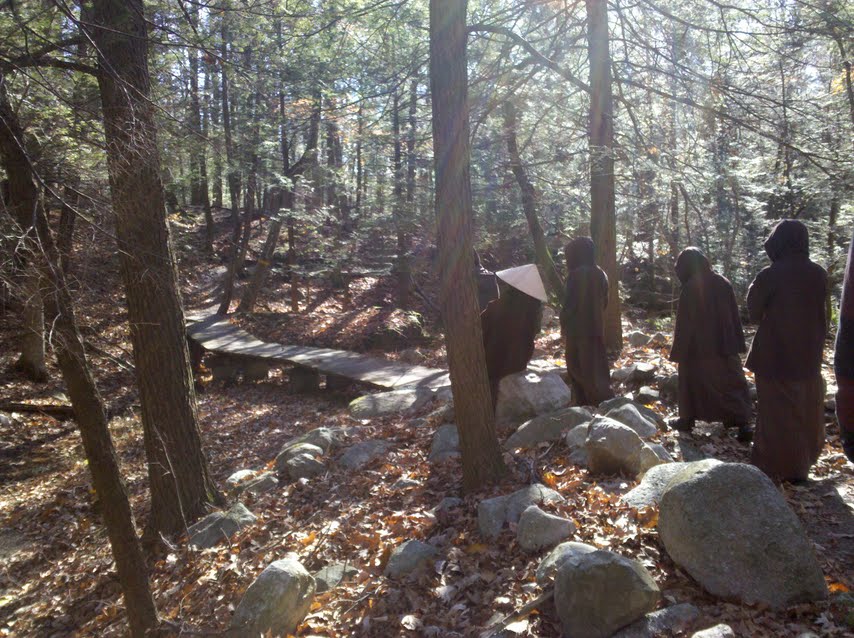 The Buddhist sisters were ahead of me on the walk. I looked at my phone and realized that I had email. And so at a Buddhist monastery on a sunny daylong retreat I found myself checking my email. (I had to resist posting my status on Facebook and Twitter. “On a walk in the woods with my Buddhist sisters.”)
 100 Days of Poems and Pics