I’m not giving up red or white. I’m not giving up sweets, trashy TV, gossip or coffee. Been there, done that.
In fact, I might even drink more, watch more Shark Tank, eat more sweets, dish on the neighbors, and hit the latte bar.
Seriously, you know, I’m a righteous soul. I’ve got to do something for Lent.
I’m going to take up some things that make me happy:
Decluttering
wine in the Adirondacks. waiting for summer.
Blogging
Traveling
Eating a plant-based diet*
Having people over for dinner*
*These last two were inspired by Pastor Andrew’s sermon a couple of weeks ago at Rutgers Church.
On second thought, having dinner parties may be challenging, given that I’m going to be traveling too. (My friend Barbara Wheeler-Bride just wrote an awesome blog post about one of my parties, Thank you, Mary Beth, at Busted Halo. Thank you, Barbara.)
If you want to join the decluttering challenge and do some synchronous cleaning, I can add you to a super-secret Facebook decluttering group. Just message me.
I want to blog more because I have been learning so much through starting my own business. I want what I’m learning to be useful to other people.
And why travel? Just because. I’ve been a little down this week. And travel always makes me happy. In fact, I’m writing this from beautiful Nokomis, Florida. (Thanks, Nicole and Brendan for hosting me!) Next week, the family and I will be on spring break at Circle Z dude ranch in Arizona. Then, just my son and I head to Charlotte, North Carolina to look at colleges for him.
While in Charlotte, I’m offering a really fun and creative workshop, Spiritual Journeying, with Cindy Sloan. We’ll be making collages and writing about moments from our lives. We’re offering the workshop on Sunday afternoon, March 23 at Dilworth United Methodist Church ($29). Please come and tell me what you’re giving up for Lent. Or if, like me, you are just giving up.
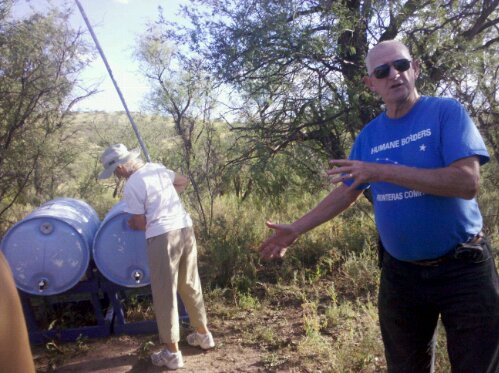
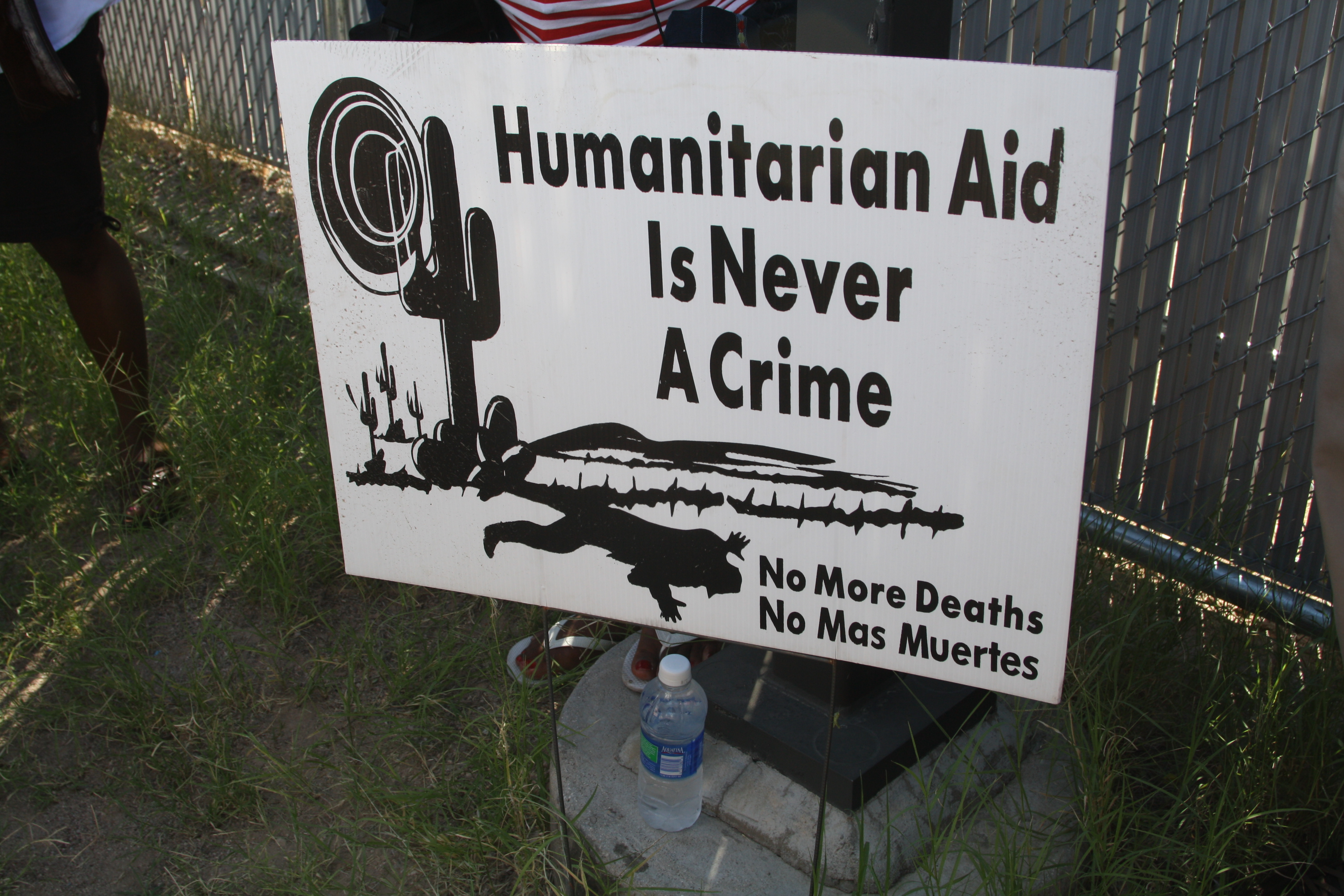
Meet Lois Martin and Gary Wolf. They’re volunteers with Humane Borders, a group in Arizona that puts water stations in the desert so that migrants who are traveling into the US will not die of thirst. Their work is legal — they emphasize this repeatedly because, apparently, some people think it is illegal to give out water to prevent death.
Dehydration is the leading cause of death in the desert and hundreds of people die every year for lack of water in the vast Arizona desert.
There were about 15 of us in the community developers group who visited the water stations. Two among us told how they had crossed these very same borders from Mexico, in the cool of the night, running, one as a girl and the other as a young woman. They are now both documented US citizens.
The Humane Borders volunteers reminded us that people cannot be “illegal.” People are people. Rather, they are people lacking documentation.
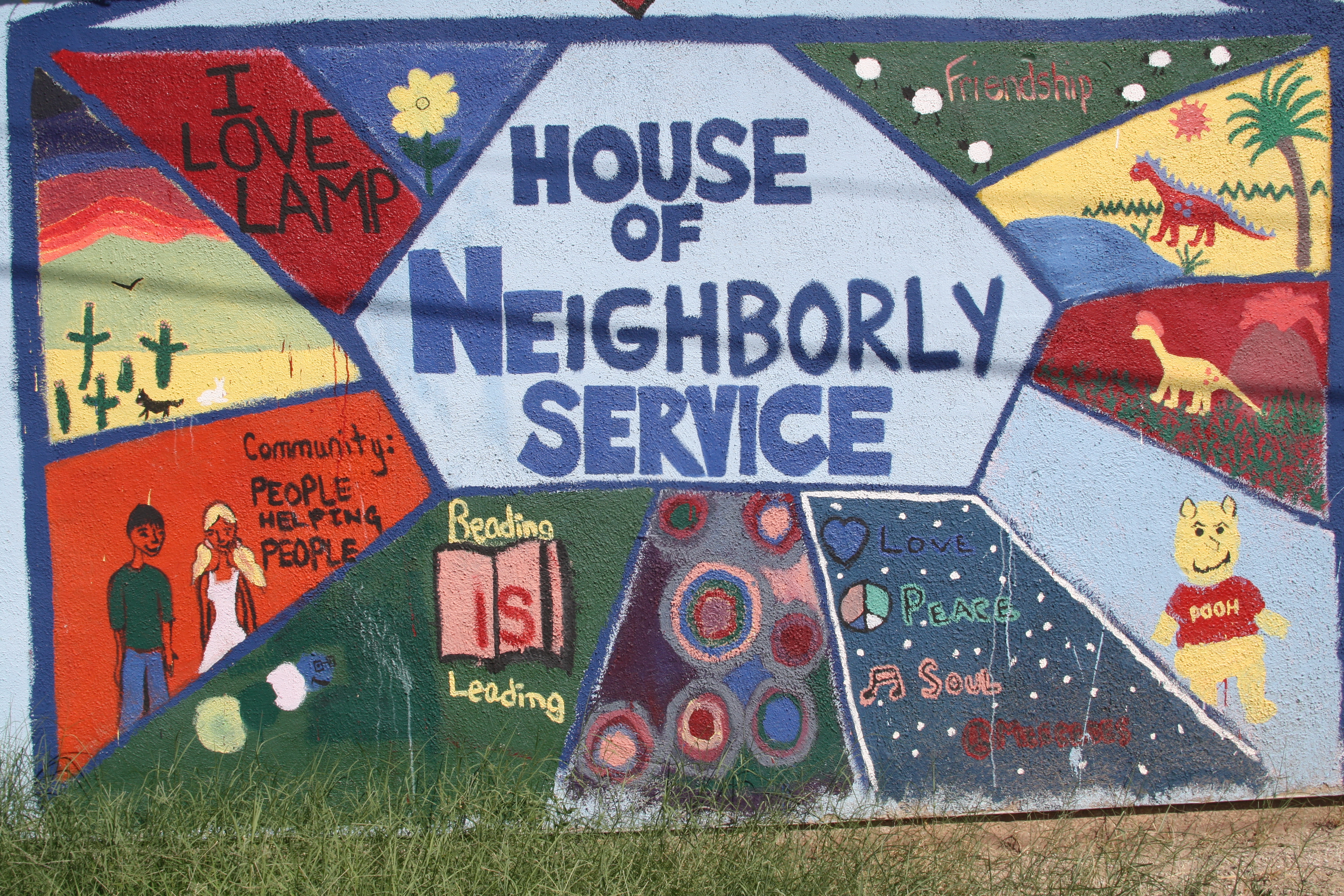
Mural on the wall at Humane Borders
Most migrants come from countries beyond Mexico. Imagine the journey.
This was the first day of the “Let’s Get Radical” event for community developers in Scottsdale, Arizona, when more than 70 community developers traveled to Tucson to visit this group, Humane Borders.
Rev. Robin Hoover, Humane Borders President, First Christian Church Pastor, taking a group to the Mexico/US border, discussing immigration, compassion, providing water.
A handful of our group went into Mexico with the Humane Borders president, across Nogales, AZ to visit the tents of compassion, weigh stations run by Catholic nuns, who minister to those who are ejected from the United States, dumped back on the Mexico/US border, with blisters on the feet and no money in their pockets. The nuns and volunteers do what they can.
Bishop Minerva Carcano of The United Methodist Church spoke about working in the tents of compassion. She told how she met a family in the tents — a father and two young children, Melvin and Joslyn. The bishop played with the family and laughed with them.
“It is an amazing journey that these brothers take. They take the journey depending on God. We do stand on the word of God. Leviticus 19: ‘You shall not oppress the immigrant. You shall welcome that immigrant as a citizen. … and you will remember you were an immigrant in the land of Egypt.’
As she left, she gave money for the small family to the father. As she walked away, she heard others say, “Gracias, mi hermano.” The father had given the money to other migrants in the tents.
“I felt I had seen the face of God,” the bishop said. Having so little, that father shared so much. (This, like many stories at the community developers’ event, made us cry.)
Community Developers group -- Mary Beth, Monte Payne, Tonia Rios, Humane Borders volunteer Karl Tucker, Malik Saafir, Rhonda Robinson
I was with the group that visited the water stations. The blue flags that mark their locations may be torn or full of bullets but the Humane Borders workers continue to check the water supply underneath the 100 or so flags in the desert. At times, they move the water stations to optimize giving (and perhaps avoid entrapment of migrants by the minute men or border patrol?)
“Minute men are right-wing whackos….Its an evil, evil, evil mess,” Karl Tucker, our volunteer, said.
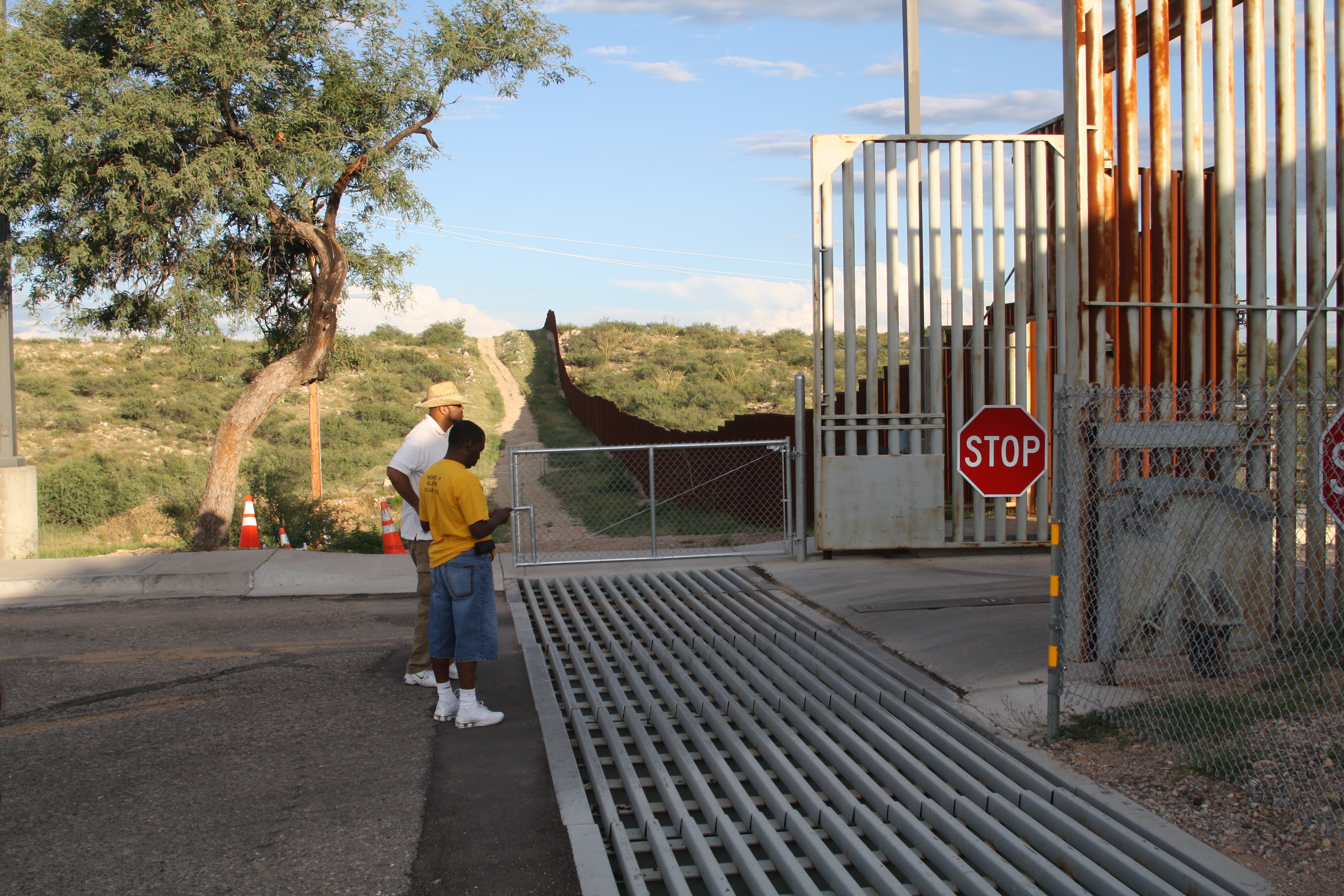
We ended the day-long trip with a visit to Sasabe, Arizona. There were no people anywhere, except for about six border patrol officers, one of whom wielded a huge gun.
Community developers approach the wall.
The diminutive, yet powerful Lois Martin requested and the officers agreed, to let us approach the wall.
It was shameful that this is how we, the US, ‘welcomes the immigrant’. We give them a wall and tell them to keep out. Whatever happened to:
“Give me your tired, your poor, Your huddled masses yearning to breathe free, The wretched refuse of your teeming shore. Send these, the homeless, tempest-tost to me, I lift my lamp beside the golden door!”
No, there is no lamp beside a golden door. There is a wall. At least there is water. And people like the Humane Borders volunteers who give small comfort. And in so doing, they save lives.





 100 Days of Poems and Pics