Happy-Go-Lucky? Good enough!

In the face of worry, I stay perky and productive. Chris does too. We continue to make a contribution — at work and at home. I want, need, and hope that we all stay as positive and productive for as long as possible.

Chris’s work is very meaningful. On the heels of his success translating The Cherry Orchard Off-Broadway and directing Picasso at Lapin Agile in Florida, he is performing in a fabulous production of Taming of the Shrew. He is also making a documentary with his friend Dan about having Parkinson’s as they rehearse for one performance of Beckett’s Endgame. (Checkout The Endgame Project.) We’re going to see the trailer for the documentary on Monday night.

So when people ask me, How is Chris doing? I usually say, “He’s doing great. He’s productive and he’s positive.”

As a family, we are doing great. Or, at least, good enough. And good enough is good enough. Lots of times, we are perky and happy-go-lucky! As I’ve said before, “We get by with a little help from our friends.” And family!

And when we feel sad about having to just get by, that’s okay. We’re human after all.

Driving with Parkinson’s Disease

On the first day of vacay, just come back from the beach, sandy and relaxed, I got Chris’s phone call with the bad news.

After I drove myself and the kids to our flight out of JFK, Chris took the driver’s seat. About five minutes later, he rear-ended a car. It was on the ramp from the airport to the highway (the Long Island Expressway?). He had been fiddling with the radio and didn’t see the car stopped at the red light in front of him.

The airbags inflated. No one was hurt. Our car was totaled. Chris told me, “My driving days may be limited.”

That night after I got that call, I didn’t sleep well. It didn’t ruin my vacation. It just felt like a signpost on the unhappy road of the progress of Chris’s Parkinson’s Disease. (He’s had PD nine years now.) Parkinson’s is a steady decline.

I have not enjoyed driving with Chris for years. Lately, he could hardly drive a city block without me clutching the dashboard or pressing my foot on a phantom break. I tried to bite my tongue, but often blurted out, “Look out!”

So, when we were together in the car, I always drove, especially with the kids in the car.

This is tough stuff. But I’m glad I didn’t have to tell him, point-blank, “I think your driving sucks.” How do tell someone that? It feels terrible. Yet, it would feel even worse if there had been a serious accident and I’d have to apologize to some stranger, knowing as I did, that his driving sucked. Maybe a small fender-bender is a blessing in disguise.

When you live with someone who is chronically ill, you have to pick your battles. You have to witness a decline. And you often don’t want to speak your truth.

You have to take over the driving. Sometimes it’d be nice to doze in the passenger seat and trust that the driver’s doing just fine. That doesn’t happen when you’re married to someone with Parkinson’s. At least, it doesn’t happen for me.

He can drive other things, but he can’t drive the family car. For that matter, neither can I. Because we don’t have one any more.

Enhanced by Zemanta

Letting Go of Gossip

This Lent, I gave up gossip. This has been tough. I miss the way gossip clarifies your values. It’s like when you watch Nanny 911 and you feel so good and smug about your own parenting skills. You think to yourself, “I would never do THAT!” (But let’s admit, we’ve all done much worse. We just, thankfully, did not have a camera crew following us and recording our parenting failures! Not too worry, those incidents will be remembered by our children who will blame us for years to come.)

In the fall, I met a church executive who told me she left church work for a while to sell Mary Kay cosmetics when her husband was in the military. She said in the Mary Kay biz, you were not allowed to gossip or criticize one another. (I don’t know how they enforce this). But she said it was a good and productive way to work and that she wished she could do this again now that she’s returned to church work.

I know there are positive sides to gossip — studies show it can bind community members together and other studies show that gossip lowers your heart rate. Whatever. From my own experience, gossip undermines creativity and productivity and inhibits trust in coworkers.

At work, I’ve felt stuck when a colleague wants to gossip about another colleague. I have no way to extricate myself.

Here I am at the work Christmas party. I hope I wasn't gossiping. (photo by J. Barnes)Should I?

1. Say nothing, which makes the gossiper think I agree so they keep on gossiping.

2. Say, “I hear you. But I gave up gossip for Lent, so, much as I’d like to join this gossip gravy train right now, I can’t.” No, this makes me feel all holier-than-thou.

3. Don’t talk to anyone. Umm, that’s not happening.

Without gossip, I’m losing an opportunity to bond.

On my Twitter feed the other day, another woman church executive wrote a tweet, something like, “We remember best the people who supported us most.” I want to be that person — the one remembered for being supportive, creative, and productive, not negative or gossipy.

I do want my heart rate lowered and I do want to bond with my colleagues. So after Easter, I may have to dive back in the gossip pool. Or I may not. There’s a lot to talk about besides each other. And there’s a lot to admire in one another. I’m a big fan of admiring my colleagues. And I want to keep admiring people more (not less).

But as one other coworker told me, “I never gossip. But you want to know who does???” (ba dum bum!)

Aging

My birthday is coming up. Not really feeling it. I am no longer an ingénue, a wunderkid, a hot new writer. I hope I hit my stride before Amy Clampitt did. But hey, she hit it big at 63, publishing her first book of poetry and following up with ten more years of poetry success (which, I know, sounds like an oxymoron).

Face it, we are all getting older. While visiting Florida this week, I’ve realized there are many ways to age gracefully.

There are athletic 85-year olds striding down the beach and bejeweled 75-year olds shopping for knick knacks.

As they say, aging is better than the alternative.

Like Phil Dunphy in Modern Family, I want to stay hip and childish. Maybe I mean, child-like and full of wonder.

I can be gullible, especially when my kids show me some new technology, my mouth falls open, Are you kidding, Facetime? Skype? You can talk on the phone and see someone? What will they think of next? Flying cars? Moving sidewalks?

Yes, at times, I am more naïve than my kids. They are growing up in New York City, after all, so that gives them an advantage over a kid like me who grew up in the Midwest suburbs. (Of course, ever since Obama became President, the Midwest is hip.)

As I age, I mainly want to stay curious and kind. I don’t want to be a know-it-all or a crabby old lady when I grow older. I love the song by Lee Ann Womack, I Hope You Dance. I love the line, I hope you never lose your sense of wonder. 

I hope, as I age, that I never lose my sense of wonder.

Shabbat Dinner

We all need a healthy dinner and time to savor it. Family dinner time is a sacred space to sit down together, to chat, to chew, to lean back in your  chair, (even when you’re told not to).

Sure I say all this, but do we do it? Last night, I ordered pork fried rice, chicken with broccoli and spicy dumplings from the Cottage. I grabbed a few bites. Then I yelled, “Chinese food on the kitchen table,” over my shoulder.

I was running out the front door as my three kids ran in. I was going to my non-fiction class. The kids were coming home from math club, play practice and track team. My husband was working. That is how we roll — busy, busy, busy.

I believe in family dinner time. I really do. So we started a Friday night dinner ritual. We’re Christian, but our ritual is based on the Jewish tradition of Shabbat dinner. (Thanks to my friend, Joe Little, who suggested this as we sat on the sidelines of our girls’ Westside basketball league and to my upstairs neighbor Ran, who has invited us to many Friday night Shabbat dinners over the years.)

On Friday nights, we turn off the computer screens and phones, we meet in the kitchen and light a candle or two, we drink grape juice, and someone cracks open the Bible (we use the brilliant translation, The Message by Eugene Peterson).

We usually read one of the Psalms, because they’re poetic, dramatic and understandable. It takes all of ten minutes, but it’s an awesome way to decompress from the week and enter the weekend. And then we have dinner and just hang out.

Last week, after our Shabbat prayer and dinner, we played the card game, Spoons. Then we watched a movie. No biggie, just chilled and relaxed.

We should have Shabbat again tonite, but one of my girls has a statewide math competition, the other is going on a sleepover, and my husband has rehearsal. That just leaves me and my son. It’s fine that it’s just the two of us.

We’ll light a candle, read the Psalms, and savor some left-over Chinese food.

Girls Leadership Institute

Last weekend my twin daughters and I spent the weekend at Grace Church School in the Village for the awesome Girls Leadership Institute.

I was surprised to learn that girls’ friendships are their whole world. Hearing about the scenarios of the other girls reinforced this. In our role playing, there were many examples of small snubs that deeply, deeply hurt — like not being invited to a party. It is tough to be a kid!

One of my takeaways from the weekend was learning four steps to navigate a conflict.

1. Affirm the relationship

2. Use an “I statement”

3. Admit your contribution

4. Solve it together

I am pathologically nice and avoid conflict at all costs. So this was good for me. I realized that I skate over step #1. And #3 too. Somehow I never fail to notice and feel the wrongs done to me, but I may not always see or feel my contribution to a conflict. (Me? Perfect ole me?)

I have to acknowledge that, “In 99% of arguments, both sides somehow contributed to the conflict…” That blew my mind. Everyone is always quick to blame others. But realizing that we each have a role in the conflict may make the solution more accessible.

At times, I felt a little strained in the workshop, because I was the only parent there with twins. The twelve or so other mothers all had just one daughter to intensely talk with or role play with. I was trying, as I always do, to be fair and distribute my attention equally. The facilitators were supportive and sometimes worked with one of the girls one-on-one, but I don’t think they were used to twins with one parent.

All in all, it was a totally excellent weekend. We learned a lot and we are already implementing it around the house (although their big brother is a bit dismissive (maybe he’s a little jealous?)) I think I need to affirm that relationship with my son, maybe even use an ‘I statement,’ admit my contribution, and then we can solve it together. That will be fun.

What’s wrong with intentional community?

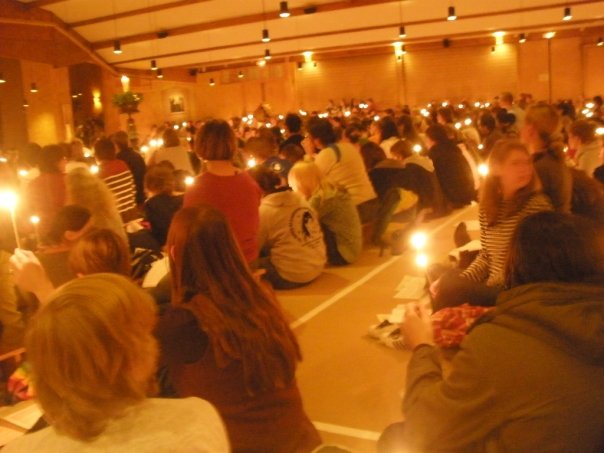
Thousands of people sing and worship together in this intentional community in Taizé.

I wrote an article for a Christian magazine a couple of months ago and mentioned that a young missionary lived in an intentional community with other missionaries.

I thought it was cool, because the missionary said the four young women had weekly meetings and talked about any cohabiting issues that’d come up — like cleaning out the fridge. And then they’d pray together.

This minor reference to an intentional community was edited out of the article. I wondered why. But, as usual, I didn’t make a fuss. I never asked the editor, Was there something wrong with that information?

And then, last night, I saw the movie Wanderlust. The leader of the hippie commune corrects Paul Rudd, “No, not a commune; We prefer intentional community.” And everyone in the audience laughed. And then I got it. Intentional community is perceived as hippy, dippy, grungy, suspicious, free love, attractive but not sustainable.

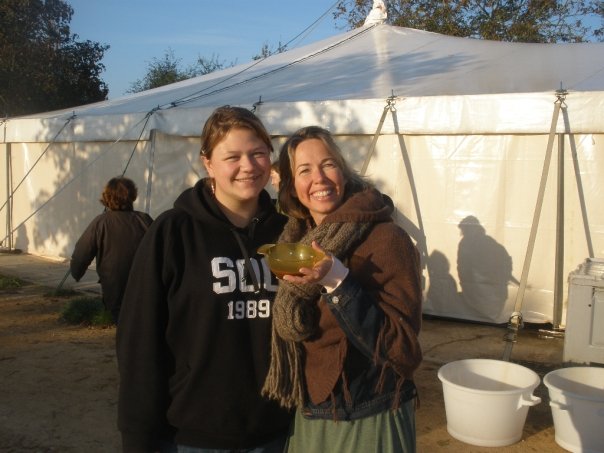
Briefly, I lived in intentional community. There was hardship and friendship. (That's me on the right, with Lee, our wrangler).

Tell that to the monks and religious orders. Religious people, like monks, priests, nuns, and, even young adult missionaries, live together and care for one another in communities all over. And it makes good sense, especially as people age and do not have children or spouses to care for them. Human beings are social creatures. We crave community, intentional or ad hoc.

Is being one half of a married, straight couple the only sanctioned way to live? I don’t think so. I thought a lot about this when I went to Taizé a few years ago. In that monastery, the brothers seemed to care a lot about one another and they cared a lot about the thousands of people visiting and living with them. That is intentional community too.

Brother Roger, who founded the Taizé community in 1940, said, “I think that I never lost the intuition that community life could be a sign that God is love, and love alone.”

If an intentional community is based on love – and figuring out who cleans the fridge – that does not seem to be so crazy. That seems to me to be the point.

Teaching

When you teach, you have to think. You have to look at things in new ways. I like thinking new things, but I don’t always like acting in new ways.

my class

I have been teaching more than usual lately. Last week I led a seminar on Writing Your Spiritual Autobiography at New York Theological Seminary.

In the fall, I taught a weekly creative writing class for middle school kids.

When you teach, you can’t multitask. You know, there’s no schmoozing by the water cooler or reading the paper with your feet on the desk as a teacher. You have to be on — prepared and smart.

I like that. And I like being in the zone of teaching. It’s a change. And today, I don’t necessarily think I can make any big life changes. While my marriage is hard, due to Chris’s Parkinson’s, we all still love each other. And besides that, the kids (and Chris? and I?) need stability.

And so to get out of my rut, I teach. I am grateful for the opportunities to indulge in this happy and meaningful pursuit (distraction from my real life).

Forgiving the Bad Apples

We had a class meeting the other night. One parent reported that a few bad apples have spoiled the whole class’s reputation. Several people nodded and one parent said something like, “Yes, if we were rid of those bad apples, everything would be fine.” Most of us nodded. (I didn’t even know the bad apples, but what she said made sense. Like the song goes, “One bad apple don’t spoil the whole bunch, girl.” Oh, wait, one doesn’t spoil the whole bunch! Good to know!)

One woman spoke up, “I think we’re too involved. Let’s let the kids work it out themselves.”

Jones Beach in winter

Another said, “Yes, we should teach our children to be forgiving. We hold our grudges for too long.”

Walking out with these new friends from the meeting, I said to the woman who advocated forgiveness, “What a powerful idea. I forget about forgiveness.”

“Some of my students’ parents still remember when their child was wronged in 1st grade and I teach 8th grade,” said a new friend, a teacher in another school. “We have to let go.”

I’ve thought about this conversation for several days. I wonder if I, like many people, define myself by NOT being one of the bad apples (and certainly none of MY children are rotten!). And I’m not sure I always forgive and forget.

I have always liked being a good apple. And have enjoyed the smug pride of my righteous, responsible and kind nature.

I actually despise bad apples. I detest overly negative people. (Especially since giving up gossip again this Lent!) And yet, I recognize the irony — I am extremely negative about negative people.

I wonder if I might try this new practice of forgiving the bad apples, the good apples, the negative people and even, myself.

enlarge

Right outside my office, there was an empty cubicle and right next to the empty cube was P’s desk which overflowed with papers and magazines. I told P. that she and I should both ask management to break down that wall and enlarge her space into the empty cube. We did and now there’s one large cube.

I like encouraging people and being encouraged to learn, grow, and get bigger. Not everyone does this. I think sometimes people might feel like enlarging someone else’s space might diminish their own. But admiring and enlarging others makes us bigger too.

I love the way Vincent Van Gogh wrote in his letters to Theo about his admiration for his contemporaries. He admired religion, Japanese art, other artists.

“If I love someone or something, then I do so in earnest and sometimes with real passion and fire, but that doesn’t make me think as a matter of course that only a few people are perfect and all the others worthless — far from it.”

More inspiring quotes from Vincent van Gogh:

“There is nothing more truly artistic than to love people.”

“I always think that the best way to know God is to love many things.”

And in his letters, Vincent advised his brother, Theo, over and over, to “admire.” For me, that means to enlarge others. I look for the good in everyone and try to get them more space.

20120218-192858.jpg