Miami, the Morning After

I love the fresh-scrubbed morning face of a city that partays. I like the clean streets and sobriety of the morning after. It’s almost as if in a new day’s light, Miami doesn’t need a face lift at all, she just needs a good face washing. Hose down her sidewalks, sweep away her broken glass, strain the salad from the pool.

Yes, lettuce leaves floated in our pool, although Laurie said they were flower petals. Petals or arugula, there was still stuff floating in our pool one night.

As the sun heats up South Beach, the music and the partying gets turned up too. Everyday the city does it all over, maybe knowing in the morning she’ll be sober — fresh and new again, ready for her morning walk or rooftop yoga. Miami likes to partay, but she also likes to stretch.

The morning’s good for walking and for running on the beach. It’s good for stopping on a bench to stare at the Atlantic and sip strong and yes, expensive, coffee. Coffee from the News Cafe is like $3.50. But, as they say, the people watching? Priceless.

We ate (and drank) at such fun places, like brunch at the News Cafe, in Miami. The first night we walked to Lincoln Road and had dinner at Nexxt. The servings were HUGE and we were glad we had decided to share our plates. Earlier we’d had appetizers at The Front Porch, good guac!

Another night we ate at Yuca on Lincoln Road. The preppy couple sitting near us recommended the Lobster quesadilla or wrap thing, but it was in the $59 range. We were not buying a wrap skirt, for God’s sake, we were buying a wrap app. We stuck to ceviche. It was all good. We had pretty drinks in pretty glasses and watched pretty people parade by.

One highlight from the Miami weekend with my sister in laws was the same highlight from my book club weekend a year ago. Dinner at NoBu. I should be jaded, after all, I live in Manhattan. But I just love the creamy, spicy rock shrimpy dish, the nice waiter, the cool ambiance, the chic-ness of it all.

I’m a sucker for the bright early morning light, but also for the fading light of dusk.

On the bed at the SkyBar at the Shore Club

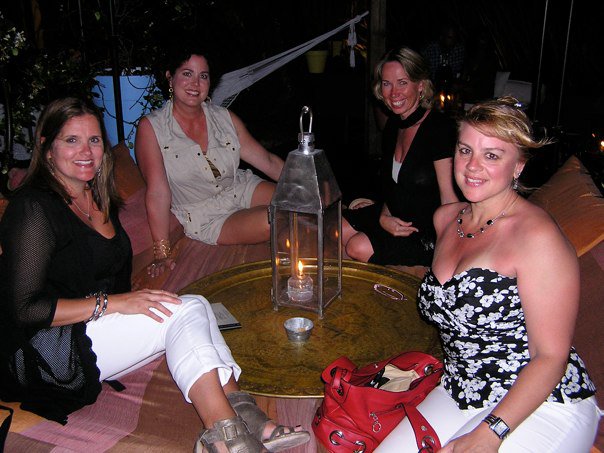
The four of us sister in laws reclined on a four-poster bed at the Shore Club for hours. We joked with some European guy who tried to flirt and giggled with some bachelorette party English women who wore tight black dresses and sequins. We debated waiting for the midnight fashion show at the Shore Club, but honestly, felt we’d seen the fashion show already.

We also discovered on our last day, the lunch spot, CJ’s Crab House, right next to our hotel, The Park Central. The other days we’d eaten lunch from this nice cafe around the corner, Cafe South Beach Deli. We’d sat on the beach and ate some really good salads, especially the fresh-cut fruit salad. And, of course, a bag of chips.  But CJ’s shrimp salad and crab salad sandwich was really good. And it was right next door.

Over the three nights in Miami, we stayed up late. We got up early. We got away. We went to night clubs, like the Shore Club. And in the morning, like Miami, we washed up and started all over again!

Rethink Mission

What is mission? Mission can be short-hand for missionary service. It can also mean an organization’s sole purpose or driving force. Both meanings apply to mission as used in Connect in Mission, a phrase used to promote the work of Global Ministries, one of the 13 boards and agencies of the United Methodist Church and the one agency charged with training, sending, and supporting missionaries.

Recent trends in missionary service reflect a greater awareness and respect for cultural context, simple living, communication, diversity, and love of the poor. These trends may seem forward-looking, yet the changing tides of missionary service refer back to the life and work of Jesus Christ.

Context and Partnership

Firstly, modern missionaries have to shake off the stereotype that a missionary is a zealot bound to harm indigenous peoples by cultural domination. After the Civil War in the United States and indeed all over the world, missionaries separated families, denigrated lives, traditions, languages, and cultures.

Today’s missionary walks with humility, love, and respect, learning about the world as they serve. Global Ministry executive and former missionary Jodi Cataldo, traveled to lead a Bible Study in Mongolia. What made an impression on the Mongolian people was “the love and compassion for the children and her dedication… The teacher’s excitement spilled over into the Vacation Bible School sponsored by a team of volunteers from the Ulsan Korean Methodist Church working in partnership with the teachers of the Gerelt United Methodist Church. Street evangelism was combined with singing and dancing, Bible stories, learning centers, ‘Olympic’ competitions, and a puppet show that captivated the hearts of 160 children,” said missionary HyeYun Hong Seo, who is from Korea and serves in Mongolia.

The journey of a missionary is one of accompaniment. Missionaries live the Gospel message. They walk the walk; they don’t just talk the talk. Their goal is not to incite the evangelized to confess their sins. Rather, the journey is an on-going and reciprocal living out of the Good Samaritan story. The message? “Go and do likewise.” (Luke 10:37) Missionaries connect people to the Gospel within a living context that has personal meaning as well as engagement with social justice, intellect, and spirit.

The modern message is not about conquering minds for Jesus Christ. It’s about living as Jesus Christ did. “It’s a lot like washing feet. You’re down on your hands and knees touching filth, grime, and all kinds of disgusting muck and mire. It’s not clean work,” says Rev. Jim Walker who ministers with the disenfranchised in Pittsburgh, Penn. In his book, Dirty Word: The Vulgar, Offensive Language of the Kingdom of God, Rev. Walker contends that the mission of the church is not about the found, but about the lost. The goal of mission is to remember Jesus, “who made himself nothing,” said Rev. Walker.

Simpler Lifestyles

The trend towards denying materialism resonates especially with young people. Among the many venues for young people to serve as missionaries within the United Methodist Church, there are US-2s who serve for two years in the United States and Mission Interns who serve in the US and internationally for three years. These young adults get paid very little, yet are motivated “to do justice, and to love kindness, and walk humbly with your God.” (Micah 6:8)

“Living as a missionary isn’t much different from living as a student so making the leap from one to the other isn’t that difficult. The truth is that you’re not making money in either profession and you’re almost always up for a free meal. It’s really not about the money, it’s about the learning when you’re a student, and again in the real world sense when you’re a missionary,” said Crickett Nicovich from Mississippi, who served as a young adult missionary from 2005 to 2008. She worked as a Mission Intern in South Africa with SHADE, a faith-based mission for displaced people. She is presently an Outreach and Advocacy Associate at RESULTS Educational Fund in Washington DC.

Rachel Harvey, a former US-2, said, “I grew up in a working class family. Choosing to be a US-2 and live on 200 dollars a month (when my rent, food and transportation was covered) wasn’t a huge issue because I’d seen my mom do it my whole life and still journey with family members living paycheck to paycheck. As a Christian, seeking to emulate a radical freedom fighter like Jesus, it was safe for me in our capitalist culture to be a US-2 because it gave me a reason to live below my means. The challenge for me came when I finished my service and was offered a salary with benefits above a living wage — that was when (economically) the challenge of being in community with someone like Jesus really hit me.” Ms. Harvey, from Pennsylvania, served as a young adult missionary from 2004-2006 as the director of CoffeeLoft.org in Vermillion, South Dakota. Ms. Harvey now serves as the Associate Executive Director of the Reconciling Ministries Network in Chicago, Illinois.

“Living a life of poverty is probably the least we can do in order to create a world where we are aware of the impact we have on the economy and others around us. I’ve seen many friends move away from a life of fulfilling everything that they want, and instead moving towards a life of simplicity. This movement towards simplicity certainly could cause a trend of more people looking at how they can help rid the world of injustice one step at a time,” said Laura Ralston from Illinois, who served as a US-2 from 2005 to 2007 with Saranam, a homeless outreach ministry with Central United Methodist Church in Albuquerque, NM. Ms. Ralston is currently a Youth Director at Central United Methodist Church.

Communicating Through New Channels

Mss. Ralston, Harvey, and Nicovich communicated their thoughts on missionary’s simpler lifestyles through Facebook. They, like many young adult missionaries, use new modes of communicating to share their message. Through Facebook and blog entries, readers can experience first-hand the daily challenges and joys of being a young adult missionary. These are also venues for sharing photos. When readers visit Joseph Bradley’s blog, a Mission Intern from Texas who is serving in Cambodia, they can learn about a taxi driver’s radical kindness and Mr. Bradley’s overall affection for and understanding of the Cambodian people.

On Mr. Bradley’s blog, http://jbradcambodia.wordpress.com/2010/01/ he links to eight other young adult missionaries, all of whom share their daily lives as missionaries.

Mr. Bradley was commissioned as a missionary in the fall of 2009 in a worship service that was broadcast live as a webcast http://new.gbgm-umc.org/about/us/mp/. Hundreds of viewers from around the world logged on to watch this commissioning service. People also look to the internet to see United Methodist news and stories at UMTV.org. Webcasts, blogs, and Facebook messages are new ways of connecting in mission, as are Twitter and Skype.

Rachael Barnett, an executive with The Advance, talks frequently to the recently commissioned missionary Shannon Goran from Tomball, Texas, who is serving as a director of student ministry at several universities in L’viv, Ukraine. The two talk through Skype, a free internet calling service, whereby the two can see one another as well as hear one another through their computers.

Pastors, too, use on-line tools to convey to their flock (and anyone else interested) what mission means. On Twitter, Rev. Mike Slaughter of Ginghamsburg Church in Tipp City, Ohio, recently sent this message to his 580 followers: “Missional church engages world in places of real need 2day; doesn’t waste time/resources fueling complex programs/structures #changeworld

Some churches and people lack email access, so missionaries continue to send letters through the mail. They are required to send three newsletters to the Mission and Evangelism unit of Global Ministries and to their supporting churches yearly. Many supplement these letters with email updates.

Either through the internet or the mail, one trend emerges: relationships matter. In fact, the quality of relationships matter more than the missionary’s experience of a place. While in the past, missionaries relied on their physical presence to evangelize, to help, to heal, and to teach; future missionaries may not need to be physically present to spark this transformation. The words, witness, and accompaniment of missionaries through new modes of communicating make a difference.

More Diversity

The missionaries of Global Ministries are truly global. Almost half of the 185 international missionaries come from countries outside of the United States and serve outside of the United States. The majority of people applying to become United Methodist missionaries are not from the US.

No longer are missionaries solely people of European descent traveling from the US to their missionary assignment somewhere in the so-called “developing” world. It is now common for people from the Southern hemisphere to do their mission work in Northern or so-called “developed” countries, like the United States. (Due to tougher immigration laws, however, this cross-pollination of the mission field poses special challenges in procuring working visas for the non-US citizen missionaries who come to serve in the US.)

Shorter and More Varied Ways to Serve

Gone are the days when missionaries boarded a boat to cross the Atlantic Ocean to serve for 30 years in a far-off land. The world of 2010 is smaller. Also, missionaries serve in local and global capacities for shorter periods of time.

Present-day missionaries change assignments more frequently than missionaries of the past. The goal of missionary work is to work oneself out of the job. When this happens, a new assignment is needed. For example, Kathleen Masters worked as a missionary for decades — in the Solomon Islands, Georgia in the US, Uganda, Zambia, New York, and West Virginia. She is now a Global Ministries executive in New York.

The usual duration of service for standard support missionaries is three years. Continuation of service depends on many factors, including the finances of Global Ministries.

The variety of venues in which missionaries may serve has changed. One new category of missionary service is the global health missionary. Dr. Eduardo Maia is one such missionary. He is originally from Brazil and serves as a physician and surgeon with Chicuque Hospital in Chicuque, Mozambique. In connection with the church-wide focus on global health, one facet of Dr. Maia’s work is to help eliminate preventable diseases, such as malaria.

To fulfill global mission partners’ requests for help, United Methodist Volunteer in Mission teams (UMVIMs) help for short periods of time. Often, these volunteers develop a heart for mission and commit to serve on a regular or long-term basis. In recent years, the number of mission volunteers has exceeded one hundred thousand.

Theology and Leadership from the Poor

The myth of the church as being led by a handful of people in robes is collapsing. In fact, the people who lead The United Methodist Church are not the pastors or even the laypeople in the pews, they are the people working in the fields, learning in the classrooms, serving in the restaurants, and living under the bridges.

The church is made up of people who are not insular or insulated; the church is made up of the marginalized. Jim Walker talks about this ministry: “What we offer doesn’t come from our expertise or from some committee but from the work of the Holy Spirit, being up to something, touching and transforming lives.” While in the past, Christianity may have emphasized sin and confession, this spirit of accompaniment and love is replacing a moralizing, Christian certitude.

In 2010, the renewed Christian missionary movement truly seeks to connect in mission by living as Jesus did. In so doing, one learns that God still loves the world. The challenge for missionaries and for the mission-minded? To continue to evangelize the church as they evangelize the world.

To support any of the missionaries mentioned in this article, such as HyeYun Hong Seo in Mongolia, Shannon Goran in the Ukraine, Joseph Bradley in Cambodia, or Eduardo Maia in Mozambique, please consider partnering with them through a Covenant Relationship. About three thousand United Methodist churches in the United States have covenants with missionaries around the world. To learn more about how you or your church can set up a covenant relationship, link to www.advancinghope.org or email: covenant@gbgm-umc.org

Mary Beth Coudal is the staff writer for Global Ministries. She would like to thank her colleagues Jerald McKie, John Nuessle, Antonietta Wilson, Fred Price, Rachael Barnett, James Rollins, Beth Buchanan, Kathleen Masters, Jodi Cataldo, and Gail Coulson for their conversations which contributed to the understanding of the missionary trends noted in this article. This sharing of ideas marks yet another trend in the mission movement of the General Board of Global Ministries — greater collaboration.

I wrote this article for New World Outlook magazine when it looked like some of the stories for their issue on “Mission” weren’t coming in, but alas, all the assigned writers turned their articles in. This story got bumped, although an abbreviated version appeared on the website at GBGM-UMC.org
The Ephemera in My Purse

You used to find cookies in my purse, cheap, crumbly, little chocolate chip cookies wrapped in a paper napkin.  Always ready. I never was good at packing the hand gel cleanser or even Baby Wipes when the kids were babies.

But I was always good at having a little something sweet tucked in an inner pocket of my bag. I was always ready to plop a little sweet thing into one of my darlings’ gobs – if they got hungry, restless, noisy, whiney, needy. So imagine my surprise at the office yesterday when I reached into my purse to grab a tube of  lipstick, not to find a tasty cookie but to find a boy’s sport’s cup.

I remembered how it got there. Hayden was fingering it while we were waiting for dinner of burgers at the West Side Brewery on Monday night.

“Gimme that!” I snatched it out of his hands and shoved it into my purse.

This must be one of those undocumented Mother’s Rights of Passage, when the cookie is replaced with the kids’ sports paraphanelia. At least I could eat the cookies myself. At least the kids’ stuff in purse had a purpose for me too.

Now, it’s just a reminder that the kid has an 8 am game this weekend in Central Park. And that’s really not as sweet.

Mother’s Day

I knew the next day was going to be a doozy when Hayden woke me at midnight, fresh from the latest fab Bar Mitzvah to tell me, “Don’t forget to sleep in tomorrow — it’s Mother’s Day!”

I woke at 6:30 like usual to make myself some coffee and write in my journal. Nice. I then returned to bed to wait for three and a half hours for my breakfast in bed. Chris had to run to the store for bagels. I was getting crabby.

When it finally arrived, the breakfast was a bust, because the kids tussled on my lap and on top of the bagels and lox, sending the cream cheese flying all over my dresser and rug.

I couldn’t have eaten much any way because Charlotte was forcing a manicure on me. Catherine replenished my lukewarm coffee. She did affix a Post-It to the mug with the handwritten words, “Best Mom EVER!”

I did not want another fight so I told the kids, “You don’t have to come to church. But I’m going.” I set out alone, which is actually a decent way to spend Mother’s Day. When I got to the back of the sanctuary though I missed the family, so I called and whispered, “Please come to church. Your friends are here.” And they did.

The sermon was about seeing the Bible as poetry and not as a textbook. The day was getting better. I called my Mom. I read the Times. I checked Facebook. I did laundry.

I was thinking about being alone as I made Mother’s Day dinner — pasta primavera and toasted bagels. I told the kids, “I may be cooking, but you’re cleaning up.” They did. They did it badly, but they did it.

As a present to myself that night, I made my reservations to join my book club weekend in San Francisco next month. Every Mom deserves a break, not just that one Sunday in May. And while I do love my kids snuggling me in bed, I also love my aloneness and my friends.

I wrote this during Donna Schaper’s lunch time class offered today at Global Ministries. It was about finding Sabbath at work. I had been to another class of hers on Sacred Chow a couple of months ago http://gettingmyessayspublished.wordpress.com/2010/03/23/sacred-chow/


The Labyrinth

I really had a lot to do. I had to finish writing two stories. But as I was dashing out of the Experience Hall, I bumped into my friend, Rachel Harvey.

“Great to see you!” I said. Rachel seemed even calmer than usual. “Love to stay and talk but I gotta’ get to the Press Room.” That’s me — busy, busy — but good busy.

“Wait. First, check out the Meditation Room. I just came from there. You can wear a prayer shawl, walk a labyrinth,” Rach said.

I’m a sucker for labyrinths. So I took Rach’s advice and visited the Meditation Room.

There were shawls draped on almost every chair. There were small gardens and a trickle of a waterfall. Women chatted quietly in pairs. Some sat silently by themselves. Some knitted, some quilted, some wrote and posted prayers on a wall.

The labyrinth was in the back. I slipped off my sandals and set off on my path. I was a little leery. Perhaps there were six people ahead of me. That seemed a little too crowded for a meditative walk.

But I walked quickly. I had to hurry. Deadlines loomed. My bare feet liked the feeling as they hit the canvas. My feet slowed down.

I remembered another time I’d walked the labyrinth. Ten years ago, I’d been with my women’s Bible Study group in the basement of Rutgers Church. It was right after I’d given birth to my twins. I’d been feeling ashamed of my body as I walked that labyrinth in the church basement. It wasn’t returning to its shape after my daughters’ birth.

At the center of the labyrinth then, I’d received a gift — a small rock sculpture of an elephant. “That’s me,” I thought. “I have a sagging once-beautiful body and a sagging once-buoyant spirit.” I had to admit to myself, newborn twins were an incredible joy, but also draining. (Literally, too, for I’d breastfed them for a year.)

I’d felt like a humongous mammal. After walking the labyrinth that day, some of my shame lifted. I’d whispered to my friend Holly at the edge of that labyrinth, “The elephant in the center of the walk was a perfect symbol for me. That’s how I feel. And though I know it’s wrong to call myself an elephant, elephants are beautiful too. Even though they’re saggy, they’re strong. Like that elephant, I can go far. That’s me, the elephant,” I said, smiling.

“It’s not an elephant,” Holly said. “It’s just a rock. Look.” And I looked back at the empty labyrinth and she was right, I’d made up the elephant in the center of the labyrinth. It was only a rock.

So, at Assembly this weekend, I wondered in this crowded labyrinth how I’d feel when I reached the center of the labyrinth. What gift awaited me in the center of this walk? It was the word Peace. I knelt down and ran my fingers over the smooth lines of the small sculpture. There was a small bird in front of the letters. (By the way, it was clearly a bird, I didn’t make it up this time.) I loved that little bird. That animal symbolized me too — darting, flying, hurrying, perched.

‘Great, now that I’d had my spiritual experience — Peace, I really have to get to the Press Room. The stories won’t write themselves,’ I thought.

I encountered an obstacle — a slow walker ahead of me on the labyrinth. I debated passing her. She was exceedingly slow. I had to go.

Then I remembered the Meditation Class I’d had at St. John the Divine with Buddhist teacher Joseph Goldstein. He had told us to walk in the St. John garden mindfully. To be aware of each foot as it hit the pavement. I tried this at Assembly as I waited for the woman ahead of me to hurry up.

I became aware of my breathing. With one step, I inhaled. With another, I exhaled. I slowed down. I felt relaxed as I walked. I tried walking with my eyes closed. I was aware of my breathing with each foot fall — heel, ball, toe. I contemplated nothingness.

Then, I realized something — I was now the slow one. A woman behind me seemed slightly impatient with my tempo. The woman who had seemed so slow was now way ahead of me.

Finally, I left the labyrinth.

I sat cross-legged on the floor. I took my time. I made a quilt square, wrote a prayer on the wall, prayed for others.

Ready to leave, the woman near the exit asked if I wanted to receive an anointing. “Yes,” I said. She put oil in my palms. We hugged.

I walked slowly back to the Press Room. Along the way, I bumped into another friend, Joanne Reich. I took my time chatting with her. I did not rush. The stories I was assigned to write could wait. They would, in fact, write themselves. I had my own story to tell. I advised Joanne to walk the labyrinth.

Big Answers on Small Screens

I like knowing where to find answers to life’s mysteries.

“And the answer is seen on that little screen. The answer is seen on that screen,” sung to the tune of the “Blowing in the Wind.” Everybody now, join in.

Ken Medema improvised this song at the Religion Communication Congress in Chicago this weekend right after hearing Jeffrey Cole, director for the Center for the Digital Future at University of Southern California. Like so much of the RCCongress 2010, Medema and Cole were brilliant. 

We are finding answers to life’s mysteries on small screens — for most of us, on our phones. In the near future, 5 billion out of the world’s 6 billion people will have cell phones. We will use our phones more than our computers or televisions (or iPads?).

I don’t know what this mean for people (like me) looking for big answers.  

Cole reported that in 35 years the amount of time we spend in front of screens has doubled. In 1975, we spent 16 hours in front of screens. In 2010, we spent 34 hours per week in front of screens.

That’s a lot. Too much, really, doncha think?

When is the TV turn off week? (To find out, I’ll Google TV Turn Off Week.) Let’s make it this week. I’m going to have my children turn off their Xbox and laptops. And yes, their cell phones. (You may want to share your experience or opinion on TV Turn Off Week on this blog. Or don’t. Just go outside and take a walk in the park.)

I just walked in Grant Park with my aunt. We wandered. We found a bench to sit. We people watched. We dog watched.

We discussed books we’d read. I told her how I loved “Let the Great World Spin” by Colum McCann. She didn’t really like “Wolf Hall.” Both were book club selections. So was “The Happiness Project.” I told her how in that book Gretchen Rubin describes having to put ‘Wander’ up on her checklist of things to do. We have trouble wandering. Aunt Kathy told me about a woman who followed Oprah’s advice for a year. We are searching.

We are searching the internet; we are asking each other. We are wandering. I am writing this on the plane from Chicago. A man just walked down the aisle with a tee shirt that said, “Not all those who wander are lost.”

So, let’s follow that advice and not act lost. Let’s pretend that when we wander we find the answers. Let’s pretend that the answer will come as we wander. Let’s pretend that the screens will reveal answers.

I read in the New York Times that James Cameron showed his film, “Avatar,” to indigenous peoples and leaders in Brazil. He said the real-life plight of preserving the people’s land was like the plight of the animated peoples fighting for their wandering island.

So the answer for the people in Brazil was found on the big screen, which you probably could view on a small screen.

My small answer to this big question is to turn off the screen. Maybe just for a week. During that time I hope to wander and find a spot on a park bench.

Greymoor Ecumenical

“I hope the zombies don’t get us,” Hayden said.

“I knew you should never have snuck into that stupid movie, Zombieland!” I told my almost-13 year old.

“Let’s go back to Kara’s,” he said.  Our friends lived down the road and had just moved to Garrison from the city. My daughters were staying with them. Hayden and I were spending one night at the Greymoor monastery.

I love monasteries. I love them in theory, but Hayden’s right, they can be spooky.  And a bit chilly. I don’t know why they’re cold. But even in October at Taize in the Southeast-ish of France, that monastery was so cold, perched as it was, way up on a hill. (Maybe that’s why monasteries are chilly, because they’re hilly!)

The day before, the friendly woman on the phone had instructed me on how to find our way into our room in the Greymoor Spiritual Life Center since we were arriving after hours. When I asked how much to pay, she said, “Whatever you want.”

We entered through the loading dock, up an elevator five stories, then walked another flight up to the sixth floor. The hallway was long and well-lit. It seemed we were the only people on the whole floor of one hundred identical cells. Er, rooms.

After the zombie conversation with Hayden, we went to sleep. Lately, I’ve been waking in the night, worried. But at the monastery, I slept well and felt prayed for, even though I woke in the night. I felt a little spooked, but also safe. I felt hidden.

Our room was college-dorm 1950’s chic. From one twin bed, you could put your feet on the other twin bed. We had a sink and a small closet. I felt I hit pay dirt when I found the extra 1950’ish blanket in the drawer.

In the morning, I asked an African woman in the long hallway for directions to the dining room. We found our way back down one flight. A different hallway this time. Full of light and art. Although it was a bit heavy on the crucifix art and the women weeping art. Still, lovely art.

Hayden wore my tee shirt that says, “Love ’em all. Let God sort out the rest.” I loved that my son joined me on this retreat. He didn’t balk about not having brought his XBox or a friend. He didn’t miss the luxuries of a hotel. 

We walked past the unoccupied Spelman library with a gorgeous view of the Hudson. We found the dining hall. Fifty empty tables. Only two occupied by a handful of grey-haired men. One monk wore the brown robe and white rope. Hayden stared. The gentlemen nodded at us or said, “Good morning.” I think the Franciscan brothers are known for their hospitality.

I had hoped they would be serving oatmeal. Yes! Thank God! Oatmeal and fresh fruit. Exactly as I’d hoped. Simple and healthy.

I don’t know why I love monasteries. Maybe because they are simple, art-filled, friendly, archiac, timeless. Maybe I like monasteries, too, because I like rules. St. Benedict’s rules had to do with humility, chastity, poverty, silence. (In college, I had to read St. Benedict’s Rules for some Midieval Literature class.)

I like having my #7 Rules for Living. They are a little easier for me than a monk’s vows.

The Seder and the Little Things

Granted, there are a few parts of the Passover Seder that could be considered boring, but Chris was asleep during the Plagues part! That’s good stuff. Frogs! Lice! Pestilence! Boils! etc.

It’s times like these I try to focus on my 7 rules. I reminded myself of Rule #2 — Escape through Literature. I buried my nose in the Seder guidebook, the Haggadah.

I’ve been more worried about Chris’s Parkinson’s lately. Like last night at the neighbor’s Seder, Chris’s chronic illness was visible, difficult, and anti-social. And it persisted. After the party, instead of getting the kids ready for bed, he sat in front of the computer and fixated on his on-line bridge game. I know I should be grateful for all he does and is. And mostly, I am. But still. I laid awake at night worried. And then I moved on to worry about the little things.

Like the possibility that the mouse we caught on Sunday was not the only mouse in the house. Honestly, my worry about the mouse in the kitchen surpassed my worry about Chris’s Parkinson’s decline. It’s the little things that slay me. That feel insurmountable as I lay awake in the middle of the night.

You somehow learn to live with cancer or chronic illness, but the mouse situation? That’s the last straw! I’m ready to toss it all in and ask for a redo. This must be why something as small as lice made it to the Top 10 list of unbearable plagues that smite mankind in Egypt. The Ancient God of the Seder knew it was the little things that get you, not the big ones. Still, it doesn’t make it any easier.

Irish Cousins

The last time I went to Ireland, I was pretty pregnant with my first child, 13 years ago. I went to Ireland to celebrate my godfather’s 50th birthday with my aunts and uncles and cousins. Highlights from Dublin were  the visits to the Abbey Theatre and the the Writer’s Museum. So awesome — a museum dedicated to the Irish writer. My husband and I had adapted a novel, “The Unsocial Socialist” by George Bernard Shaw. We loved the cafe in the museum.

I’d been to Ireland four or five times. The first time I visited Kerry and Dublin as part of a whirlwind European tour with my aunts and mom. I was 12. Then in college I went to Belfast to visit my pen pal from junior high. We went to the Giant’s Causeway, hung out in pubs, talked politics like about the Iran Contra affair.

Later that year, my boyfriend (who became my husband) and I rented a car and drove the perimeter of the island. We especially loved West Ireland and the city of Cork. I loved the singing in the pubs. It was summer, my hair was bleached blonde, dyed blue so it looked green. We had tons of sunshine (like today’s St. Patty’s Day). We swam in the cold water off of rocky beaches nearly every day!

But the highlight of all of my trips to Ireland was on that last pregant trip when I visited the ancestral home in Kinsale (?). The thatched roof home still stands — sturdy, beige, beautiful. A couple lived there with a newborn babe. The teley was on. The house looked too small to hold the brothers (and sisters?) of the Mahoney family who would immigrate to Chicago to become police officers and salesmen. The ancestral home touched me in a way that surprised me. I got choked up standing on the footpath leading to the thatched house. It might’ve been my pregnancy hormones.

But I had a sense of the new world and the old world converging in me. At that one axis. Just as Colum McCan writes about in the book “While the Great World Spins.” (We read this for book club, met last night.)

Characters drift into one another, rooted in a place,  rooted in a time. We intersect, like a man on a wire, between two world trade centers — our past, our future. We are spinning as if on a globe on some invisible axis. Caught in the here and now, infused with memories and with dreams. Caught in the present on a wire.

These are my thoughts on St. Patrick’s Day, 2010.

Passion Leads to Death

I started crying in the Viand diner this morning when the photo of the trainer, Dawn Brancheau, came on the television news. She so clearly loved the orca who killed her. She loved her work as an animal trainer.

The kids said, “Mom, don’t cry.”

But I don’t know how to explain this. What is the life lesson here? Tell my kids to chose their passions carefully? I do not want them to luge, to ski, to snowboard, feed predators for their life’s work.

And by the way, I do not want them to travel with relief efforts to developing countries either. How much can we protect our children from risky, heartfelt passions? How much can we protect ourselves? What is life — if it is not an engagement with physical and meaningful challenges which have the potential to consume you?

I hope, like me, my kids will find their passion in literature and in theater. These seem relatively benign passions. Although I suppose every passion has its its dangers. When you are fully committed, you can lose everything, including your life. Sobering and sad thoughts on a snowy Manhattan morning.  

I guess this relates to my life lesson – “live everyday as if it is your last.” Cliche? Yes, but cliches can be true.