Nothing Good’s on TV When You’re About to Die

Siesta Key Beach -- the world's most beautiful beach

I don’t want to be too dramatic. No, not me. But on the JetBlue plane ride home from Florida on Sunday, we hit an air pocket and we suddenly dropped far and fast. It felt like we dropped 100 feet. Some people gave out a quick short scream — like we were on a roller coaster ride. I didn’t scream. I even thought, Good for you, MB, for not screaming and adding to the general terror level around here!

I had just closed my laptop on my tray table. My seat mate’s Diet Coke flew all over my arm and my tray table. And I thought, if I live and my hard drive needs replacing, I’m so screwed with the guys in my workplace IT department.

The seat belt light ding-ed on. Once we leveled off to normal turbulence, the pilot was on the loud speaker, assuring us that other planes ahead of us had also experienced this weather.

“So we’re not alone,” my seatmate, Win, said.

We were in the 5th row. I looked back, down the aisle, and it was littered with ice.

Wyn said he had his pilot’s license. He assured me that the kind of clouds we now saw outside the jet’s window, long and thin, were less dangerous than the clouds, big and fluffy, we’d just flown through.

“You’re scared,” Wyn said.

“Yes,” I said. “I can’t have anything happen to me. My kids need me.” I tried to breath. I explained that at times, I was a single parent because of my husband’s Parkinson’s Disease.

We stopped talking. To distract myself from my clammy hands and shortness of breath, I turned on the TV. I channel-tripped across a couple of dozen channels. There was nothing on. Nothing. Nothing that comforted me or distracted from my thoughts — we were about to die. There were home decorators, chefs, political pundits all yapping. But nobody was saying, “You are going to be okay. Don’t worry. Life is deep and rich. You’re still a part of it.”

What did comfort me? The real people around me, like Win, who was steady and unflappable; the flight attendants and their calmness; the idea that planes are designed to fly, even through turbulence and big air pockets.

I noticed the flight attendants seemed to be ministering to someone laid out in the back of the cabin. That didn’t comfort me.

Once we landed, I thought, I don’t want to fly again for a very long time. Unfortunately, I’m going to have to fly again in a few weeks.

I worried about my laptop, but when I turned it on again, thank God, it booted up.

Business as usual. Just keep flying. One day at a time. We’re not alone.

Death by Perfection

It is not inadequacy that is my enemy, it is my belief that I should be above inadequacy.

Perfectionism is the enemy of art.

On a few summer afternoons, my father and I painted on the porch of the Big House. We’d just come back from painting classes in Burlington, Vermont and we could experiment with new techniques.

The feeling of a paintbrush in my fingers thrills me, but my paintings? Not so much.

I fail to make art or share it, because I know it’s not perfect. Not yet. I do not want to expose myself to other’s criticism or hear their good and helpful ideas.

I think I must throw it all out there, acknowledge my work is a work in progress. As is my life.

I remember this slogan from a 12-step meeting, “high perfectionism, low productivity; low perfectionism, high productivity.” If my work is good enough and done, that is far better than perfect and never done.

Learning Is Not Easy

I found my kids’ classrooms and tried not to embarrass them by drawing attention to my enthusiasm for learning.

As reported in the Times magazine article (What if the Secret to Success is Failure? by Paul Tough), the head of school at Riverdale, Dominic Randolph, is passionate about developing character and resilience. On Parents’ Day, Randolph spoke about his passion for learning. Here are some of Randolph’s remarks and my responses:

1. Grammar, syntax — this skills are important. But more important is voice. Voice is mystical. “Finding voice and developing it is like tending to a campfire in the night; it is easily bulldozed.”

Love this. I can have skills but I need craft, which leads me to my unique voice. Craft only shows up when I write daily. Writing, like meditation, is a practice, not an achievement. Voice is difficult to attain and easily dismissed.

2. For skills and knowledge to stick — and our writing to be compelling, simple, elegant — we need emotion and story.

Humans are wired to love stories. There is something in our brain chemistry that begs for a beginning, middle and end. We are always in pursuit of closure and resolution to our stories, but we need and love the pursuit.

Love this picture of kids at Riverdale Country School. Getting out of the classroom and into the sunshine.

3. Learning is hard. We are all in it together. We need to coax and encourage one another to share our learning.

Yes, learning may seem to be a solitary endeavor, but humans are social animals. We need the camaraderie of a shared challenge or pursuit. Pursuing learning is innate, like hunting and gathering. 

4. Learning is experiential. So we move the science class to the bank of the Hudson River.

Get out of the dark interior of your thoughts, your classroom, your computer station; get into the realm of sunshine, river and mud. Invite your senses to partake in learning. Our minds will remember more when our bodies are engaged. 

 After hearing Randolph speak, I was inspired to unleash my enthusiasm for learning and creativity, even if this enthusiasm is a source of constant embarrassment to my kids.

Yesterday, I was inspired again at NYU alumni day, when I listened to John Sexton, president, talk about the city school, “in and of the city.” http://mybeautifulnewyork.wordpress.com/2011/09/24/nyus-john-sexton/

The Times article I referenced can be found at: http://www.nytimes.com/2011/09/18/magazine/what-if-the-secret-to-success-is-failure.html?pagewanted=all

The Sunset and Away From Her

image

After I walked the labyrinth, I watched the sunset.

I am at the Life Enrichment Center in Fruitland Park, Florida, covering a missionary event.

After the labyrinth and the sunset, I hung out in my retreat room and watched Away From Her, a movie with Julie Christie who is awesome as Fiona — so great-looking, especially when cross-country skiing and going crazy!

You can tell that Fiona’s Alzheimer’s is getting worse by the way her hair gets messier. Her husband, Grant, played by Gordon Pinsent, also has way too much hair for an older person. He is unbelievably devoted. Not to ruin the plot for you, but Grant, the caregiving spouse, has a passionate moment with another caregiving spouse, Marian, played by the fabulous Olympia Dukakis.

You can see their happiness in this brief encounter — the sheer ecstasy. This encounter supports Pat Robertson’s advice  — to love your spouse, to get good care for your spouse and then divorce your divorce. I never thought I’d defend Pat Robertson, but after seeing Away From Her, I can understand where he’s coming from. Go for it, Marian and Grant!

But then there is my life, which is not a movie. As a caregiver of a spouse with Parkinson’s Disease, I feel, at times, very lonely and too hard-working. Of course, I am loving, supportive and grateful for my husband’s contribution and creativity. More than anything, I appreciate the way he lovingly parents our kids.

Unlike Fiona and Grant, we do not have great hair. We do not cross country ski. We work; we parent; we lose patience; we laugh; we cry; we take out the garbage. Our lives do not fit into a neat movie plot; it does not always make good sense. So to figure it all out, I love to travel for work, watch the sun set and walk the labyrinth.

Love of Learning at Riverdale Country School

I love that people are discussing the reasons and ways we educate children. The New York Times magazine on September 18 features Dominic Randolph whom I have loved listening to and talking to at Riverdale Country School about how children can become global citizens and good stewards of their gifts and passions.

I know one purpose of school is to develop a student’s thinking, but what about developing a student’s soul? Is school responsible for that? As we grow up, we all have to hit life’s curveballs. To do that, it’s more important to have resilience and relationships than high test scores and awards.

Don’t get me wrong — I love being an intellectual. But I don’t always love going through life with brainiacs. For example, I have one extended family member who delights in correcting others. He’s not the most fun to be around or the one I turn to when I need encouragement; and he’s not the one my kids run to when they’ve not seen him for a while.

The family member who gets the biggest hug is the one who is human, who listens well, who is quirky and artistic, who acknowledges mistakes, who shares a passion for learning, who lays on the grass and looks up at the sky, exhausted from a family soccer game. (And their grandmother — they love her too. Simply because they know she loves them.)

As a teacher and parent, I have to share with my kids what I consider important — compassion, a passion for learning, a global perspective, and a commitment to hard work.

I have to take the time even when I am busy. Like many New York parents, I am way too in love with the rush of achievement. And I probably convey this to my kids.

I also love being a good citizen, taking out my ear buds; listening to the breeze and shooting the breeze. I think education is about that too.

I’ve written about Dominic Randolph a few times on my blogs —

About what makes for community https://mbcoudal.wordpress.com/2011/05/07/what-is-community/

And how I was blown away by Randolph’s advice to eighth graders:  http://gettingmyessayspublished.wordpress.com/2011/06/10/good-advice/

I hate to admit it  — because then it would seem I am all about achievement and not simply about sharing my passion — but once again, I have scooped The New York Times. If you read my blogs, Dominic Randolph is old news to you, but if you read the New York Times magazine this weekend, you can discover even more about Randolph’s thinking about a Riverdale education, of which, I am a huge fan.

Check out the article at: http://www.nytimes.com/2011/09/18/magazine/what-if-the-secret-to-success-is-failure.html

The Mother in the Movie — Secretary or Fighter?

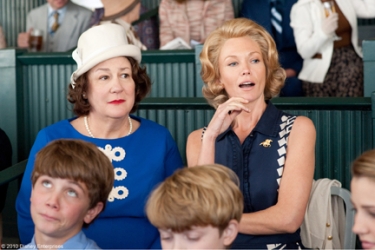
Over the last couple of weeks I’ve seen some mind-blowing performances by women in Hollywood films that make me question what it means to be a mother — Diane Lane in Secretariat and Melissa Leo in The Fighter. Yes, these are very different mothers but they are both very strong, passionate and powerful performances.

I wondered which of these two mothers I am more like.

No surprise! I hope I am more like Diane Lane in Secretariat. Good God, the woman is gorgeous. I loved her wardrobe. But let’s look at the content of the performance and not just the deliciousness of its style. Lane is an awesome actress. She plays Penny Chenery, a gritty mother of teens who time and again, has to (wants to?) choose her horse over her kids.

There are moments in the Disney movie where Lane breaks down and then buttons herself up. This is me. On a regular basis, I fall apart — teary, weary, girly, helpless. Then, a moment later, I’m back to myself — capable, energized, womanly, in control. I will write that article or pay my bills, I vow, and don’t try to stop me. I love the strength of a working mother.

Chenery and I, we do not have the time or luxury to fall apart. There’ s work to do — horses (and children) that must be fed! Other workers depend on us. We have a family business to run.

On Sunday, I ran into Margo Martindale at church. I told her how fabulous she was in the movie Secretariat. Margo played Elizabeth Ham, Chenery’s assistant and another strong character — caregiver for the ailing father and secretary for the dwindling farm. (I need a Ham in my life.)

Margo Martindale and Diane Lane in Secretariat.

I told Margo, “You and the film were absolutely amazing.” I gushed that I was so glad to see it with my kids.

“It reminded me — especially as a mother and as a writer — that it’s okay to pursue my passion,” I said.

“Not just okay. It’s essential,” Margo said. (Love her!) She said the cast had a lot of fun making the film.

The other mother I’ve been contemplating is the Academy Award winner Melissa Leo in the Fighter. She, too, had some inspired costume pieces, and, I ask you, Are there really any mothers with figures as awesome as Lane’s or Leo’s? I don’t think so.

As the mother of dysfunctional brood, Leo was strong. Yes, and scary, controlling and chain-smoking. Like Lane, she let her guard down, but she did not button herself up. Or zip up the hurricane of her codependence into a less destructive path. She needed a job other than as her son’s manager. (Mothers, take this word of warning: Look at what happens when you live through your children’s successes and failures. Look at Alice Ward. Good God!)

These women — Lane, Martindale, Leo — are forces of nature. Strong and passionate. Hard-edged. I loved them. I know them. I am them.

I saw these on Netflix. I know, I’m a beat behind and they came out a while ago.

Melissa Leo as Alice Ward in The Fighter

Celeste Victoria and 9/11

Cat was watching a Linda Ellerbee Nick special. I frowned. She explained, “I want to know what happened.”

“Turn it off,” I said.

“It’s okay, it’s on Nick. There will be no upsetting images,” she said.

I left the room. A few minutes later, I heard H. tell Cat, “Turn it off. This show’s upsetting me.”

Cat turned it off and came into my room. “Why does it upset you? Do you know anyone who died?” She asked.

celeste victoria“I did. I knew this great, nice, fun mom. Celeste Victoria. Though sometimes I’d get her name mixed up. And I’d call her Victoria Celeste. But she’d laugh that off. She worked with me at Manhattan Neighborhood Network. She was incredibly kind to everyone. Seriously. I remember telling her that too, ‘You’re so nice to EVERYONE. To all the crazy people with cable access shows.’

“She helped me with my show. And it was just so unfair to me that someone so incredibly nice and beautiful would die. She was a single mom, about my age. Her little daughter would be with her at MNN sometimes, doing homework at the reception desk. She was such a nice little kid too. It was just crazy that her mom would die.”

Back in my MNN days, I’d heard Celeste’d gotten a job in the corporate world and had left MNN. And I learned Celeste was helping to staff a breakfast at Windows on the World that morning. I thought of how she must’ve found it lovely to arrange a breakfast there and probably had looked forward to it. I always loved going to Windows on the World with friends or family, especially when I was in college.

All during college I worked as a front desk clerk the Vista Hotel in the World Trade Center. I walked through the concourse hundreds of times, ate my lunch in the windy, sunken courtyard between the buildings.

It’s really too much. The commemorations are everywhere you turn this week. On every newspaper cover, on every TV channel, on every announcement in the my workplace elevator, there’s some kind of ten-year anniversary reminder, prayer service, discussion group. Christ! And then there are the images — ghost-like light beams of the twin towers at night.

If I have to remember 9/11 at all this week, and apparently, I have to, I’ll remember Celeste Victoria and her smile.

I don’t want to be re-traumatized. I don’t want to return to the incredible beauty of that morning.

Maybe it’s okay, it’s raining all week. It’s fine to be depressed.

Dreary’s fine. Eventually we’ll get sunshine. We won’t get Celeste. But we can be like Celeste — hard-working mothers who are friendly to everyone, even (and especially) the crazy people.

This was the sunset over the Hudson the other day.

Summer’s End

School starts tomorrow and I am so glad. Today I’ll buy the kids pencils, notebooks, all that crap. I’ll fold laundry. I’ll get organized.

I’m glad the darlings will get off the couch and get back into some semblance of a routine. They know they play their iTouch, Xbox, Café World too much. They can’t help it. My kids feel about their games the way their mom feels about cocktail parties. They’re delicious.

So yesterday I forced them up and out. We biked to church. We pedaled to Riverside Park. In my bike basket was a blanket, the newspaper, their summer reading books — Septembers in Shiraz and The True Confessions of Charlotte Doyle.

We lay under a willow tree; got comfortable.

Then we freaked out. Above us somewhere was a really loud rattling, rattlesnake-like noise. It sounded mechanical and crazy.

I explored the branches looking for a stereo speaker. Could this be some new art installation in the tree? That is honestly what I thought, We’re in someone’s art exhibit. In Manhattan, you cannot escape the street art — the sidewalks, the streets, the parks are teeming with art! I love it. But I wanted to turn the speaker down and read my Sunday New York Times in peace.

Cicada from Creative Commons

But it wasn’t art. It was one frog-sized cicada making all that racket. The kids said they couldn’t concentrate on their books. “That noise is weird. It’s too hot. I want to go home.” So we packed everything back in my bike basket and rode home.

The kids lay on my bed in the one air-conditioned room in this messy apartment, reading their books, eating cookies in my bed, making more mess. They put in the required time with their books (an hour). Then they returned to Farmville and Fallout 3. And later, we all went to a cocktail party/barbecue!

Summer’s winding down. But the cicadas are still making noise.

Saying No to a Culture of Criticism

“There are too many noises in the apartment. The dryer buzzer just buzzed. It’s supposed to buzz three times. It only buzzed once,” Coco woke me from a deep sleep to tell me this. I walked her back to her room, laying beside her in her twin bed.

I thought about my last couple of days.

I was so proud to have gotten published in Salon and so unprepared for the barrage of criticism. My mind drifted to my workplace book club where my women colleagues had so many negative things to say about the Think: Straight Talk for Women to Stay Smart in a Dumbed-Down World by Lisa Bloom. I thought the book was awesome. I loved how Bloom attacks tabloids and reality shows. And, of course, those conflicts are manufactured for our entertainment.

In my lunch time book club, all these brilliant coworkers trashed Bloom because she was writing about the failings of mainstream media while she was a part of media herself.

At Salon.com all these people criticized me for my story when I never asked what they thought (but I guess Salon asked by opening the comments to a free-for-all.) I wrote more about this on my writing blog yesterday. http://gettingmyessayspublished.wordpress.com/

Last night, comforting my daughter, holding her hand as she drifted back to sleep, I thought, we live in a society of criticism. We constantly criticize one another. I’m not sure if it’s the vitriol of reality shows, politics or our own insecurity over jobs, relationships, parenting, whatever.

Trash talking bonds people together. “Look, isn’t Bloom an idiot!” “Yes, I agree.” But the whole thing leaves a bitter taste in my mouth. Not a sweet one.

An article popped up on my Twitter feed this morning — about happiness helping productivity (Do Happier People Work Harder? by Teresa Amabile and Steven Kramer)  http://ow.ly/6kXqQ

Employees are far more likely to have new ideas on days when they feel happier.

Yes! True for me. When I delight in criticism of other people I internalize it, get in a habit of criticism and then criticize myself and hold back on my creativity and kindness — as if we should be stingy with our happiness. As if joy in life, in our accomplishments were a weakness not a strength.

I struggle every single freakin’ day to be happy.

While I’m criticizing our culture for being so critical, I’m also happy there are writers like Bloom, Amabile, Kramer, and even me. Who ask, What do we need if not more criticism? The Times article says we need to “support workers’ everyday progress.” Simply pay attention to one another’s well being and stop the barrage of negativity. Simplistic? Maybe.

I go back to my rules, especially my rule learned from improv. Say yes! Happiness is harder but encouragement is essential. I like to take the difficult path.

Coco was fast asleep in her twin bed by now. The dryer had stopped tumbling. I was falling asleep myself. I unwound from her blankets. As I pulled my hand away, she squeezed it. Thanks!

Why Be Happy?

I was looking at a draft of this post as an earthquake just rippled through New York. Several of my workmates felt it. I didn’t — I was dreamy, lost in a break from work, reading my own blog.

My niece made this heart in the sand. Kids are amazing.

Here’s the post I was looking at when the rest of NYC felt the tremor —

***Maybe I should stop looking for happiness and start looking for meaning.

In How To Land Your Kid in Therapy the writer Lori Gottlieb asks: “Could it be that by protecting our kids from unhappiness as children, we’re depriving them of happiness as adults?”

I’ve blogged about this  A Generation of Disconnected Kids And decided I’m going to walk the middle ground between helicopter mom/tiger mom and neglectful mom.

Gottlieb’s article is tearing up the blogosphere. Even the blog, The Quotidian Hudson, http://quotidianhudsonriver.com/, devoted to the awesome Hudson River, quotes Gottlieb’s article:

“Happiness as a goal is a recipe for disaster.”

That is something it seems we don’t teach much anymore.  As the founders/Jefferson put it, Happiness is not an unalienable right “the pursuit” is… (Robert Johnson)

I think part of my problem with over-parenting is that I am overly involved with my kids’ happiness. I need to step back and let them pursue their own happiness. Then I can pursue my own.

I can do less, but that means I need to ask for more help. Asking For Help.  And that’s not easy.

But remember my Number 2 Rule? Pile on the People!

And though everyone’s talking and blogging about Gottlieb’s Atlantic article. I hope the discussion on overinvolved parents (read mothers) doesn’t devolve into a mother-bashing session,  ’cause God knows, we mothers are doing the best we can.

That would be a nice after-shock to the article — if people had a greater appreciation for a mother’s work and helped one another out more.