One day at the Art Students League, my teacher was late. The art teachers there always wander in late and bleary, as if awakened from some brilliant art-making reverie only to remember that they have to teach a bunch of art-starved students.
Since the teacher was late, the proctor, a middle-aged woman with uncombed red hair and bright eyes, sidled over to me.
She told me, “Tape your paper to the board and just get started. You’re not afraid of the blank page, are you?”
“No,” I laughed. Not me. I’m not afraid of the blank the page. The blank slate. The tabula rasa. Every time I go to blog, every time I start to write or paint anything, there it is – the blank page. And I’m not afraid.
I am so not afraid of the blank page that I have to excise it immediately. I must do away with it. I must X out the blank page using any old black font on the white screen. I must not pause. I must not stop. I must let my fingers fly.
gesso-ing my art journal
In art class with Robert Burridge at the Holbein Art event several years ago, Burridge instructed me, my sis, and my dad to prime the heavy paper with acrylic gesso. Gesso is that heavy white, chalky paint that makes the next layer of paint stick. Then, my dad, or maybe Burridge, said all that gesso-ing is just a way of smearing your DNA on the page, making it your own.
My problem with gesso-ing the page is that I have to wait for the page to dry. Once I gesso, I want to get right in there and go. Slide the brush around the page.
Yup, that’s me. Not afraid of the blank page, but impatient for the creative process.
In about a month, I’m going to be divorced from my job. In many ways the marriage has been fruitful. We’ve had wonderful children (projects) together; we’ve gone many places; we’ve grown; we’ve pushed each other to grow; and now we’re moving on. We are going our separate ways. We have other loves and other children and other journeys to take. Still, it’s weird. I have mixed emotions.
I find myself moody and at times sad and in need of attention. My friend Rachael said, “That’s good. As it should be.” I remember as a kid going to summer camp or to college and missing my crazy family like crazy. (Work has been like a family to me.) But I assured myself, “It’s okay. It’ be horrible if I was just happy to be rid of them. Just to be free.”
There is a longing for freedom — a desire to speak my truth and not care if my truth jibes with the dogma of the faith-based group. I want to scream from the mountaintops, “I love Buddhists, Hindus, Sikhs! I love all religions — no one has a corner on truth. No one of you is more perfect than the rest!” And if I blog about how I love gay marriage I don’t want to fear some stuffy church exec pulling me aside, “You represent the agency so please keep your public opinions to yourself.” (Yes, that kind of thing, on occasion, happens!)
I’ll miss the family dramas. I’ll miss the comedy. I won’t miss the meetings.
I’ll miss my identity as a writer. I always felt I had the best job at the place. There are many writers who want to write full time. And for most of my 20 years with the agency (10, part time and 10, full time) I’ve done it. But writing for work is different than writing for your own passion. And because I’ve given at the office, I don’t always feel like giving out at home.
I gave the best years of my life to that workplace. (I get dramatic. Maybe the best is yet to come?) The agency made me better and I made the agency better.
Still, I feel untethered, unmoored. What am I doing? I need the apron strings of a day job to get by in NYC, especially since I have three kids heading to college within the next six years.
I assure myself I am not alone. I am one of 38 of the 201 full time staff of my agency who accepted this voluntary severance package. That’s about 20 percent of us, who are cut loose and footloose.
I’m starting my own business coaching writers. (Check out my new biz.) I’m freelancing writing and teaching in a couple of afterschool programs. Oh, and I’m going to every single one of my kids’ meets and games in track, swim, basketball, soccer, and gymanstics. I’m going to volunteer with the PTA, go on field trips, and help backstage at the shows.
Here’s the view from the top of my office building.
I’m not going far. I’ll still hang out with my old work friends for lunch, happy hour, maybe even to walk the 19 flights up to the roof, hit up the art opening, visit the ecumenical library, or take my old Pilates class. It is, it turns out, all of these peripheral things that I’ll miss, that I’ve added on to my work life, that have made my life meaningful. It is what I’ve brought with me. And these things, it turns out, I can take away.
I may be getting a divorce from work, but it is an amicable one. We still love each other very much and want only the best for one another.
One of my daughters asked, “Why did he have to take her?”
The kids’ Sunday School teacher, Joyce Mwanalushi Landu, died suddenly while visiting her family in Zambia a couple of weeks ago. We learned the news last week. And it hit us very hard. I think Joyce was probably near 50 and the cause of death was heart-related.
Joyce was a beautiful, creative, spiritual person.
In a tribute at church yesterday, Laura talked about how Joyce never raised her voice or was physically affectionate or demonstrative, yet the kids were drawn to her and knew they had her respect. And she had theirs.
I believe Joyce truly loved my kids. Losing someone who loves you and whom you love is always crazy. It calls to mind all those people you’ve loved and who’ve died. A death makes you wonder about your own death and what kind of legacy you will leave. I would like to be remembered as someone who loved unconditionally, as Joyce did.
Australian hospice nurse Bronnie Ware, in her book The Top Five Regrets of the Dying, said that a top common regret from every dying man she tended was “I wish I didn’t work so hard.” I know I work very hard, sometimes too hard. But then, I play hard too. (This book was quoted in that Atlantic article Why Women Still Can’t Have It All)
I understand nothing of God’s plan. Why did Chris have to get Parkinson’s? I am tongue-tied when my kids ask “Why?”
the kids at Rutgers Church during prayer time
All I know is that I have to love the people I’m traveling through life with. I have to make art and love my peeps.
I have to remember:
Don’t search for the answers, which could not be given to you now, because you would not be able to live them. And the point is, to live everything. Live the questions now. Perhaps then, someday far in the future, you will gradually, without even noticing it, live your way into the answer. Perhaps you do carry within you the possibility of creating and forming, as an especially blessed and pure way of living; train yourself for that — but take whatever comes, with great trust, and as long as it comes out of your will, out of some need of your innermost self, then take it upon yourself. –Rainer Maria Rilke from Letters to a Young Poet (1903)
On Wednesday night I came home from a work trip to Elizabethtown College, where I was leading communications and organizational change workshops for United Methodist Women. I hung out with my fam and then flopped on my bed with the latest issue of The Atlantic. I LOVE their cover stories; the issues on single women, obesity, and parenting have given me a lot to blog about. (For example, see Letting My Kids Find Their Own Happiness.)
My first reaction — and I feel bad about this — was sheer jealousy. As the author, Anne-Marie Slaughter, admits several times in the article, she is elite. Ms. Slaughter worked for the Obama administration and is now a professor at Princeton College. Sure, I have an advanced degree and a decent job. But as I consider new ventures in the coming months, I don’t get to pick between national policymaking and the Ivy League. (Or do I? Perhaps, it’s true, we women aim too low?)
I feel held back from success, not just by the age of my kids and the demands of my work, but also by my husband’s chronic illness. As a friend commented on Facebook, “I’d like to have written that article, but I’ve been too busy having it all.” So yes, I was jealous. I wasted time comparing my achievements to Slaughter’s and I came up short. But as the saying goes, Don’t compare your insides to others’ outsides.
I found a lot to like in The Atlantic Article on Having It All, including Slaughter’s suggestion that kids’ schooling hours should match parents’ working hours. As an after-school teacher, (yes, I have part time jobs to go with my full time job), I think kids should stay longer at school. And they should do fun stuff, like drama and sports and art. We all need more time to play. Let’s make work and school more playful and creative and then it’s not such a drag.
One missing ingredient in the article is the need for everyone to create a supportive community, not simply have an awesome spouse. I know I get by with a lot of help from my friends and family. You can pursue happiness –and remember the pursuit is guaranteed, not the attainment — if you have a village behind you. I’ve written about the three things we need for community: hard work, passion, and diversity.
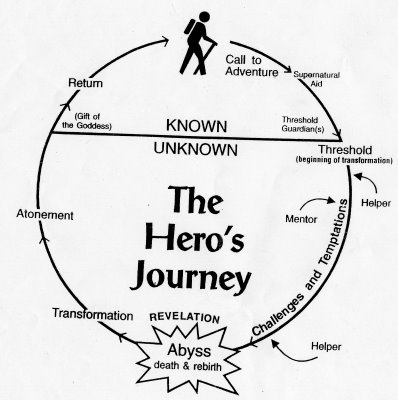
I need to remember the hero’s journey. The hero has to try and fail several times. And the hero has to leave, even if that means going on a business trip to Pennsylvania!
“You leave the world that you’re in and go into a depth or into a distance or up to a height. There you come to what was missing in your consciousness in the world you formerly inhabited.” (From Joseph Campbell on The Power of Myth with Bill Moyers)
As I set out on a new journey professionally, I know that I will fail. Like Odysseus, the homeland will be in sight and then the winds will whisk me back to the sea. Yet I will adapt. Each of us must make our own quest. With flexibility, creativity, and community, we can pursue happiness (a.k.a., have it all).
Happiness is not found in professional or material success — though give me that success and I’ll let you know. Honestly, success is found in having good relationships and in creating beauty and in being in nature.
So pursue happiness. When you embark on that pursuit, you become the mythic hero on a quest. You become the hero of your own life story. And you can have (or pursue) it all.
I rode my bike very fast across the walkways in Central Park to get to my day of rest. (I note the irony.) I thought I’d take a short cut behind Belvedere Castle. But I hit Shakespeare’s Garden and endless steps. Shoot. I had to slow down. I had to bounce my bike up and down the steps.
I do not like being late. Yet I am frequently late.
I got to 95th Street and Fifth Avenue but felt lost. I’d expected a church. Instead, I got a mansion, a beautiful retreat center, the House of the Redeemer, just off the park.
Our small group from Rutgers Church talked about times we’d felt refreshed. We reported that we’d felt relaxed during a storm with the lights out, while laid up in the hospital, on vacation in the Caribbean, or pausing for a moment when we ran near the ocean. I felt relaxed just talking about relaxation.
But I could not rest long. At lunch time, I had to bike again back across the park to meet the kids at the post office to renew and reapply for our passports. (I avoided the gardens.) I don’t know where we’re going, but I know we must be ready to go.
We will probably be late for wherever we are going. We will probably go the wrong way. We will probably hit steps when we least expect them. But I bet the place will be better than we had imagined, once we do arrive.
I am rarely sick. I know this has to do with my genes. But I wonder if my basic overall good health has anything to do with my morning routine. Every morning, I get up, drink coffee, and write about my life. I started this more than 15 years ago, a la Julia Cameron’s The Artist’s Way. Studies have shown that daily writing about stress, anxiety and trauma boosts your immune system.
Writing and art is good for the soul. And maybe the arts are good for the body too. Since January, I’ve not only been writing longhand in a spiral notebook, but I’ve been updating my art journal. I am repurposing the hardcover book, The Rules of the Game by Georges Simenon. The library was discarding this book.
The paper in a hardcover is much lovelier than in any spiral bound notebook. For me, the challenge is that the words are already there. Sometimes the words hinder and sometimes they help. Sometimes the words peek through and sometimes I paint over them.
One of my darlings has strep throat. Of course now the whole family feels a little sick. Even me who never gets sick. I think I will take two aspirins and write or paint in my art journal.
This Lent, I gave up gossip. This has been tough. I miss the way gossip clarifies your values. It’s like when you watch Nanny 911 and you feel so good and smug about your own parenting skills. You think to yourself, “I would never do THAT!” (But let’s admit, we’ve all done much worse. We just, thankfully, did not have a camera crew following us and recording our parenting failures! Not too worry, those incidents will be remembered by our children who will blame us for years to come.)
In the fall, I met a church executive who told me she left church work for a while to sell Mary Kay cosmetics when her husband was in the military. She said in the Mary Kay biz, you were not allowed to gossip or criticize one another. (I don’t know how they enforce this). But she said it was a good and productive way to work and that she wished she could do this again now that she’s returned to church work.
I know there are positive sides to gossip — studies show it can bind community members together and other studies show that gossip lowers your heart rate. Whatever. From my own experience, gossip undermines creativity and productivity and inhibits trust in coworkers.
At work, I’ve felt stuck when a colleague wants to gossip about another colleague. I have no way to extricate myself.
Should I?
1. Say nothing, which makes the gossiper think I agree so they keep on gossiping.
2. Say, “I hear you. But I gave up gossip for Lent, so, much as I’d like to join this gossip gravy train right now, I can’t.” No, this makes me feel all holier-than-thou.
3. Don’t talk to anyone. Umm, that’s not happening.
Without gossip, I’m losing an opportunity to bond.
On my Twitter feed the other day, another woman church executive wrote a tweet, something like, “We remember best the people who supported us most.” I want to be that person — the one remembered for being supportive, creative, and productive, not negative or gossipy.
I do want my heart rate lowered and I do want to bond with my colleagues. So after Easter, I may have to dive back in the gossip pool. Or I may not. There’s a lot to talk about besides each other. And there’s a lot to admire in one another. I’m a big fan of admiring my colleagues. And I want to keep admiring people more (not less).
But as one other coworker told me, “I never gossip. But you want to know who does???” (ba dum bum!)









 100 Days of Poems and Pics