A Spoken Word Kind of Poem

never give up
never stop fighting injustice
a rhetoric of hate is not good for this country
it is not good for any country
it is a dangerous road to travel
tell the leaders — abstain from vilifying the poor and the hungry and the needy
those who need bread and sanctuary
i am grateful when people ask me for help
children innately respond positively to this teacher’s request
“who is a helper?”
our country can be one of helpers not hurters, not fear mongers, but fish mongers
(that reminds me, i bemoan the loss of the charming local stores in NYC)

last night i had a dream of teaching a discussion about race
and gender
and another teacher called a girl a boy
and we all were insulted
and the girl said something wise
and more than half of the kids’ hands went up and i said
You’ve started a great discussion
and I woke missing teaching my high school English class,
the bigger discussions you could have with older students,
where it wasn’t all about getting them to behave but it was about getting them

to think, to share, to build on and from one another — not tear down

i was really into the Starz documentary of American and Me
my childhood friends Nancy Irvine and her mom Mary Ann were in it
they were so good. so honest. so like themselves.
ordinary, extraordinary.
and that is probably why i had that dream.

wanting to be like the dedicated teachers, parents at the school
and I connected with so many of the Oak Park River Forest high school kids
those who were not sure of their place

or those who used spoken word to convey their truths
spoken word was not a thing when i was young
but man, i love the spoken word raw energy, their radical stories of growing up
and finding their voice
i missed all that
and Ms. Stovall’s honest dialogue on race, so cool. so good.
permission to talk about difficult topics — the places and ways we need to grow.
so needed. don’t sweep it all under the rug.
talk about your identity, how you see yourself — your flaws with authenticity.
be an ally. love the human race.
but do not deny that many have it harder than you based on their skin tone.
acknowledge that there is bias – which is different than prejudice
find your space
notice your privilege. we’re not going to get it perfect. but we have to try
we have to strive to live in the community
the neighborhood
the glorious melting pot
with each other

random thought: i miss my kids
but it’s a kind of missing them from an earlier age
and i miss my younger self too
i miss the early days with Chris
for who we are now is not who we will always be.
and i worry
i go down that worry road and doubt the future sunshine

tomorrow might be sunny
it might rain
i’m not giving up
not at all
not me
not today

gotta keep going

put hate away. tell the country’s leader to stop hating on the poor.

we’ll give up another day. until then, we love, we go down a road for justice

20150215_131446
When my kids were little, we’d lay on the floor and look up at the Great Blue Whale at the Museum of Natural History. It was as if we were deep under water. I miss those days


Going To the Movies

I don’t know why I loved the movie First Man with Ryan Gosling as Neil Armstrong so much. Maybe it was the footage of Kennedy calling on Americans:

We choose to go to the moon in this decade and do the other things, not because they are easy, but because they are hard…

I want to enter a time in this country when we seek greatness through difficult shared tasks and achievements and good old-fashioned self sacrifice.

There’s a weird recurring motif in the movie where Armstrong remembers himself slightly younger with his family, wearing a red baseball cap. What is the symbol of the red hat conveying to viewers? That Armstrong is the America that was once great (as in, make America great again)? However. He places the hat on his infant daughter — and that is my takeaway: children make the world great.

Certainly, Armstrong was amazing, but his era was fraught with divisiveness — as in, the Viet Nam war. There’s a beautiful moment in the film of a beat poet reciting Whitey on the Moon (by Gil Scott-Heron). Here’s a glimpse:

I can’t pay no doctor bill.
(but Whitey’s on the moon)
Ten years from now I’ll be payin’ still.
(while Whitey’s on the moon)

There is someone sketching for a moment in the film too. And the music is sublime. Science, poetry, art, music — these matter. They must savored, not dumped for the worship of money.

The film’s subject matter inspired me. The moon landing was such an incredible achievement and so many lives were lost to the dream of humans walking on the moon. That dream deferred, that dream now lost. There is also a melancholy I feel when I think about the lack of awe we, as a society, have towards science.

The moon landing still seems so extraordinary. Here we are, a lifetime later, and the achievement cannot be replicated. This milestone was achieved in the 1960s — when I was just learning to walk and when people smoked like chimneys.

And in the film, the spacecraft seems put together with aluminum foil and lug nuts. Every close up of a screw in the hull of the rocket’s interior saddened me, reminding me of the Challenger shuttle’s fiery explosion.

I want to step into a dream of greatness for this country — something great for everyone, not just some. Some step towards an overarching unity. But that greatness must be in the future, not in the past. For the future of our children. And perhaps our greatness will lie in the U.S. contributions to science and the arts. And we will achieve difficult things, and that is why we do them.

IMG_6481
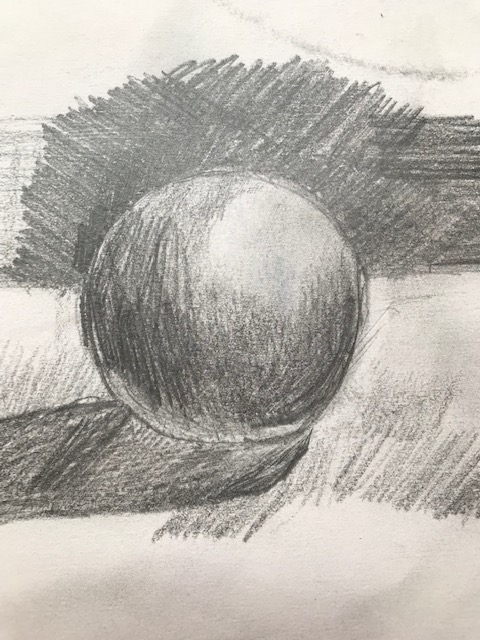
I wanted to write today about this simple truth: when you teach, you learn. The other day at school, I taught a lesson in sketching spheres. This was my attempt. 

Free Write and Gratitude

I don’t want to grow old but, you know, like they say, consider the options. One upside to aging? Higher cheekbones. One downside? Lower boobs.

One upside? I tan easily. One downside? Skin cancer — but mine’s basal cell, the least problematic type, so I’m cool with that. I really shouldn’t complain.

The thing I’m really not loving about growing old is the way that you gain one pound a year for 10 years and then suddenly you’re like 10 pounds more than your ideal weight.

But wait, let me remind myself. I have had friends and colleagues, younger than me, who have been diagnosed with cancer. And many survived and a few are no longer around. And they’d all probably remind me to not worry about weight. So seize the day.

I am reminding myself to take nothing for granted. I’m happy today’s problems include:
1. I don’t feel like writing right now.
2. I don’t feel like emptying the dishwasher.

Sure, I sometimes feel sorry for myself. Chris is really having more troubles with his Parkinson’s and the tasks of daily living. This worries me. A lot.

Let me grind my gears back to a place gratitude.

Here’s today’s gratitude list:

  • Citibike – commuted home today although it was cold. It feels so good to sail through the beautiful streets of the Upper West Side of Manhattan.
  • My two good legs — to power the Citibike and take me up and down so many flights of stairs at work.
  • My fitbit — although my battery does not stay charged for as long as it should. (Don’t we all wind down as we age?) I may not have achieved my 10,000 steps for today, but I have been active nine out of nine hours.
  • My beautiful big apartment. It is always a work in progress. But it’s been the perfect place for raising my beautiful family and occasionally hosting the fabulous dinner party.
  • My washer/dryer and dishwasher — true, I don’t feel like unloading the dishes, but, wow, I have clean dishes. Such a gift.
  • Big one here — my kids. Love love love these nerds. As my neighbor upstairs used to say, “Not one is a shrinking violet.” Nope. That’s the way I like them.
  • Chris. Yes, he’s a handful, but we do connect on a deep level.
  • My excellent job — sure, it’s not perfect — I’m far too nomadic, moving from one class to another, but I have wonderful colleagues and generally look forward to going to work every day (and coming home at the end of the day). Several days a week I have to take the little guys to the bus and guess what? On those days, I hold hands with kindergartners and cross them safely. How lucky am I? Kids are hilarious.
  • My writing — whether it’s my journaling or my humorous essays or these half-baked blog posts.
  • My attitude. New York City is known as a FuggetAboutIt kinda place. But actually, most people are cool. They’re just in a hurry. Me? I’m naturally happy-go-lucky.

So, I’m grateful that I’m growing older, that I have my health, that I am loved and that I love well. What else is there? Unloading the dishwasher? Ah, FuggetAboutIt. I’m going to watch TV. Yes, grateful for my TV too.

Snapseed (6)
So many bridges in Central Park. The chipping paint looked like lace on this one.

Wave Hill

IMG_5477

Today I was up at Wave Hill.

I was late today meeting my group of girlfriends at the museum cafe, always a highlight. Museum cafes are a bit pricey but delicious and the ambiance is so chill.

Ten years or so, around Thanksgiving, the kids and I joined the family art workshop and made corn husk dolls, taught by young Native Americans. Another time we looked at pictures of Matisse’s cut outs and tried to cut our flowers likewise. Wave Hill always reminds me of art and nature.

IMG_5480

When you arrive before noon on Saturdays, the gardens are free.

I visited the aquatic garden. So many gardens, so little time.

I rushed from the gardens to Riverdale Country School’s reunion/homecoming. Although I never attended Riverdale, I do feel a part of the community there — having taught Lower School Drama, parented my children when they were there, and met cohorts of my husband from his school days.

I’ve met so many alumni and educators at the school, the place has a special place in my heart. And with Wave Hill and Van Cortland Park right nearby, all of Riverdale is a magical place. Not that far from my Upper West Side.

Studio Touring in the Garment District

Last night, my friend Ina invited me to visit some of the dozens (hundreds?) of art galleries in the Garment District during the Garment District Arts Festival. My nephew Girard joined us. We three were blown away by the varieties of creativity and mediums of so many artists.

IMG_6452
Here’s Girard at an artist’s studio where the Dutch artist is riffing on our surveillance society by surveiling on Newark’s surveillance camera.

There was so much political and personal art. I loved the beauty of it all. To be creative, you have to admire other’s creativity.

IMG_6448
Here I am with one of my new favorites, artist Margaret Zox Brown. I loved the color and the dynamism of her work.

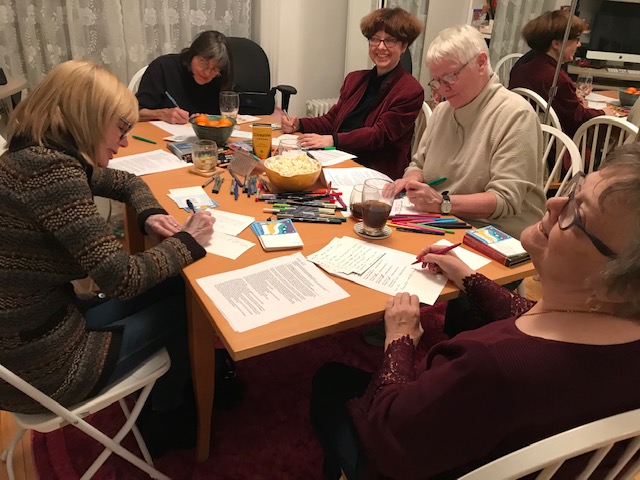
Before the art touring, I fulfilled my civic responsibility by writing Postcards to Voters. I gathered with some church friends, where we encouraged random voters to vote. My assigned candidate was Jen Lunsford for State Senator in New York. I don’t know her, but having read about her, I like her! We have to keep pushing for better leaders — civil discourse. Our current political climate is abysmal. We need leaders who care more about humanity than money. We need leaders who value freedom of the press, art, equality, respect for our neighbors, the environment, integrity.

IMG_6446
A gathering for good — Postcards to Voters

Doing good — supporting political artists and encouraging voters — feels good. These activities restore my faith in this country. I’m grateful to be among so many upstanding citizens in New York — my friends, fellow artists and my nephew, too.

Extreme Kindness

I was at a faculty meeting where the administrator kept raving about one particular teacher and I felt like pulling my turtleneck over my head. Why did she not praise others? Was that one teacher her favorite? I suddenly realized, This is what a child feels like when a parent overly praises a sibling.

Children see their parents as if they were Olympic judges flashing scorecards. If one gymnast is getting straight 10s, that must mean I am getting 7s or 8s, and, let’s face it, a perfect score is nearly impossible to beat, so why even try?

But, here in the workplace conference room, we are all adults, not children. Shouldn’t we enjoy the success of our colleagues? I am going to try to enjoy other’s success, even if it feels, like, I am being passed over.

Just for today, I am going to make a secret vow to be exceedingly kind to everyone I meet. And in my generosity, I will pick no favorites.

I am hell-bent on fairness. As a teacher, I am exceedingly kind, yet I am firm and set boundaries. I am not a freakin’ doormat. Sometimes students ‘call out’ over me or another student, I will note such interruptions, respectively, asking gently, ‘Please wait your turn,’ or ‘Quick reminder: Raise your hand next time.’ I choose not to correct in a shaming way.

“Quit calling out. You’re being rude.” I have heard teachers (at another school) label students as ‘rude.’ Truly, students are motivated towards comedy, amusing one other and themselves. But I do not believe they are intentionally rude. Or are they? I’m sure behavioral psychologists have figured out at what age a child’s disrespect becomes willful or intentional. What is the age of self-control? It must arrive sometime after First Grade.

Why does kindness seem so hard? Is it that we’re giving away a bit of ourselves? Is it that giving something away goes against our human / animal tendency to hoard — hoard things like compliments? I’m not sure. All I know is that as I’m giving more and more kindness away, I haven’t lost a thing. If anything, the rewards keep rolling in.

It’s not always easy. Still. Keep on keeping on with by showing of extreme acts of daily kindness in words and deeds.

Snapseed (1)
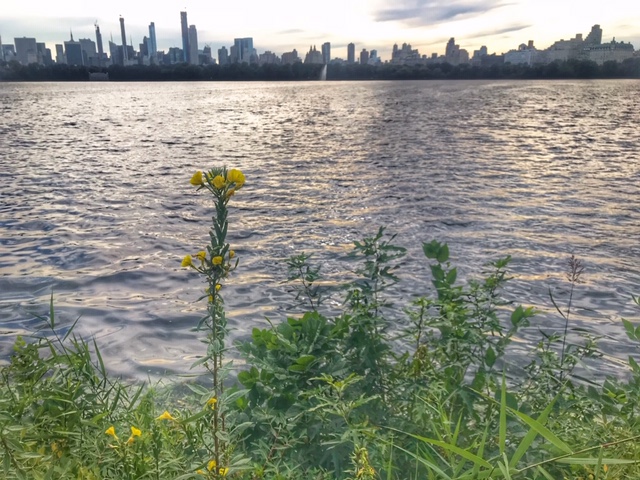
Yesterday, I walked along the Reservoir from the east to the west side to meet friends.

When I was young, I used to admire intelligent people; as I grow older, I admire kind people. – Rabbi Abraham Joshua Heschel

Incidentally, I realized I wrote about excessive kindness three years ago. October must be my season for reflecting on matters of kindness in the classroom.

Change the Narrative

Susanne Craig, a business reporter with the New York Times, is a hero of mine. She co-authored the story that proved Trump’s folksy narrative of himself as self-made billionaire is a lie.

This investigation into the fraud and financial misdealings of our commander in chief was the first story the Times has ever published twice — one time mid-week, and then again in last Sunday’s paper. The team combed through more than 100,000 financial documents over 18 months. The eight-page story follows the charade of shady financial dealings of the Trump family.

Asked about the administration’s animosity towards the press, Craig replied, “You have a president who believes that the Bill of Rights starts at the Second Amendment.”

That being true, “Donald J. Trump is as good for the media as war is good for the economy,” she quipped.

In preparing to publish the ground-breaking story on Trump’s misconduct and deceitful practices, the Times gave the pres a month to respond. “Stories are always richer when the other side comments,” she said. However, he did not comment (or deny).

Craig cautioned us several times that sources must understand that a reporter can never induce them to give a reporter evidence. A journalist can only receive evidence if it is unsolicited.

In looking to the future, she did not refute the possibility of another financial meltdown. The current administration is “going after protections that were put in place” to safeguard the economy, like the Dodd Frank Act.

I am inspired and impressed by the work ethic of Susanne Craig. It’s clear from listening to her that all presidents should release their taxes and ‘end this charade.’ This way we will know if they are in the pocket of industries, countries, or special interests. Follow the money to find the truth.

In 2016, Susanne Craig was the recipient of the three pages of 1995 tax returns that appeared in her mailbox at the New York Times. The itemized loss of a billion dollars meant that Trump received a billion dollar gift card.

As we continue to learn news of Jared Kushner’s lack of paying ANY taxes, I am grateful for journalists who comb through arcane tax codes and pages of documents.

The truth will come out. It always does. The resilience and reporting of journalists like Craig is a gift card to the American people.

IMG_6430
Susanne Craig speaks to students at the School for Ethics and Global Leadership.

Investigative Reporting


Dogged determination. Facts. Empathy. Fairness. These are just some of the attributes of investigative reporter Mike Rezendes of the Boston Globe Spotlight team.

Rezendes, who began reporting on the Boston Catholic clergy abuses of children and youth some sixteen years ago, has noted a change in society of late. Back when he began, when people came forward with allegations of crimes, they were seen as shady. And they were, generally, not believed. Even children were not believed by their parents. The ‘sea change?’ “Now they’re listened to. They have credibility. That was profoundly satisfying,” Rezendes said.

Asked about the attributes of an investigative reporter, he replied, ‘Be naturally empathetic, curious, a good listener.’ He also said that, along with his fellow Spotlight reporters, he “became an amateur psychologist. When you’re a reporter you pick it up as you go along.”

He laughed when asked whether Mark Ruffalo was an apt actor to play him in the film Spotlight. He reported that Ruffalo and he, besides sharing the same initials, shared similar characteristics. (And Ruffalo might have nailed Rezendes a little too accurately.)

**

Hearing the wisdom of Rezendes and Susanne Craig, who I will write about tomorrow, at the homecoming and family weekend of the School for Ethics and Global Leadership in Washington DC, and the brilliant students who questioned them, totally inspired me. These young people and journalists have great integrity.

While I am a fast and good (humble) writer, I am not a dogged writer. I lose interest in stories that require lengthy research. I joke that my favorite parts of journalism are accepting the job and accepting the paycheck. It’s all the in-between stuff that I find difficult.

That’s not completely true, I do love interviewing people too. I like to cut through B.S. and get to what matters to people. My motto? Go deep fast.

Back to the seismic shifts in the betterment of society from the reporting of Rezendes and Craig — I believe that there is a sea change of honesty and empathy emerging in our national conversations. I have hope that my fellow civilians will treasure the work of the press the way I do.

Asked about how they respond when naysayers call the media ‘fake’ or deny the facts, Rezendes said, “Get the documents. Get the proof. Push for evidence.”

Regarding his own reporting on the institutional abuse of children by the Boston clergy, he said, “I wanted to be as fair as I could be…I’m a paid skeptic.”

As Noah Bopp, founder of the School for Ethics and Global Leadership, said at the outset of this panel, “Our ethos is to be empathetic.”

IMG_6422
From left, Reporters Susanne Craig, Mike Rezendes, interviewer Valeria Gonzalez, and School for Ethics and Global Leadership founder Noah Bopp at the homecoming weekend.

Creative Disobedience

“I said my piece in a shaky voice,” Stephanie Wilkinson said about the night in June when she quietly turned away Sarah Huckabee Sanders from her restaurant.

Ms. Wilkinson is the co-founder and co-owner of The Red Hen, and she characterized her action as a “private act of conscience, not meant to be public.” The only reason her small action made it to the evening news and became a part of the national discourse was that a server posted the story on Facebook.

“This was about our own personal stand.” Since that quiet moment on the patio when she asked Ms. Sanders to leave, she’s received more than four thousand pieces of mail (including, literally, ‘pieces of shit.’)

From that small chat, a larger conversation emerged — when and with whom do our colleagues feel safe? Is this simply a sign of our polarized nation? Is a restaurant a public or private space; that is, is a restaurant more like a club than an open public park? It is, most assuredly, a business.

Ms. Wilkinson said, Yes, dining together — breaking bread — is personal, but it’s also political. As a restaurant that serves farm-to-table food, ‘We have to think about the immigrants who are picking our strawberries.’ Or the hands in the kitchen preparing our salad. Also, the context matters. How do you treat a person who fails to apologize for the lies of our executive in chief? How about someone who dismisses sexual abuse?

Is the person who explains policy about, basically, kidnapping children at our border welcome to dinner at your home?

“Would you serve Hitler? Would you serve Osama Bin Laden? Someone who kidnapped your child? ….Everybody has a line,” Wilkinson said. “What is the line you will not cross?” By asking Sanders to leave, Wilkinson and her staff addressed the inhumane and dangerous practices of the administration.

Not too be dramatic, Ms. Wilkinson said, but that was the context of the June evening when Ms. Sanders and her party quietly exited the restaurant.

While many people disagree with the choice the staff at the Red Hen that night, ‘business is up at the Red Hen. Business is up in the town.’ (Business is also good for Nike, led by Colin Kaepernick’s civil disobedience.)

Asked whether she would have taken the same action, had she known the outcome, Ms. Wilkinson replied, “I sleep very well at night. I have a staff who sleeps very well at night.”

While she does receive hate mail, she also receives gratitude mail. People have purchased gift cards from the restaurant. She has received meaningful letters, like the one that says, ‘I am an immigrant. What you did makes me feel there are people who stand with me.’

IMG_6417
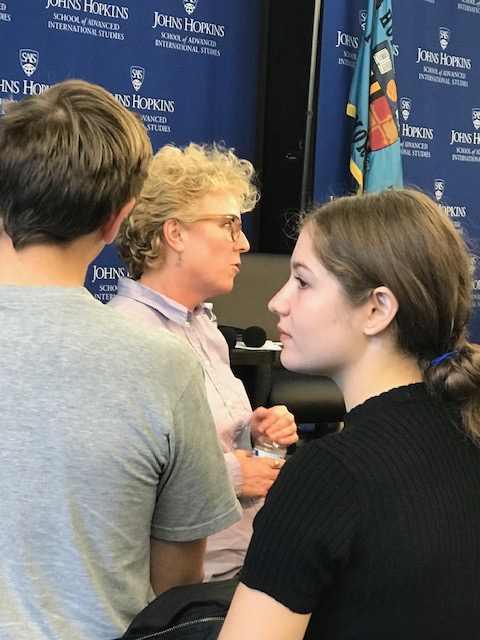
I am far left talking to Wilkinson beside me and two other mothers at the homecoming for the School for Ethics and Global Leadership in Washington DC today.


Social Justice Rules

Last night I heard the clarion call of justice from the prophetic Bryan Stevenson, death row lawyer and author of Just Mercy, at B’nai Jeshurun with my book club. Here was his message:

1.Get closer to the poor.
2. Change the narratives.
3. Have hope.
4. Do uncomfortable and inconvenient things.

I elaborate on each point below.

  1. “Get proximate,” is the term he used. Stevenson talked about his grandmother’s hugs and how he felt her tight squeeze for hours afterwards.  When they were separated, she would ask,”SnapseedDo you still feel me hugging you?” We must, too,  embrace one another. Even on her death bed, his grandma squeezed his hand.

2. Addiction and dependency are health care problems and the criminal justice system is not equipped to be a healing place for ill people.

We must not be governed by fear and anger, but by compassion for the suffering.

Also, children are not “super predators.” They are worthy of our protection — they must not be tried or sentenced as adults.

And, let’s face it, he said, we must recognize we live in a post- genocidal world. The United States has committed atrocities. Other countries — South Africa, Rwanda, Germany — confess and learn from their crimes against humanity. Citizens of the United States ought to remember and reflect on our history of the attempted extinction of Native Americans and the reality of the slavery of African Americans.

His remark on ‘making America great again,’ — ‘What decade, would, I, as an African American, want to return to?’ — drew applause.

3. “Injustice prevails when hopelessness persists – your hope is your superpower,” Stevenson said. As my friend Jean noted, this makes sense on a personal level, too. After all, we can not seek changes in our lives if we do not believe change is possible.

4. “Why do we want to kill all the broken people?” ‘It’s a broken system. We have to get to know each other — because we are all broken.’ Personally, I have always been against the death penalty because I have known that grace and redemption are possible. We must not look exclusively at what the indicted have done, but what we, as a society, are doing to the incarcerated. As a people, do we really want to kill people?

“The opposite of poverty is not wealth but justice.” And we cannot measure our success the same ways others do (simply by our financial gain).

In answering a question from the group about how to persuade people to our point of view, Stevenson spoke about meeting people where they are. Listening.

He noted that politicians have much trouble apologizing. “Saying I’m sorry does not make you weak. It makes you strong. We don’t do sorry well.” The crowd laughed when he noted that we can learn from couples married for 50 years:  ‘They have learned to apologize.’

Stevenson said that the U.S. needs Truth and Reconciliation like in South Africa. This reminded me of the book, Dear White America: Letter to a New Minority by Tim Wise who starts by saying, basically, that as a country, we are asked to ‘Remember the Alamo’ and ‘Never Forget 9/11,’ but when the topic of systemic enslavement for hundreds of years of African American people emerges, white people, basically, say, “Oh, get over it!” This is why, I believe, his museum, The National Memorial for Peace and Justice and the lynching memorial, and the study of the history of Civil Rights work in Alabama, is so important. We must never forget. We must make amends.

Another take-away: “Ask not ‘How do I help?’ but, ‘How do I serve?'”

As for the question I asked (and others too) on the new make up of the Supreme Court, he said, “They (the justices) cannot be indifferent to suffering.”

I woke this morning with so much hope — hundreds of people were at this event and the message was energizing. Our book club even talked about heading to Alabama for a long weekend to visit the new museum.

If he’s ever giving a talk in your area, go learn from Bryan Stevenson, an amazing and motivating speaker. His delivery was impassioned; he spoke without notes and without rancor.

His message was clear: “Stay on the side of love.” ‘We cannot go to the side of hate.’  As for me, just for today, I will not give up fighting for justice. My dream is to someday see Bryan Stevenson on the Supreme Court.

Until then, my friend, continue to beat the drum for justice.