How’s Parkinson’s? It’s fine.

heart in the sand
My niece Isabelle made this heart in the sand at the beach on Lake Champlain.

People often ask me how my husband is. I hesitate to answer. I try to gauge why they are asking.

Are they worried about him? Are they wondering how I am coping with his Parkinson’s Disease? Are they being polite and maybe don’t really want to know? If I stay too long on my answer, will I be perceived as whining or ungrateful? If I answer the question flippantly, am I in denial?

There are many gifts of love that our relationship has bestowed: mainly, the three awesome kids. And also people ask, How are the kids managing? To answer that, I usually say, “They’re great. They should probably be in counseling (as should we all), but we are all overscheduled and actually, we’re fine.”

Is it okay for me, a spouse of member with a chronic illness to say, “Fine?” I don’t know how much to open up. I mostly express gratitude for my husband’s positive attitude. I am grateful that he works out through the JCC Parkinson’s Program several times a week. He also goes to the chiropractor several times a week. He leans to one side a lot. He has other physical limitations. The disease bestows pscyho-social consequences which can be difficult for our family. He falls asleep a lot. There are other behavioral aspects, tied to the medication or disease or odd sleep habits.

The question is valid: how is he? My answer is also valid: I don’t know.

My husband has a progressive illness. His disease is progressing. He was diagnosed nine years ago. He is still amazingly capable of many daily tasks of living. And yet, there are many tasks that have fallen by the wayside.

I don’t always want to talk or write about it. I want to say (and people may want to hear), “Fine. He is fine. We are fine. Now, how are you? How’s your family?”

The truth is, if you answer me that you are not fine, that you have struggles too, and that life’s not always easy or what you bargained for, it’s okay with me. It’s okay if you are not always grateful.

In fact, admitting the struggle, and aiming for a semblance of resilience, somehow makes me feel better and makes me feel less alone. Because by asking me, How’s he doing? I think you know for our family, the disease is not always fine, easy, or inspiring. But it’s fine, one day at a time. It’s fine.


Small Cup of Kindness

My eyes were a little red. I felt sad. It felt odd to be alone on a five-hour train ride back to the city. I had been juggling fast and furious — with the kids, getting them to camp and Spanish language school; encouraging the chronically ill husband; maintaining my cool with difficult and sad issues around my husband’s family; starting my own small business; finishing a job I love and need to leave.

The peaks looked insurmountable. Seemed there was nothing but trudging uphill ahead of me.

Just keep it together, girl, I told myself. That’s all you can do. Although another side of me said, Go ahead, indulge in your self-pity. No one would blame you.

And so I asked for a cup to tea to join me in my quick sand of brewing self-doubt.

But this woman and Amtrak worker, Veronica, gave me more than a cup of tea — she gave me her smile. And I felt restored by the kindness of a stranger, another woman on the train.

I felt, Oh screw the sadness. Because I’ve got my cup of tea, a laptop, and a smile on this train. I’ll make it just fine. And we chugged along.

Here’s another post on why I like trains better than planes.

Enhanced by Zemanta

Why?

One of my daughters asked, “Why did he have to take her?”

The kids’ Sunday School teacher, Joyce Mwanalushi Landu, died suddenly while visiting her family in Zambia a couple of weeks ago. We learned the news last week. And it hit us very hard. I think Joyce was probably near 50 and the cause of death was heart-related.

Joyce was a beautiful, creative, spiritual person.

In a tribute at church yesterday, Laura talked about how Joyce never raised her voice or was physically affectionate or demonstrative, yet the kids were drawn to her and knew they had her respect. And she had theirs.

I believe Joyce truly loved my kids. Losing someone who loves you and whom you love is always crazy. It calls to mind all those people you’ve loved and who’ve died. A death makes you wonder about your own death and what kind of legacy you will leave. I would like to be remembered as someone who loved unconditionally, as Joyce did.

Australian hospice nurse Bronnie Ware, in her book The Top Five Regrets of the Dying, said that a top common regret from every dying man she tended was “I wish I didn’t work so hard.” I know I work very hard, sometimes too hard. But then, I play hard too. (This book was quoted in that Atlantic article Why Women Still Can’t Have It All)

I understand nothing of God’s plan. Why did Chris have to get Parkinson’s? I am tongue-tied when my kids ask “Why?”

the kids at Rutgers Church during prayer time

All I know is that I have to love the people I’m traveling through life with. I have to make art and love my peeps.

I have to remember:

Don’t search for the answers, which could not be given to you now, because you would not be able to live them. And the point is, to live everything. Live the questions now. Perhaps then, someday far in the future, you will gradually, without even noticing it, live your way into the answer. Perhaps you do carry within you the possibility of creating and forming, as an especially blessed and pure way of living; train yourself for that — but take whatever comes, with great trust, and as long as it comes out of your will, out of some need of your innermost self, then take it upon yourself.  –Rainer Maria Rilke from Letters to a Young Poet (1903)

Enhanced by Zemanta

How Women Can Have It All

flowers in Pennsylvania

On Wednesday night I came home from a work trip to Elizabethtown College, where I was leading communications and organizational change workshops for United Methodist Women. I hung out with my fam and then flopped on my bed with the latest issue of The Atlantic. I LOVE their cover stories; the issues on single women, obesity, and parenting have given me a lot to blog about. (For example, see Letting My Kids Find Their Own Happiness.)

My first reaction — and I feel bad about this — was sheer jealousy. As the author, Anne-Marie Slaughter, admits several times in the article, she is elite. Ms. Slaughter worked for the Obama administration and is now a professor at Princeton College. Sure, I have an advanced degree and a decent job. But as I consider new ventures in the coming months, I don’t get to pick between national policymaking and the Ivy League. (Or do I? Perhaps, it’s true, we women aim too low?)

I feel held back from success, not  just by the age of my kids and the demands of my work, but also by my husband’s chronic illness. As a friend commented on Facebook, “I’d like to have written that article, but I’ve been too busy having it all.” So yes, I was jealous. I wasted time comparing my achievements to Slaughter’s and I came up short. But as the saying goes, Don’t compare your insides to others’ outsides.

I found a lot to like in The Atlantic Article on Having It All, including Slaughter’s suggestion that kids’ schooling hours should match parents’ working hours. As an after-school teacher, (yes, I have part time jobs to go with my full time job), I think kids should stay longer at school. And they should do fun stuff, like drama and sports and art. We all need more time to play. Let’s make work and school more playful and creative and then it’s not such a drag.

One missing ingredient in the article is the need for everyone to create a supportive community, not simply have an awesome spouse. I know I get by with a lot of help from my friends and family. You can pursue happiness  –and remember the pursuit is guaranteed, not the attainment — if you have a village behind you. I’ve written about the three things we need for community: hard work, passion, and diversity.

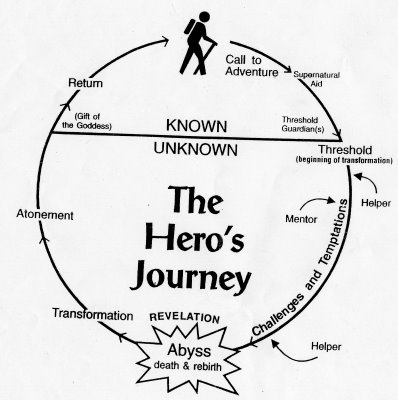
I need to remember the hero’s journey. The hero has to try and fail several times. And the hero has to leave, even if that means going on a business trip to Pennsylvania!

“You leave the world that you’re in and go into a depth or into a distance or up to a height. There you come to what was missing in your consciousness in the world you formerly inhabited.” (From Joseph Campbell on The Power of Myth with Bill Moyers)

As I set out on a new journey professionally, I know that I will fail. Like Odysseus, the homeland will be in sight and then the winds will whisk me back to the sea. Yet I will adapt. Each of us must make our own quest. With flexibility, creativity, and community, we can pursue happiness (a.k.a., have it all).

Happiness is not found in professional or material success — though give me that success and I’ll let you know. Honestly, success is found in having good relationships and in creating beauty and in being in nature.

So pursue happiness. When you embark on that pursuit, you become the mythic hero on a quest. You become the hero of your own life story. And you can have (or pursue) it all.

Enhanced by Zemanta

Happy-Go-Lucky? Good enough!

In the face of worry, I stay perky and productive. Chris does too. We continue to make a contribution — at work and at home. I want, need, and hope that we all stay as positive and productive for as long as possible.

Chris’s work is very meaningful. On the heels of his success translating The Cherry Orchard Off-Broadway and directing Picasso at Lapin Agile in Florida, he is performing in a fabulous production of Taming of the Shrew. He is also making a documentary with his friend Dan about having Parkinson’s as they rehearse for one performance of Beckett’s Endgame. (Checkout The Endgame Project.) We’re going to see the trailer for the documentary on Monday night.

So when people ask me, How is Chris doing? I usually say, “He’s doing great. He’s productive and he’s positive.”

As a family, we are doing great. Or, at least, good enough. And good enough is good enough. Lots of times, we are perky and happy-go-lucky! As I’ve said before, “We get by with a little help from our friends.” And family!

And when we feel sad about having to just get by, that’s okay. We’re human after all.

Driving with Parkinson’s Disease

On the first day of vacay, just come back from the beach, sandy and relaxed, I got Chris’s phone call with the bad news.

After I drove myself and the kids to our flight out of JFK, Chris took the driver’s seat. About five minutes later, he rear-ended a car. It was on the ramp from the airport to the highway (the Long Island Expressway?). He had been fiddling with the radio and didn’t see the car stopped at the red light in front of him.

The airbags inflated. No one was hurt. Our car was totaled. Chris told me, “My driving days may be limited.”

That night after I got that call, I didn’t sleep well. It didn’t ruin my vacation. It just felt like a signpost on the unhappy road of the progress of Chris’s Parkinson’s Disease. (He’s had PD nine years now.) Parkinson’s is a steady decline.

I have not enjoyed driving with Chris for years. Lately, he could hardly drive a city block without me clutching the dashboard or pressing my foot on a phantom break. I tried to bite my tongue, but often blurted out, “Look out!”

So, when we were together in the car, I always drove, especially with the kids in the car.

This is tough stuff. But I’m glad I didn’t have to tell him, point-blank, “I think your driving sucks.” How do tell someone that? It feels terrible. Yet, it would feel even worse if there had been a serious accident and I’d have to apologize to some stranger, knowing as I did, that his driving sucked. Maybe a small fender-bender is a blessing in disguise.

When you live with someone who is chronically ill, you have to pick your battles. You have to witness a decline. And you often don’t want to speak your truth.

You have to take over the driving. Sometimes it’d be nice to doze in the passenger seat and trust that the driver’s doing just fine. That doesn’t happen when you’re married to someone with Parkinson’s. At least, it doesn’t happen for me.

He can drive other things, but he can’t drive the family car. For that matter, neither can I. Because we don’t have one any more.

Enhanced by Zemanta